Israel Built Heaven & Earth. Jesus Said Heaven & Earth Will Pass Away!
The tabernacle was built the way the world was made. It was finished, inspected, and blessed the way the world was.
In Part 2 we heard Jesus say, "Heaven and earth will pass away" (Matthew 24:35). This time I want you to see where He was sitting when He said it, and what He was looking at across the valley.
Start with a psalm. "He built his sanctuary like the high heavens, like the earth, which he has founded forever" (Psalm 78:69). The psalmist doesn't say God's sanctuary was in heaven and on earth. He says God built it like them. The temple in Jerusalem was meant to be a picture of the whole world God made, with God enthroned at the center of it.
The tabernacle was built the way the world was made. Put the end of Genesis 1 beside the end of Exodus and you hear the same words. "Thus the heavens and the earth were finished" (Genesis 2:1), and "Thus all the work of the tabernacle of the tent of meeting was finished" (Exodus 39:32). "And God saw everything that he had made, and behold, it was very good" (Genesis 1:31), and "And Moses saw all the work, and behold, they had done it; as the LORD had commanded" (Exodus 39:43). "And on the seventh day God finished his work" (Genesis 2:2), and "So Moses finished the work" (Exodus 40:33). "So God blessed the seventh day" (Genesis 2:3), and "Then Moses blessed them" (Exodus 39:43).
The pattern runs deeper than those four pairs. God gives the tabernacle instructions in seven speeches, each opening with "The LORD said to Moses" (Exodus 25:1; 30:11, 17, 22, 34; 31:1, 12). The seventh is about the Sabbath, and it gives the reason the Sabbath is a sign: "that in six days the LORD made the heavens and the earth, and on the seventh day he rested and was refreshed" (31:17). The man who builds it is filled "with the Spirit of God" (31:3), the Spirit who hovered over the waters in Genesis 1:2. When the work is done, God moves in: "the glory of the LORD filled the tabernacle" (40:34). God was building a small heaven and earth and coming to live in it.
Josephus read the building the same way. He was a priest from Jerusalem who knew the temple before it fell, and he wrote it down for readers across the Roman world. He wasn't alone. Philo of Alexandria, writing decades earlier, read the tabernacle as a picture of the universe in his Life of Moses. He said "this proportion of the measures of the tabernacle proved to be an imitation of the system of the world." The inner room, where the priests could not enter, "is, as it were, a heaven peculiar to God," and the outer part "is, as it were, sea and land, on which men live, and so this part is peculiar to the priests only" (Antiquities 3.123). A few pages later he said it again: "When Moses distinguished the tabernacle into three parts, and allowed two of them to the priests, as a place accessible and common, he denoted the land and the sea, these being of general access to all; but he set apart the third division for God, because heaven is inaccessible to men" (Antiquities 3.181).
He described the temple Jesus walked through in the same terms. The great curtain hanging in front of the holy place was "a kind of image of the universe," with blue for the air, linen for the earth, purple for the sea, and scarlet for fire, and "embroidered upon it all that was mystical in the heavens" (Wars 5.5.4). A Jew walking up to that temple was looking at heaven and earth in miniature, with the Most Holy Place standing for heaven itself.
God's own words tell you why a building could only be a copy. "Heaven is my throne, and the earth is my footstool; what is the house that you would build for me, and what is the place of my rest?" (Isaiah 66:1). The real heaven and earth are His house. Anything made by hands could only ever be a model of it. Stephen quoted that verse to the council that was about to stone him, right after saying, "the Most High does not dwell in houses made by hands" (Acts 7:48–49). Jesus was accused of saying, "I will destroy this temple that is made with hands, and in three days I will build another, not made with hands" (Mark 14:58).
Hebrews uses the same language from a different angle. For Hebrews the tabernacle is a copy of the heavenly sanctuary. The earthly priests "serve a copy and shadow of the heavenly things," because Moses was told, "See that you make everything according to the pattern that was shown you on the mountain" (Hebrews 8:5). Christ entered "not into holy places made with hands, which are copies of the true things, but into heaven itself" (9:24). He came through "the greater and more perfect tent (not made with hands, that is, not of this creation)" (9:11). If the true tent is "not of this creation," the earthly one was. It was a made thing, a copy, and in Hebrews made things are the ones that get shaken (12:27).
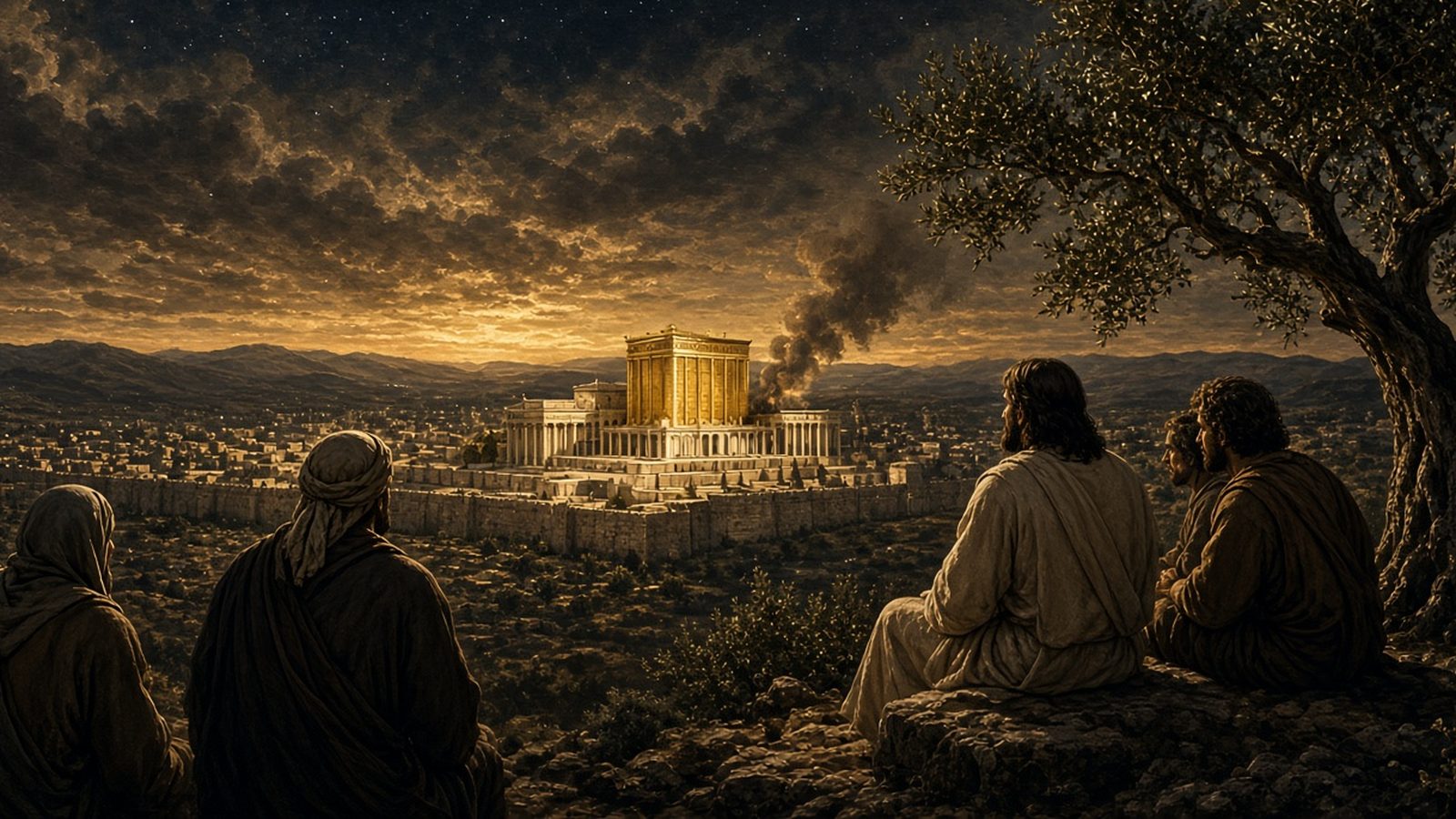
Now put Jesus back on the Mount of Olives. He had just walked out of the temple, His disciples pointed to its buildings, and He said, "there will not be left here one stone upon another that will not be thrown down" (Matthew 24:2). Then "he sat on the Mount of Olives opposite the temple" (Mark 13:3), and they asked Him when. Through the whole sermon that building stood in front of them across the Kidron Valley. It's what He was looking at when He said, "Truly, I say to you, this generation will not pass away until all these things take place. Heaven and earth will pass away, but my words will not pass away" (Matthew 24:34–35).
I don't think "heaven and earth" in that verse simply means "the temple," and people disagree on how far to press it. What I'm sure of is where He was sitting. He said it in front of a building Scripture says was built "like the high heavens, like the earth," a building Jews like Josephus read as a picture of the world, in a sermon that began with that building coming down.
The curtain tore first, then the building fell. When Jesus died, "the curtain of the temple was torn in two, from top to bottom" (Matthew 27:51). Josephus' embroidered curtain hung at the doors of the holy place, and Hebrews speaks of the inner "second curtain" in front of the Most Holy Place (9:3). Matthew doesn't say which one tore. Both hung in the same building. Hebrews says the way into the holy places stayed closed "as long as the first section is still standing," which is "symbolic for the present age" (Hebrews 9:8–9). Then it tells us the curtain was His flesh, and the way through it is open: "we have confidence to enter the holy places by the blood of Jesus, by the new and living way that he opened for us through the curtain, that is, through his flesh" (10:19–20). The cross opened the way, and forty years later the building that pictured the old heaven and earth was gone.
Hebrews had told its readers it was coming. The promise came first through Haggai, to the men rebuilding the Second Temple: "Yet once more, in a little while, I will shake the heavens and the earth," and then "I will fill this house with glory" (Haggai 2:6–7). Hebrews reads the same promise, "Yet once more I will shake not only the earth but also the heavens," and explains that this "indicates the removal of things that are shaken." It names them, too: "things that have been made." They are removed "in order that the things that cannot be shaken may remain. Therefore let us be grateful for receiving a kingdom that cannot be shaken" (Hebrews 12:26–28). The same letter had already called the earthly holy places "made with hands" and the first covenant "becoming obsolete and growing old," "ready to vanish away" (8:13). The copy was shaken and removed, and the readers were receiving the kingdom that can't be shaken right then.
John's new heaven and earth has no temple at all. "I saw a new heaven and a new earth, for the first heaven and the first earth had passed away" (Revelation 21:1). The city that comes down is a cube, "its length and width and height are equal" (21:16), the same shape as the Most Holy Place in Solomon's temple, twenty cubits each way (1 Kings 6:20). "And I saw no temple in the city, for its temple is the Lord God the Almighty and the Lamb" (Revelation 21:22). Isaiah had joined the two long before: "For behold, I create new heavens and a new earth … for behold, I create Jerusalem to be a joy, and her people to be a gladness" (Isaiah 65:17–18). The old heaven and earth was a building you could only look at from the outside, with a room one priest could enter once a year. In the new one, "the dwelling place of God is with man" (Revelation 21:3), and the whole city is the Most Holy Place.
None of this depends on how you read Genesis 1. Some full preterists I respect argue that Genesis opens the covenant story the way Revelation closes it. I'm still studying that, and it's a conversation for another day. Whatever you conclude about Genesis 1, God made the real sky and the real ground, and the case on this page stands on Psalm 78:69, the Exodus account, Josephus, and Hebrews. Moses built the tabernacle as a copy of heaven and earth, and the copy is what fell in AD 70. The sky is still up there.
I'm also not the first to see the temple as a small world. Scholars who are nothing like preterists, like G. K. Beale in The Temple and the Church's Mission, have argued at length that Israel's temple was built as a model of the cosmos. Where I part ways with most of them is the timing, because Jesus put the passing of heaven and earth inside "this generation" while He sat looking at the building that pictured them.
Where this is contestable. The hardest text for this post sits in the same letter. Hebrews 1:10–12 quotes Psalm 102 about the created heavens, "they will perish, but you remain," and a futurist will say that's what "things that have been made" means in 12:27, the whole created order. I read Psalm 102 as the Lord outlasting everything He made, and I took it up in Part 2. It tells us heaven and earth aren't forever. It doesn't tell us when. Hebrews 12 does, because its readers were "receiving" the kingdom that can't be shaken as they read it (12:28), and the letter had already named what was "ready to vanish away" (8:13).
In Part 4 we go back nearly eight hundred years before Jesus, to a prophet who filed this same lawsuit against the northern kingdom, and whose words Jesus kept quoting to His own generation: Hosea.