Heaven & Earth Stood as Witnesses. They Too Would Vanish Away.
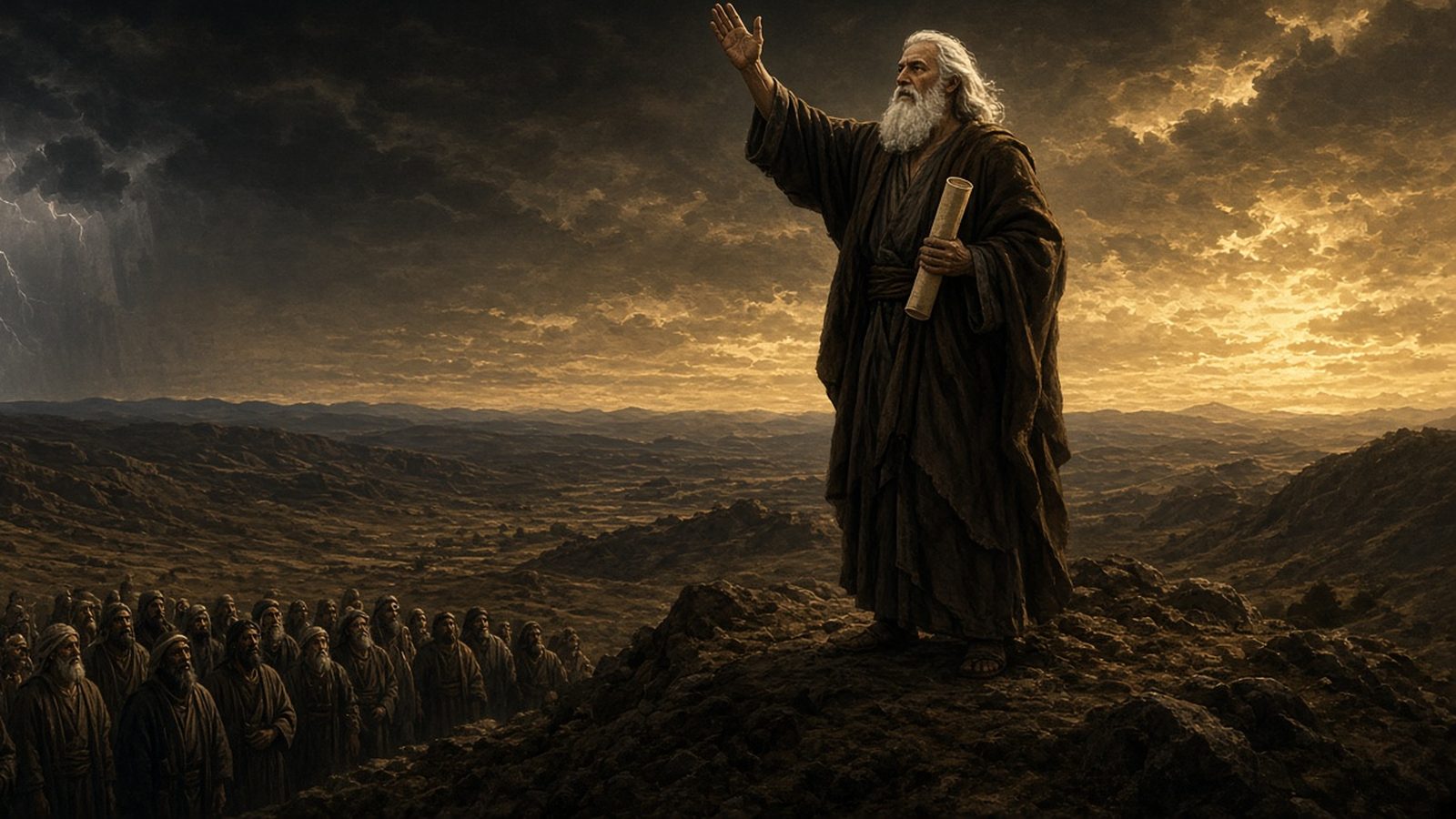
Moses called two witnesses. His own law asked for at least two.
In Part 1 I said Moses swore in witnesses before Israel ever crossed the Jordan. This post is about who they were. "I call heaven and earth to witness against you today, that I have set before you life and death, blessing and curse. Therefore choose life, that you and your offspring may live" (Deuteronomy 30:19). We usually quote that verse for the second half. Look at the first half. Moses is standing on the plains of Moab with a nation about to cross the river, and he swears in two witnesses: the sky over their heads and the ground under their feet.
Moses did it three times. "I call heaven and earth to witness against you today, that you will soon utterly perish from the land" (4:26). "I call heaven and earth to witness against you today" (30:19). "Assemble to me all the elders of your tribes and your officers, that I may speak these words in their ears and call heaven and earth to witness against them" (31:28). Those are the only three places in the Hebrew Bible where that formula appears. Then he opens his song by calling the same two to order: "Give ear, O heavens, and I will speak, and let the earth hear the words of my mouth" (32:1). The question I kept asking was why anyone would call the sky to court.
A covenant in Moses' world needed witnesses. When the Hittite kings made treaties, they called their gods as witnesses, and in one treaty the list closes with "the mountains, the rivers, the springs, the great Sea, heaven and earth, the winds (and) the clouds" (Mursili II with Duppi-Teshub). Israel had one God, with no other gods to call, so Moses called the part of that list God Himself had made, the part every generation would still be standing under. The medieval Jewish commentator Ibn Ezra, on Deuteronomy 32:1, said heaven and earth were chosen because they are permanent. Moses' great-grandchildren would see the same sky he pointed at.
One more detail has stayed with me. Moses' own law said, "A single witness shall not suffice against a person … Only on the evidence of two witnesses or of three witnesses shall a charge be established" (Deuteronomy 19:15). Moses called two witnesses, and his own law asked for at least two.
The covenant itself took the stand too. Heaven and earth heard the terms, but they couldn't recite them, so God put the words on the record as well. "Now therefore write this song and teach it to the people of Israel. Put it in their mouths, that this song may be a witness for me against the people of Israel" (31:19). "And when many evils and troubles have come upon them, this song shall confront them as a witness" (31:21). Then the Book: "Take this Book of the Law and put it by the side of the ark of the covenant of the LORD your God, that it may be there for a witness against you" (31:26). One chapter gives us three kinds of witness: the sky and land over Israel, the song in their mouths, and the Book beside the ark. Centuries later Jesus told the leaders of His day, "There is one who accuses you: Moses, on whom you have set your hope" (John 5:45). The written covenant was still testifying.
The witnesses also carried out the sentence. In Moses' law, witnesses didn't just testify. "The hand of the witnesses shall be first against him to put him to death, and afterward the hand of all the people" (Deuteronomy 17:7). Now read the curses with that in mind. "The heavens over your head shall be bronze, and the earth under you shall be iron" (28:23). "He will shut up the heavens, so that there will be no rain, and the land will yield no fruit" (11:17). Leviticus says it the other way around, "I will make your heavens like iron and your earth like bronze" (Leviticus 26:19). The two witnesses Moses called are the two that bring the drought. Their hand is against Israel first, the way a witness's hand was first against the guilty man.
The prophets watched it happen. "The LORD has a controversy with the inhabitants of the land … Therefore the land mourns, and all who dwell in it languish" (Hosea 4:1, 3). Isaiah widened the same pattern to the whole earth: "The earth mourns … for they have transgressed the laws, violated the statutes, broken the everlasting covenant" (Isaiah 24:4–5). Jeremiah looked at Judah's coming judgment and saw creation undone: "I looked on the earth, and behold, it was without form and void; and to the heavens, and they had no light … For this the earth shall mourn, and the heavens above be dark" (Jeremiah 4:23, 28).
Whenever the covenant was broken, the prophets reconvened the same court. Isaiah's first words are "Hear, O heavens, and give ear, O earth; for the LORD has spoken: 'Children have I reared and brought up, but they have rebelled against me'" (Isaiah 1:2), the same two witnesses and the same two verbs as Deuteronomy 32:1. Micah summoned the mountains and the earth's foundations: "Hear, you mountains, the indictment of the LORD, and you enduring foundations of the earth, for the LORD has an indictment against his people" (Micah 6:2). The psalmist wrote, "He calls to the heavens above and to the earth, that he may judge his people" (Psalm 50:4). Jeremiah called them twice: "Be appalled, O heavens, at this" (Jeremiah 2:12), and "Hear, O earth; behold, I am bringing disaster upon this people … as for my law, they have rejected it" (6:19). The witnesses Moses swore in never left the courtroom. Prophet after prophet called them back by name.
Because heaven and earth stood over the whole covenant, the prophets used the pair for the covenant world itself. God says He put His words in Israel's mouth, "establishing the heavens and laying the foundations of the earth, and saying to Zion, 'You are my people'" (Isaiah 51:16). Forming a covenant people is described as planting heavens and founding an earth. The ESV says "establishing," and the Hebrew verb is "plant." I read 51:16 as covenant language, and so did the man I quote next. Three verses earlier the same words describe creation itself (51:13), so there's room to read it another way here.
I'm not the first to read it that way, and the man I'm about to quote believed in a future final judgment. The Puritan John Owen, preaching on 2 Peter 3 (Works, vol. 9), said that in the prophets "heavens" and "earth" are often used for "the civil and religious state and combination of men in the world," and read Isaiah 51:16 as God forming Israel "into a church and state." He concluded that Peter's fire spoke of "that utter desolation and destruction that was to be made of the Judaical church and state."
The pair fit the covenant for another reason, too. Israel built heaven and earth in miniature at the center of the nation. "He built his sanctuary like the high heavens, like the earth, which he has founded forever" (Psalm 78:69). Josephus said of the tabernacle that the inner room was "as it were, a heaven peculiar to God," and the outer room stood for "sea and land, on which men live" (Antiquities 3.123). Part 3 walks through that building, because it changes how you hear "heaven and earth will pass away."
A trial doesn't keep its witnesses forever. Once the verdict is in, the court is dismissed. Listen to how Jesus talked about heaven and earth: "Until heaven and earth pass away, not an iota, not a dot, will pass from the Law until all is accomplished" (Matthew 5:18). He put two "untils" in one sentence. Not a dot passes from the Law until heaven and earth pass, and not until all is accomplished. I read the two "untils" as marking the same moment.
On the Mount of Olives He set it right beside the deadline: "Truly, I say to you, this generation will not pass away until all these things take place. Heaven and earth will pass away, but my words will not pass away" (Matthew 24:34–35). He used the same verb three times in two verses. The generation would not pass away before it was done, heaven and earth would pass away, and His words would not.
Hebrews, most likely written while the temple still stood, says the first covenant was "becoming obsolete and growing old" and "ready to vanish away" (8:13), and that God was about to shake "not only the earth but also the heavens" (12:26), which Part 3 takes up. I covered Peter's version, the heavens and earth "stored up for fire," in my post on 2 Peter 3.
Then John watches the court rise. "Then I saw a great white throne and him who was seated on it. From his presence earth and sky fled away, and no place was found for them" (Revelation 20:11). That last phrase is the one Daniel used for the kingdoms the stone broke apart, "no place was found for them" (Daniel 2:35, KJV). Then comes "I saw a new heaven and a new earth, for the first heaven and the first earth had passed away" (Revelation 21:1). Even the end of Moses' song comes back. Heaven was summoned to hear the charge at the start of the song (Deuteronomy 32:1), and the song closes, "Rejoice with him, O heavens … for he avenges the blood of his children" (32:43). When Babylon the great falls in Revelation, heaven is called to rejoice again: "Rejoice over her, O heaven, and you saints and apostles and prophets, for God has given judgment for you against her!" (Revelation 18:20). A chapter later God "has avenged on her the blood of his servants" (19:2).
The sky didn't go anywhere in AD 70. You can walk outside tonight and look at it. In Deuteronomy, heaven and earth are the real sky and the real land, called precisely because they last, and Moses didn't mean "old covenant" when he named them. My point is narrower. The witnesses Moses called stood over a covenant, and as I read Him, Jesus tied their passing to the end of that covenant, inside that generation.
Where this is contestable. Jesus also said, "it is easier for heaven and earth to pass away than for one dot of the Law to become void" (Luke 16:17), and some take that as a way of saying "never." I take Matthew 5:18 as the fuller form of the same saying, with its "until all is accomplished," and I take Jesus at His word that "all these things" would take place in "this generation." The word behind "become void" in Luke is the Greek word for fall. The Law never fell. Every dot of it was fulfilled. Hebrews 1:10–12, quoting Psalm 102, and Isaiah 51:6 use creation language for heaven and earth wearing out "like a garment." I read those as the Lord outlasting everything He made. They tell us heaven and earth aren't forever. They don't tell us when Matthew 24:35 happens. The next verse opens "But concerning that day and hour" (24:36), and many partial preterists, with commentators like R. T. France, read that "now concerning" as Jesus turning from Jerusalem's fall to a final coming. Paul uses the same Greek phrase to change subjects (1 Corinthians 7:1; 8:1), so the point is fair. I read "that day" as the day of "those days" He had just described (24:29), because the disciples asked about the temple and His coming in one breath (24:3), and He was still answering them. Last, placing Revelation 20:11 at the end of the old order touches the thousand years and the judgment of the dead. I take both up in the Tough Verses (Revelation 20 and the dead since AD 70), and I hold judgment as two-tier, once for all at AD 70 and for each person at death (Hebrews 9:27). I could be wrong here, and I'll change my mind for a better answer from the text.
The old covenant's witnesses were sky and land. Jesus named the witnesses of the new one, and they're people: "you will receive power when the Holy Spirit has come upon you, and you will be my witnesses in Jerusalem and in all Judea and Samaria, and to the end of the earth" (Acts 1:8). Paul adds the Witness behind them: "The Spirit himself bears witness with our spirit that we are children of God" (Romans 8:16). Heaven and earth were called to testify against a people who broke the covenant. The Spirit testifies for a people the Son has kept.
In Part 3 we go to the building Israel built as heaven and earth in miniature, and to the hillside where Jesus sat looking at it when He said heaven and earth would pass away.