"The elements will melt" was never about the earth burning.
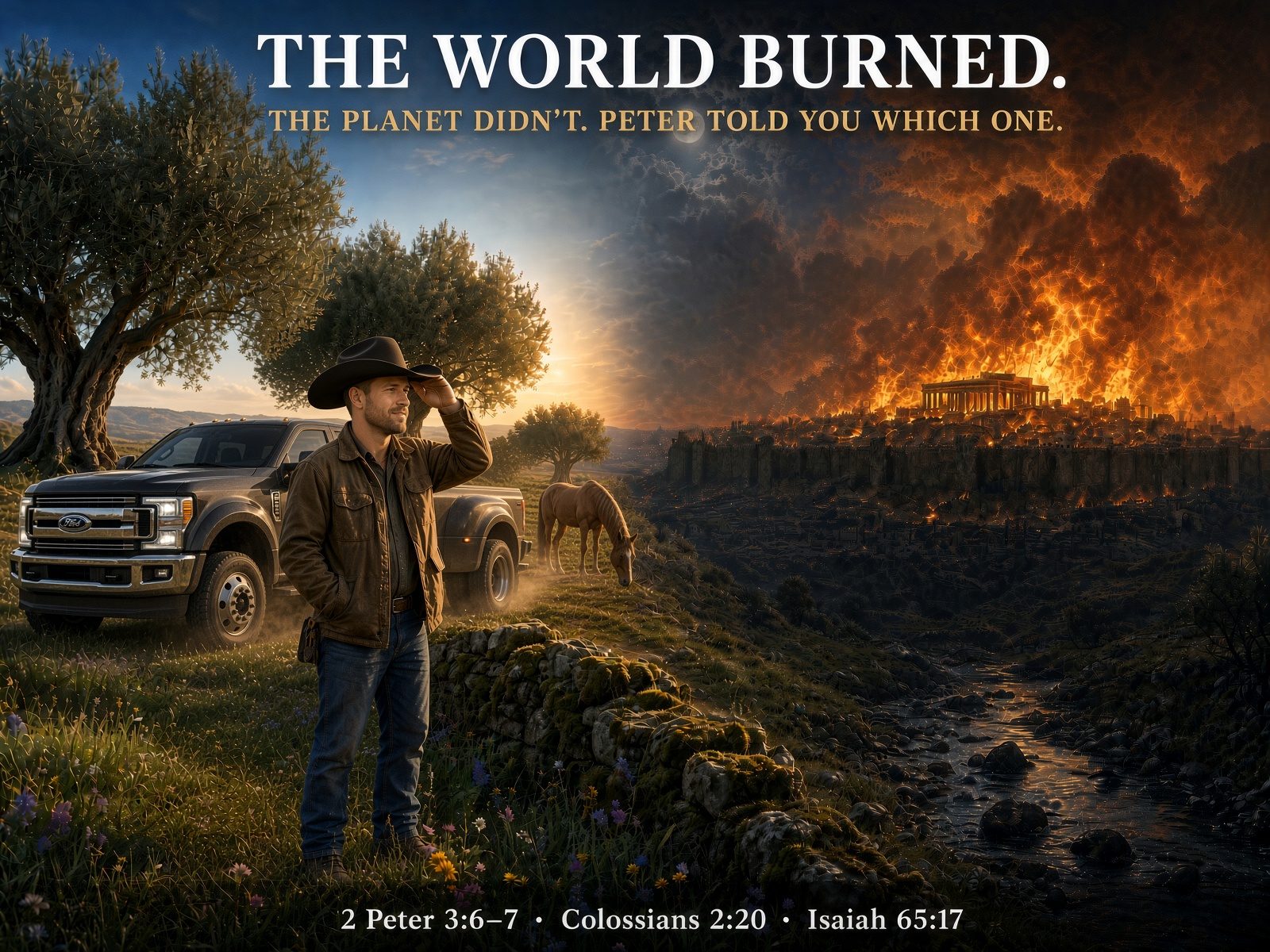
The world burned. The planet didn't. Peter told you which one.
After Revelation 21, this is the chapter people reach for when they want the planet to burn. "The heavens will pass away with a roar, and the heavenly bodies will be burned up and dissolved" (2 Peter 3:10). At first glance a new reader will think it sounds like the end of the physical universe. Read the whole chapter, and watch Peter tell you what he means, more than once.
Start with who he's answering. "Scoffers will come in the last days with scoffing… They will say, 'Where is the promise of his coming?'" (3:3–4). Stop on that. You don't mock a promise nobody expected soon. The scoffers were laughing because the apostles had said "soon" and it hadn't happened yet. They saw no Deuteronomy 28 curses, a Temple that had never looked better, and the whole covenant system still running. Peter's chapter is an answer to people in his own day who thought the coming was late, and that only makes sense if the original audience thought His coming was supposed to be close. It was. This is the same Peter who told the same readers, in his first letter, "The end of all things is at hand" (1 Peter 4:7), and who opens this chapter by reminding them it's "the second letter that I am writing to you" (3:1).
Watch the analogy he uses. The scoffers say nothing ever changes. Peter says it already did once: "the world that then existed was deluged with water and perished" (3:6). The world perished. The planet didn't. Noah stepped off the ark onto the same ground, under the same sky. Peter's word for what perished is kosmos, the ordered world of people, "the world of the ungodly" (2:5), not gē, the ground. The earth "formed out of water" (3:5) is the thing that came through. Then he says the "heavens and earth that now exist" are stored up for fire the same way (3:7). The same way. Somebody will tell you the flood was a literal, physical catastrophe, so the fire must be too. Read Peter's own words: the analogy proves that a world can perish while the ground stays exactly where God put it.
Watch the word. "Elements" is stoicheia, and the ESV renders it "heavenly bodies" here, which is an interpretation, not a translation. Everywhere else in the New Testament the word means the elementary principles of a system: "we were enslaved to the elementary principles of the world" (Galatians 4:3), "the weak and worthless elementary principles" (4:9), "the elementary principles of the world" (Colossians 2:8, 20), "the basic principles of the oracles of God" (Hebrews 5:12). Every one of those is about the old covenant order, the rudiments of Sinai. Paul says believers "died with Christ to the elementary principles of the world" (Colossians 2:20). The stoicheia that melt in 2 Peter 3 are the ones Paul says the church had already died to. I'll be fair about the word: the Greek lexicons also list "the basic components of the physical world" as a meaning, and most commentators take it that way here. My reading of the word is a reading. The case doesn't rest on the word. It rests on Peter's flood analogy, the promise he quotes, and the people he says God is patient toward.
Watch the verse itself. The KJV ends verse 10 with the earth and its works "burned up." The ESV ends it "the earth and the works that are done on it will be exposed." That isn't a softening. The oldest manuscripts read "will be found," laid bare, and the ESV follows them. The verse everyone quotes for the planet burning says, in its best text, that the earth is left standing and uncovered for judgment. Fire that exposes is not fire that annihilates.
Watch the Old Testament he's quoting. "Heavens and earth" is consistently how the prophets name a covenant world order. God says He planted the heavens and laid the foundations of the earth in order to say to Zion, "You are my people" (Isaiah 51:16). Jeremiah looked at Judah's coming judgment and saw "the earth… without form and void; and to the heavens, and they had no light" (Jeremiah 4:23), and Judah was conquered, not the cosmos. Zephaniah said "all the earth shall be consumed" in the fire of God's jealousy (Zephaniah 1:18; 3:8), and Babylon burned Jerusalem in 586 BC while the earth kept turning. The Song of Moses, which predicted Israel's end from the beginning: "a fire is kindled by my anger… and it devours the earth and its increase, and sets on fire the foundations of the mountains" (Deuteronomy 32:22). The fire of 2 Peter 3 is the fire Moses sang about, falling on the people Moses sang about, in the generation Jesus named. Peter even uses the Olivet Discourse's own phrase: "the day of the Lord will come like a thief" (3:10), which is Jesus (Matthew 24:43) and Paul (1 Thessalonians 5:2) describing the same day.
Watch where he lands. "According to his promise we are waiting for new heavens and a new earth in which righteousness dwells" (3:13). According to his promise. Which promise? Isaiah's: "For behold, I create new heavens and a new earth" (Isaiah 65:17). Read what Isaiah put in that new earth: people building houses, planting vineyards, living long lives, having children, and dying old (65:20–22). The prophet who coined the phrase did not describe a replacement planet. He described a new covenant world, and Peter says that's what his readers were waiting for. It's what they were promised, no matter how hard we try to redefine it today.
Watch him name the cross-reference. "Count the patience of our Lord as salvation, just as our beloved brother Paul also wrote to you" (3:15). Peter says Paul wrote about the same things. Paul wrote "the night is far gone; the day is at hand" (Romans 13:12) and "the present form of this world is passing away" (1 Corinthians 7:31). Peter is pointing at those letters and saying: same day, same fire, same old covenant world passing.
What about verse 8? "With the Lord one day is as a thousand years, and a thousand years as one day." Read verse 9, which is the sentence it sets up: "The Lord is not slow to fulfill his promise as some count slowness, but is patient toward you." Toward you, Peter's readers, not us. The thousand-years line explains God's patience toward the people holding the letter, not a conversion rate for stretching "soon" to twenty centuries. Peter closes the thought by telling those same readers to be "waiting for and hastening the coming of the day of God" (3:12). Hastening. You don't hasten something two thousand years off.
Here's the picture, then. A fire was coming on a world: the old covenant world of Temple, priesthood, sacrifice, and the law that gave sin its power. It fell in AD 70, in the generation Jesus named, with the city burning while the earth under it stayed exactly where God put it. Noah's world perished and the ground didn't. Jerusalem's world perished and the ground didn't. Peter told you both in the same chapter.
The elements of the old covenant world melted. We cannot make that into the de-creation of the physical earth, no matter how badly some of us were taught to want it to burn.