God Sued Israel. Jesus Reopened the Litigation on Jerusalem.
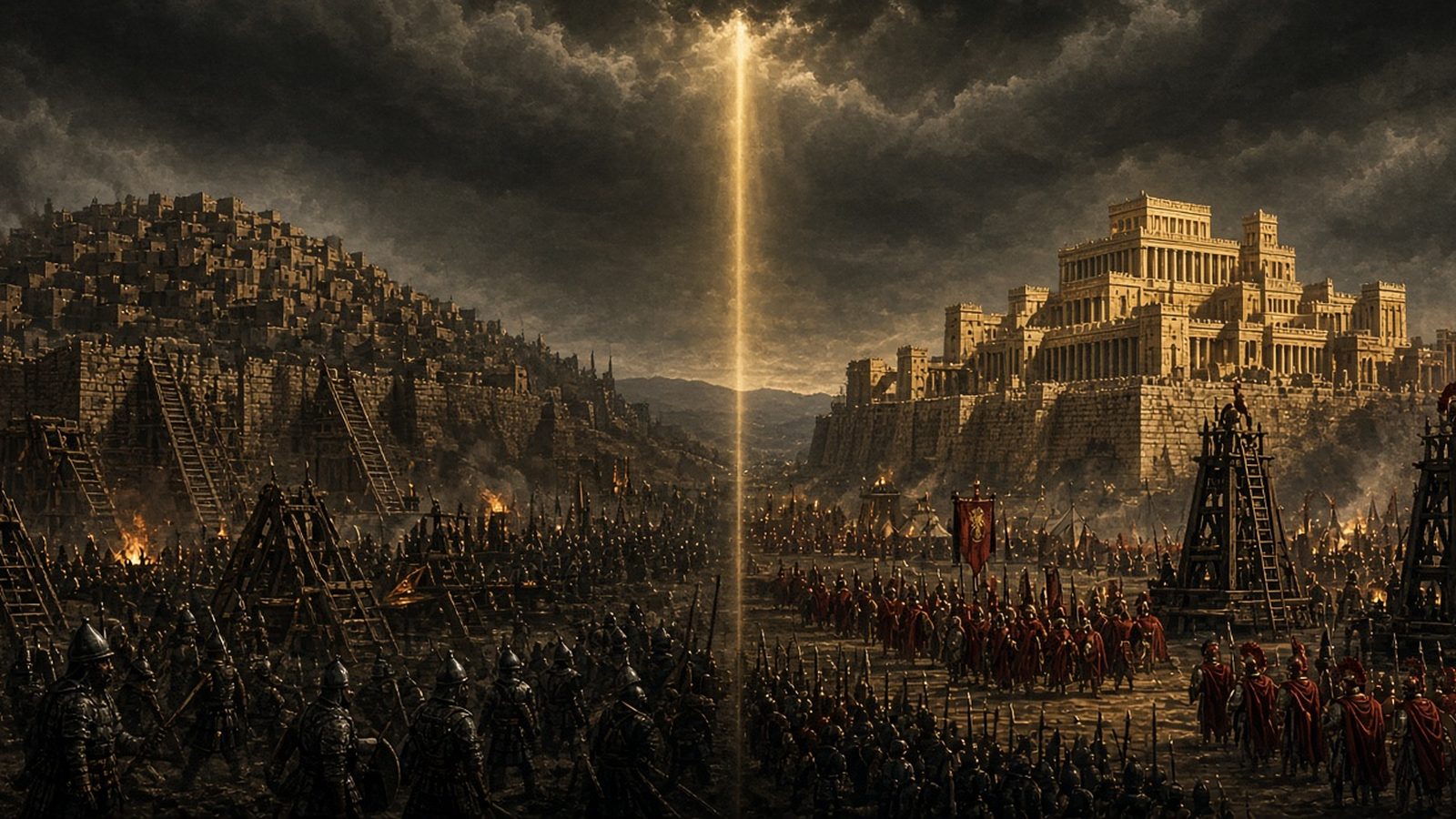
Hosea said it over Samaria before Assyria came. Jesus said it over Jerusalem before Rome came.
Yesterday we stood in front of the temple Israel built as heaven and earth in miniature. Today the series ends where Jesus' own road ended. They were leading Jesus out to be crucified, and a crowd of women followed, weeping. He turned around and said, "Daughters of Jerusalem, do not weep for me, but weep for yourselves and for your children. For behold, the days are coming when they will say, 'Blessed are the barren' … Then they will begin to say to the mountains, 'Fall on us,' and to the hills, 'Cover us'" (Luke 23:28–30).
That last line isn't His own. It's Hosea's: "and they shall say to the mountains, 'Cover us,' and to the hills, 'Fall on us'" (Hosea 10:8). Hosea said it about Samaria, the capital of the northern kingdom, before Assyria came and carried its people away. On His way to the cross, Jesus said it over Jerusalem.
In Part 1 I quoted Hosea's line about the LORD's controversy with the land. Hosea is the book where that whole lawsuit is filed and argued, and 2 Kings 17 records it carried out. As I read it, Jesus kept reaching for Hosea because He was reopening the same case.
Hosea preached to a kingdom that had about a generation left. He prophesied "in the days of Uzziah, Jotham, Ahaz, and Hezekiah, kings of Judah, and in the days of Jeroboam the son of Joash, king of Israel" (Hosea 1:1), in the eighth century BC. The northern kingdom, Israel, also called Ephraim after its leading tribe, was rich and confident under Jeroboam II, and within a generation it was gone. "The king of Assyria invaded all the land and came to Samaria, and for three years he besieged it. In the ninth year of Hoshea, the king of Assyria captured Samaria, and he carried the Israelites away to Assyria" (2 Kings 17:5–6). That was 722 BC, and the historian who recorded it gave the reason in covenant terms: "They despised his statutes and his covenant that he made with their fathers and the warnings that he gave them" (17:15). Hosea was one of those warnings.
The case file was Hosea's own marriage. God told Hosea, "Go, take to yourself a wife of whoredom and have children of whoredom, for the land commits great whoredom by forsaking the LORD" (1:2). His marriage to Gomer became the evidence, and their children's names became the charges. The third child was named Lo-ammi: "Call his name Not My People, for you are not my people, and I am not your God" (1:9). That's the covenant formula turned inside out, because at the exodus God had said, "I will take you to be my people, and I will be your God" (Exodus 6:7).
Then God files the case in the language of a family court. "Plead with your mother, plead," He says to the children, "for she is not my wife, and I am not her husband" (Hosea 2:2). "Plead" is rîb, the courtroom word from Part 1, and Israel is being charged with adultery against her husband. Jeremiah tells us how that case ended for the north: "She saw that for all the adulteries of that faithless one, Israel, I had sent her away with a decree of divorce. Yet her treacherous sister Judah did not fear, but she too went and played the whore" (Jeremiah 3:8). The northern kingdom got the divorce papers, and Judah watched it happen without learning a thing.
Hosea doesn't end in divorce, though. Even in the first chapter God promises, "in the place where it was said to them, 'You are not my people,' it shall be said to them, 'Children of the living God'" (1:10). He promises to bring her back into the wilderness, speak tenderly to her, and marry her again: "I will betroth you to me forever. I will betroth you to me in righteousness and in justice, in steadfast love and in mercy" (2:19). "I will say to Not My People, 'You are my people'; and he shall say, 'You are my God'" (2:23). Hold on to that promise, because we'll see who received it.
The charges read like the Ten Commandments broken one by one. "Hear the word of the LORD, O children of Israel, for the LORD has a controversy with the inhabitants of the land. There is no faithfulness or steadfast love, and no knowledge of God in the land" (4:1). "Controversy" is rîb again, with God as the plaintiff and the court in session. Then He reads the charges: "there is swearing, lying, murder, stealing, and committing adultery; they break all bounds, and bloodshed follows bloodshed" (4:2). The prophet is reading the covenant back to the people who had sworn to it. The priests get named too. "My people are destroyed for lack of knowledge; because you have rejected knowledge, I reject you from being a priest to me" (4:6). "Hear this, O priests! … For the judgment is for you" (5:1). "As robbers lie in wait for a man, so the priests band together; they murder on the way to Shechem" (6:9).
God doesn't sound like a prosecutor who enjoys his work. "What shall I do with you, O Ephraim? What shall I do with you, O Judah? Your love is like a morning cloud, like the dew that goes early away" (6:4). Then comes the verse Jesus would quote twice: "For I desire steadfast love and not sacrifice, the knowledge of God rather than burnt offerings" (6:6). The worship kept going the whole time, at Bethel in the north and in Jerusalem in the south, and the sacrifices kept coming. What God actually wanted, they never gave Him. "But like Adam they transgressed the covenant; there they dealt faithlessly with me" (6:7).
The sentence came in Hosea's own words. "Set the trumpet to your lips! One like a vulture is over the house of the LORD, because they have transgressed my covenant and rebelled against my law" (8:1). "The days of punishment have come; the days of recompense have come; Israel shall know it" (9:7). "Because of the wickedness of their deeds I will drive them out of my house. I will love them no more" (9:15). "Ephraim is stricken; their root is dried up; they shall bear no fruit" (9:16). "Samaria shall bear her guilt, because she has rebelled against her God; they shall fall by the sword" (13:16). Right in the middle of all that, God's own heart breaks through: "How can I give you up, O Ephraim? How can I hand you over, O Israel?" (11:8). Assyria carried out the sentence in 722 BC, and the northern kingdom never came back as a nation.
Jesus kept quoting Hosea to His own generation. When the Pharisees complained that He ate with sinners, He told them, "Go and learn what this means: 'I desire mercy, and not sacrifice'" (Matthew 9:13). When they condemned His disciples for picking grain on the Sabbath, He said it again: "if you had known what this means, 'I desire mercy, and not sacrifice,' you would not have condemned the guiltless" (12:7). That's Hosea 6:6, the heart of Hosea's charge, aimed at the religious leaders of His own day. Later He said they had "neglected the weightier matters of the law: justice and mercy and faithfulness" (23:23), which is Hosea's charge again in fresh words. Matthew even applies Hosea to Jesus Himself: "Out of Egypt I called my son" (Matthew 2:15, from Hosea 11:1). Israel was the son who went after other lovers, and Jesus is the Son who didn't.
Jesus called the coming destruction of Jerusalem "days of vengeance, to fulfill all that is written" (Luke 21:22). In the Greek Old Testament the early church read, Hosea 9:7 begins, "The days of vengeance have come," the same plural phrase Luke records. The Greek of Moses' song has it in the singular, "in the day of vengeance" (Deuteronomy 32:35, where the ESV reads "Vengeance is mine"). This link rests on the Greek, not on the English. When He wept over the city as He rode in, He said the judgment would come "because you did not know the time of your visitation" (Luke 19:44), which echoes the charge Hosea brought when he found "no knowledge of God in the land." Then, on the road to Golgotha, He took Hosea's doom-cry over Samaria and gave it to the daughters of Jerusalem. John hears the same cry in Revelation when the sixth seal is opened: "calling to the mountains and rocks, 'Fall on us and hide us'" (Revelation 6:16).
There are quieter echoes too. Hosea said Israel was once like "the first fruit on the fig tree" (Hosea 9:10), and in the end "they shall bear no fruit" (9:16). In His last week Jesus cursed a fig tree with leaves and no fruit: "May no fruit ever come from you again!" (Matthew 21:19). Hosea heard God say He would drive them out of His house (9:15), and Jesus said, "See, your house is left to you desolate" (Matthew 23:38). I hold those two as echoes rather than quotations, and they fit the pattern.
The idols were different, and the charges underneath were the same. I want to be careful here, because it's easy to overstate. Hosea's main charge was Baal worship, bowing to idols on the high places and the golden calves at Bethel. Jesus' generation wasn't bowing to Baal, and the Gospels never charge them with idols. They had the temple, the sacrifices, and the Scriptures, and still didn't know the time of their visitation. What they shared with Samaria was what lay under the idols. They had rejected the knowledge of God (Hosea 4:6; Luke 19:44). Their priests led the guilt, as Hosea's did (4:6; 5:1; 6:9), and it was the chief priests who handed Jesus over. They kept the sacrifices and lost the mercy, the very charge of Hosea 6:6 that Jesus threw back at the Pharisees twice. Hosea's "bloodshed follows bloodshed" became Jesus' "on you may come all the righteous blood shed on earth … all these things will come upon this generation" (Matthew 23:35–36). Hosea said, "They made kings, but not through me" (Hosea 8:4), and Ephraim ran to Assyria and Egypt for help (7:11). The chief priests stood in front of Pilate and said, "We have no king but Caesar" (John 19:15). It was the same unfaithful bride with different idols, and that's the case Jesus reopened.
Hosea wasn't only talking about the north, either. "The LORD has an indictment against Judah" (12:2), and "Judah also shall stumble with them" (5:5). Judah watched Samaria fall and, in Jeremiah's words, "did not fear." Babylon came for Judah well over a century later. Jesus' generation had both stories in their Bibles, Samaria under Assyria and Jerusalem under Babylon, and He told them the same sentence was coming again, this time through Rome, inside "this generation."
The promise Hosea made came true. Paul tells us who received it. God called His people "not from the Jews only but also from the Gentiles? As indeed he says in Hosea, 'Those who were not my people I will call "my people"'" (Romans 9:24–25). Peter writes to scattered believers, "Once you were not a people, but now you are God's people; once you had not received mercy, but now you have received mercy" (1 Peter 2:10). Those are Hosea's children, renamed. Hosea also promised that after "many days without king or prince, without sacrifice," Israel would "seek the LORD their God, and David their king … in the latter days" (Hosea 3:4–5). Peter preached that God's oath to seat one of David's descendants on his throne was fulfilled when Jesus was raised and exalted to God's right hand (Acts 2:30–36).
The lawsuit that ended in divorce for Samaria ends in a wedding in the New Testament. Paul says believers "have died to the law through the body of Christ, so that you may belong to another, to him who has been raised from the dead" (Romans 7:4). I read Hosea's betrothal "forever" (2:19) as fulfilled in the marriage of the Lamb (Revelation 19:7). Paul even borrowed from Hosea for his resurrection chapter. "O death, where is your sting?" (1 Corinthians 15:55) comes from Hosea 13:14, where the line sits inside a judgment speech and the next words are "Compassion is hidden from my eyes." Readers have long argued over whether Hosea meant it as a promise or a threat. Paul hears in it the end of death's power, and he says the saying will "come to pass" when "the perishable puts on the imperishable" (1 Corinthians 15:54), the resurrection itself. The Messiah took the judgment so death would lose its sting, and that's the gospel.
Where this is contestable. Hosea promised more than a renamed people: "the children of Judah and the children of Israel shall be gathered together, and they shall appoint for themselves one head" (Hosea 1:11). Dispensationalists read that as a national regathering still to come. Paul quotes the verse right before it for Jew and Gentile called together (Romans 9:24–26), and I follow Paul. I read the one head as Christ and the gathering as the one body He made of both (Ephesians 2:14–16). Paul also puts Hosea 13:14 at the resurrection, which places the defeat of death inside this same story. That raises the question of everyone who has died since AD 70, and I answer it in the Tough Verses.
That's the whole case, start to finish. Hosea preached to Samaria, and Assyria fulfilled his words. He never predicted AD 70. The covenant he read to Samaria was the same covenant Jesus read to Jerusalem, and Jesus kept reaching for Hosea's words to say so. Moses wrote the terms and swore in heaven and earth as witnesses. The prophets brought the charges, and Hosea filed them against Samaria. Jesus read the verdict over His own generation, and Rome carried it out in AD 70. Through all of it, Hosea's last chapter stays open as an invitation: "Return, O Israel, to the LORD your God … I will heal their apostasy; I will love them freely, for my anger has turned from them" (14:1, 4).
Which side of Hosea's book are you reading yourself into, the divorce or the wedding?