"Thou shalt not kill" expired in AD 70?!?
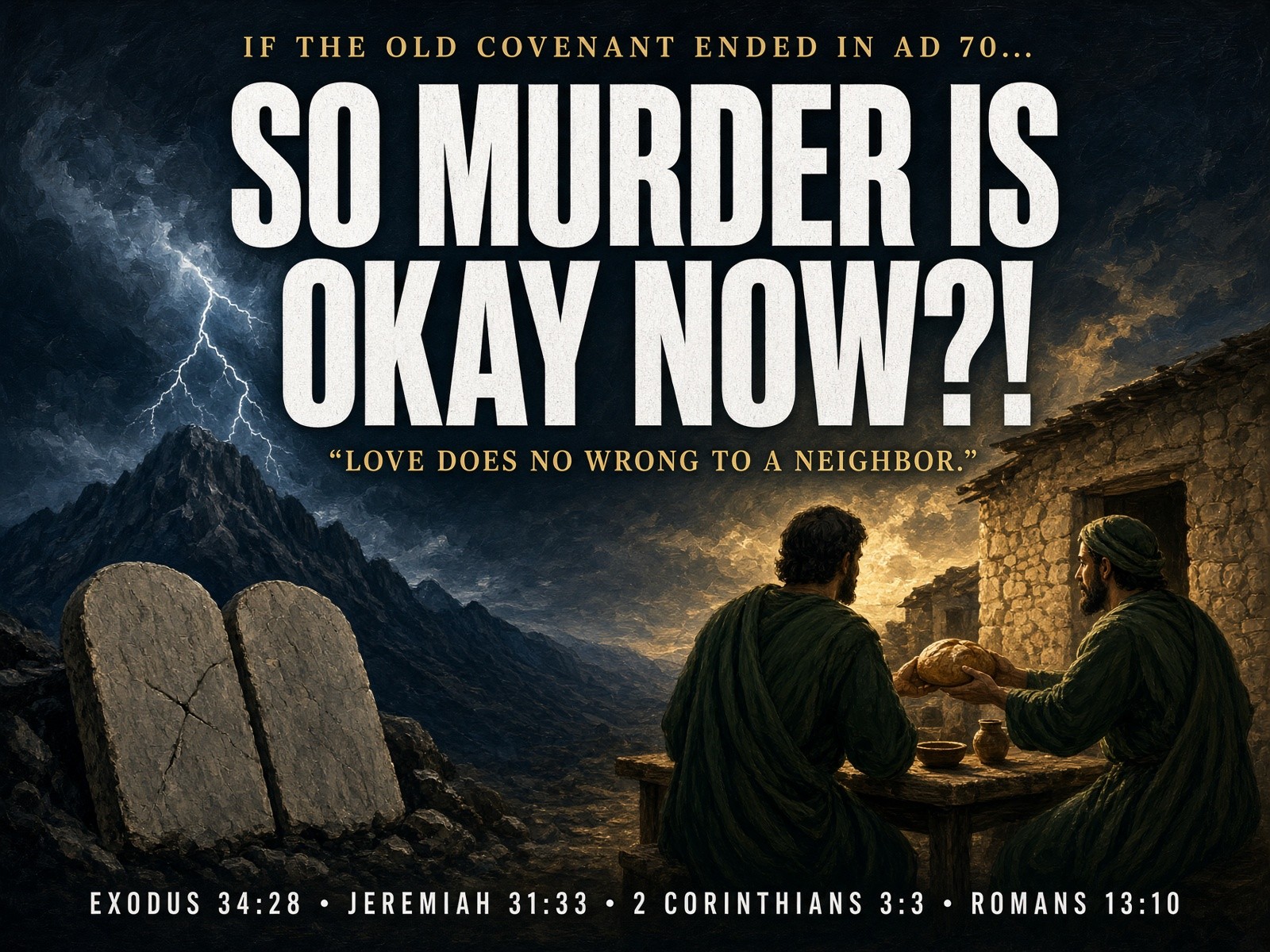
A few weeks back somebody sent me a graphic asking whether God's law has been replaced. Behind it sits a question I get a lot. If the old covenant ended when the Temple fell, is murder okay now?
If that covenant ended, the rules are done! Can I steal? Cheat? Commit idolatry?
The answer? ABSOLUTELY NOT. Let me show you why.
Start with what the Ten Commandments are. The tablets carried "the words of the covenant, the Ten Commandments" (Exodus 34:28). Hebrews calls them "the tablets of the covenant" (9:4). The Ten Commandments are the Sinai covenant itself, cut in stone.
Hebrews says what was happening to that covenant. "In speaking of a new covenant, he makes the first one obsolete. And what is becoming obsolete and growing old is ready to vanish away" (8:13). That's an imminent end to a covenant that had stood for well over a thousand years.
Paul says something about that covenant I wouldn't dare say on my own. He calls it "the ministry of death, carved in letters on stone" (2 Corinthians 3:7), and says it "was being brought to an end" (3:11). The part of the law carved on stone was the Ten Commandments.
Someone will say only the ceremonies ended. Only the feast days. Others would say it's just the Levitical requirements added to the law. Paul says believers "have died to the law" (Romans 7:4). Three verses later he tells you which law he means. "You shall not covet." That's the tenth commandment.
IS COVETING OKAY NOW?
It never was. Cain was guilty of murder long before Sinai. Joseph ran from Potiphar's wife and said, "How then can I do this great wickedness and sin against God?" (Genesis 39:9). There were no tablets yet. Right and wrong didn't start at Sinai, and they didn't end when Sinai's covenant did.
Paul tells us where he stands. He says he is not under the law, and in the same breath he is "not… outside the law of God but under the law of Christ" (1 Corinthians 9:20-21).
Here is how that law reads. "You shall not commit adultery, You shall not murder, You shall not steal, You shall not covet," and any other commandment, "are summed up in this word: 'You shall love your neighbor as yourself'" (Romans 13:9). "Love is the fulfilling of the law" (13:10).
Murder is still sin. Adultery is still sin. Theft is still sin. If I LOVE my neighbor I don't kill him, sleep with his wife or take his truck. God promised to write His law on the heart (Jeremiah 31:33), and Paul says He did, "not on tablets of stone but on tablets of human hearts" (2 Corinthians 3:3). Even people who never had the tablets "show that the work of the law is written on their hearts, while their conscience also bears witness" (Romans 2:15). We can listen to it or ignore it.
What about Jesus? "Until heaven and earth pass away, not an iota, not a dot, will pass from the Law until all is accomplished" (Matthew 5:18). I believe Him. He uses those same words again in Matthew 24:34, "until all these things take place," and there He says when. "This generation." Logically, that covers the time from Christ's ministry and His death until the old covenant heaven and earth passed away and the new covenant world was established. The Law didn't fail. It was fulfilled.
The next verse warns against relaxing even the least commandment (5:19). Matthew tells us who did that. The teachers who "made void the word of God" for their tradition (15:6). Jesus says twice what the Law and the Prophets come down to, and both times it's love (7:12; 22:40). He said, "If you believed Moses, you would believe me; for he wrote of me" (John 5:46). Teaching Christ as the One the Law pointed to is keeping it. Going back to the Law without Him is how you lose it.
The hardest verse for me is Ephesians 6:2. Paul tells Gentile children, "Honor your father and mother," and calls it "the first commandment with a promise." He quotes one of the ten to a church as something that still speaks. I can't make that verse go away and I won't try. Here's what I see. Paul gives his own command first, "obey your parents in the Lord, for this is right" (6:1). Then he quotes Moses and leaves off "that the LORD your God is giving you" (Exodus 20:12). He's teaching from the commandment. The ten still teach us. They aren't the covenant we're under. Isn't honoring your father and mother simply LOVE?
One of the ten gets singled out more than the rest. The Sabbath. "Let no one pass judgment on you in questions of food and drink, or with regard to a festival or a new moon or a Sabbath. These are a shadow of the things to come, but the substance belongs to Christ" (Colossians 2:16-17). The Sabbath pointed at Him. "Come to me… and I will give you rest" (Matthew 11:28).
Plenty of Christians believe the ten still stand as God's moral law and only the ceremonies ended. I respect that. I can't get it past 2 Corinthians 3 and Romans 7.
THE LAW OF CHRIST IS WRITTEN ON HIS PEOPLE!
What do you do with Romans 7:7?
Where this is contestable. Ephesians 6:2 is the hardest verse for me and I said so above. Matthew 5:19 is the next hardest. "One of the least of these commandments" sounds like the small rules of Moses, and most readers take it that way. My reading needs "does them" to mean keeping them as Christ fulfilled them, and a fair critic will call that a stretch. I point to what Jesus does in the very next verses. Moses said to keep your oaths, and Jesus says, "Do not take an oath at all" (5:34). Moses said "An eye for an eye," and Jesus says, "Do not resist the one who is evil" (5:38–39). He changed the wording and said He wasn't relaxing anything. Paul taught that "nothing is unclean in itself" before the Temple fell (Romans 14:14), and my answer is that Jesus had already said "it is not what goes into the mouth that defiles a person" (Matthew 15:11). Paul names the coming of Christ as the turning point, "now that faith has come, we are no longer under a guardian" (Galatians 3:25), and no verse says in so many words that the Law let go when the Temple fell. I read the end of the Law as something that began at the cross and finished when the Temple fell, the way Hebrews calls it "becoming obsolete" (8:13). The link I draw between Matthew 5:18 and 24:34 rests on the Greek, where "until all is accomplished" and "until all these things take place" are the same clause. Hebrews 4:9 says "there remains a Sabbath rest for the people of God," and many read that as a day still to be kept. Sabbath-keepers will also point out that God rested on the seventh day long before Sinai (Genesis 2:2–3), which is my own Cain and Joseph argument turned around. Many Christians hold that the ten stand as God's moral law, and "the law is holy, and the commandment is holy and righteous and good" (Romans 7:12) is a verse I agree with. I don't say the Law was bad. I say it was a covenant, and that covenant ended.