People still die in the new earth. Isaiah said so.
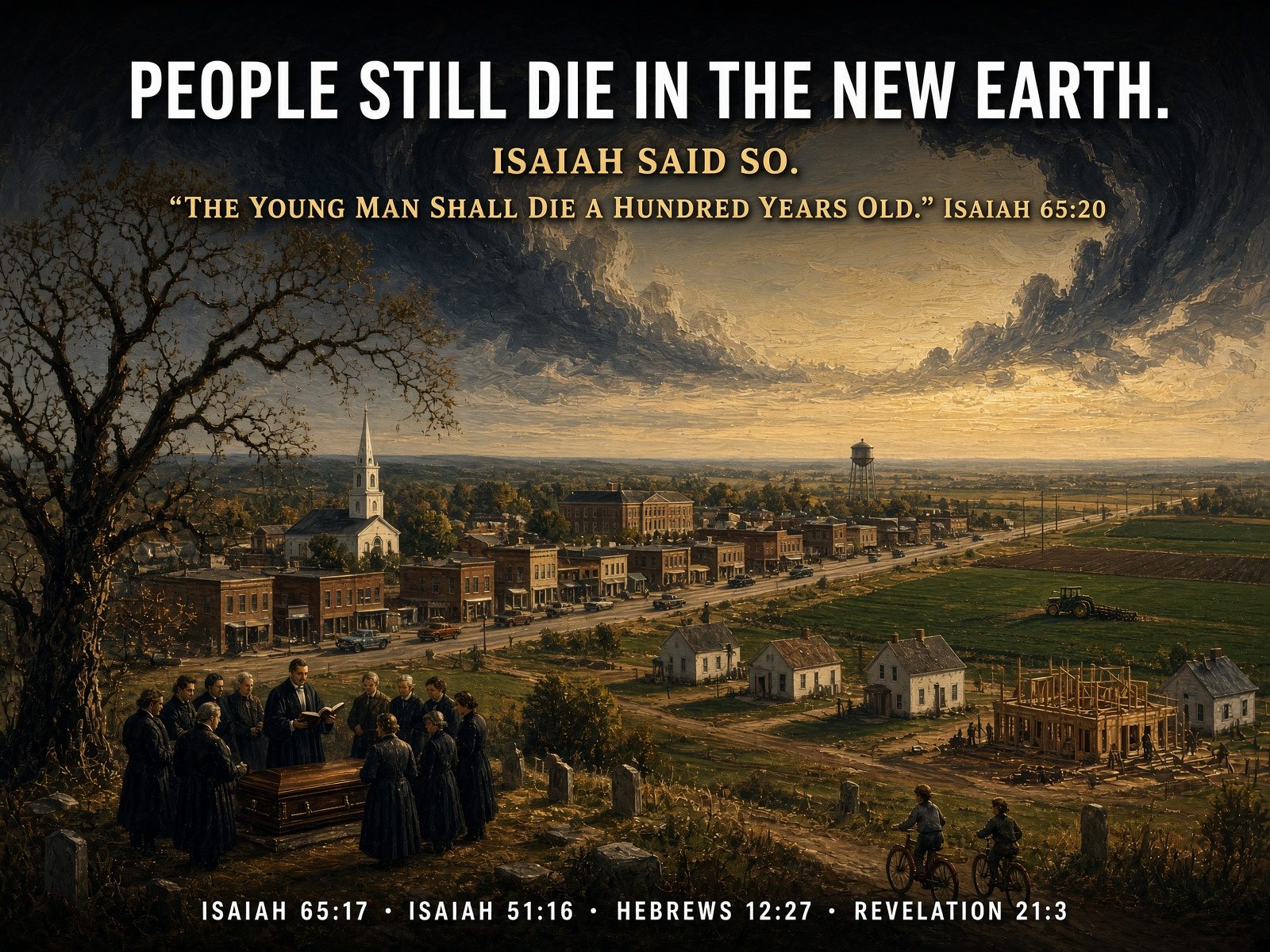
The hope was never a better planet. It was God dwelling with His people, with no veil and a door that never shuts.
When you hear "new heavens and new earth," you picture a planet. Earth 2.0, after the fire, no graves, no tears, forever. I pictured it too. Then I read the chapter the phrase comes from.
Peter says what he was waiting for and where he got it: "according to his promise we are waiting for new heavens and a new earth in which righteousness dwells" (2 Peter 3:13). Whose promise? Isaiah's. The phrase appears exactly twice in the Old Testament, Isaiah 65:17 and 66:22, so that's the promise Peter means. Read Isaiah 65 start to finish and watch what kind of "new earth" it is.
It opens with God found by people who weren't looking for Him and rejected by a people He'd held His hands out to all day (65:1–2). Paul quotes both verses in Romans 10:20–21 and says they're about his own day: the Gentiles coming in, Israel refusing. Paul put the opening of Isaiah 65 in the first century. The chapter goes on: the rebels judged, a remnant kept, and God says, "you shall leave your name to my chosen for a curse… but his servants he will call by another name" (65:15). Then, "behold, I create new heavens and a new earth, and the former things shall not be remembered" (65:17).
Now keep reading, because this is the verse that decides everything. "No more shall there be in it an infant who lives but a few days, or an old man who does not fill out his days, for the young man shall die a hundred years old, and the sinner a hundred years old shall be accursed" (65:20). People die in the new earth. Sinners live in it. The next verses have people building houses and planting vineyards (65:21). Isaiah 66 says the same thing from the other side: in the new heavens and new earth "all flesh shall come to worship before me," and the chapter ends with the dead bodies of the rebels outside (66:22–24). Whatever Isaiah's new earth is, it's a world with funerals, farms, and unbelievers in it. It is not the eternal state after the end of history. That picture doesn't come from Isaiah. It comes from the chart.
What "heavens and earth" meant to the men who wrote it. Watch how the prophets use it. When Babylon falls, "the stars of the heavens… will not give their light… I will make the heavens tremble, and the earth will be shaken out of its place" (Isaiah 13:10, 13). Babylon fell to the Medes. The sky stayed up. When Edom is judged, "all the host of heaven shall rot away, and the skies roll up like a scroll" (34:4). Edom is gone; the sky isn't. When Jeremiah sees Judah's judgment, "I looked on the earth, and behold, it was without form and void; and to the heavens, and they had no light" (Jeremiah 4:23). That's Genesis 1 run in reverse, for Jerusalem in 586 BC. In the prophets, "heavens and earth" collapsing is a nation's world ending under God's judgment. It happened to Babylon, Edom, and Judah, and nobody asks where the astronomy records are.
Here's the one that names what the new heavens and earth are. God tells Isaiah, "I have put my words in your mouth and covered you in the shadow of my hand, establishing the heavens and laying the foundations of the earth, and saying to Zion, 'You are my people'" (Isaiah 51:16). Planting heavens and founding an earth is, in God's own words, making a covenant people. Moses opened the Song of Moses the same way, calling heaven and earth as witnesses to the covenant (Deuteronomy 32:1). The old covenant was a "heavens and earth." Josephus says the Temple's own layout was built as an image of the universe (Antiquities 3.7.7). When that world ended, a new one was promised.
Jesus said when the old one would end. "Until heaven and earth pass away, not an iota, not a dot, will pass from the Law until all is accomplished" (Matthew 5:18). Heaven and earth pass when the Law's purpose is finished, and Hebrews tells us when that was coming: "what is becoming obsolete and growing old is ready to vanish away" (8:13). Ready. Then Hebrews quotes Haggai, "Yet once more I will shake not only the earth but also the heavens," and explains it: "the removal of things that are shaken… in order that the things that cannot be shaken may remain. Therefore let us be grateful for receiving a kingdom that cannot be shaken" (12:26–28). The shaking of heaven and earth was the removal of the old order, and the thing that remained was the kingdom they were receiving, present tense. Peter's readers were "waiting for and hastening the coming of the day of God" (2 Peter 3:12). You can't hasten something two thousand years off. The elements that melted were the stoicheia, the same word Paul uses for the "elementary principles" of the old covenant (Galatians 4:3, 9; Colossians 2:20). I wrote a whole post on that chapter; it's linked below.
Now John. "I saw a new heaven and a new earth… And I saw the holy city, new Jerusalem, coming down out of heaven from God, prepared as a bride" (Revelation 21:1–2). The angel tells John who the city is: "Come, I will show you the Bride, the wife of the Lamb," and shows him the city (21:9–10). The new Jerusalem is the church. Then, "the dwelling place of God is with man" (21:3), which is exactly what Paul had already told the Corinthians: "we are the temple of the living God; as God said, 'I will make my dwelling among them'" (2 Corinthians 6:16). Keep reading John's city. Its gates are never shut (21:25). The nations walk by its light and kings bring their glory in (21:24). Nothing unclean enters it (21:27), which means unclean people still exist outside it. The leaves of the tree are "for the healing of the nations" (22:2), which means nations still need healing. The last invitation in the Bible is still open: "let the one who is thirsty come" (22:17). That is not a sealed eternal state. That is a city with its doors open and people walking in. It's the world we're living in.
Where this is contestable, and I'll say it plainly. "No more death" (21:4) is the hardest line for my reading. I take it through Isaiah 25:8, which John is quoting, and through Genesis 2:17, where Adam "surely died" the day he ate, not by stopping breathing but by being cut off from God. That's the death that's gone for those in the city. I hold that as a reading. Isaiah 65:20 is the reason I hold it, because the prophet who promised the new earth put dying people in it. Romans 8's groaning creation gets its own post. If you read Isaiah 65:20 as a literal future golden age with long lifespans, I can't prove you wrong from that verse alone; I can only ask why a chapter Paul dated to his own day would jump two thousand years in the middle.
Here's what I'll leave you with. The hope in "new heavens and new earth" was never a better planet. It was God dwelling with His people with no veil, no temple, no priest in between, and a door that never shuts. Isaiah promised it. Peter waited for it. John watched it come down. We're standing in it, and the gates are open.
Isaiah promised it. Peter waited for it. John watched it come down. We're standing in it.