The seven trumpets were Jericho's trumpets.
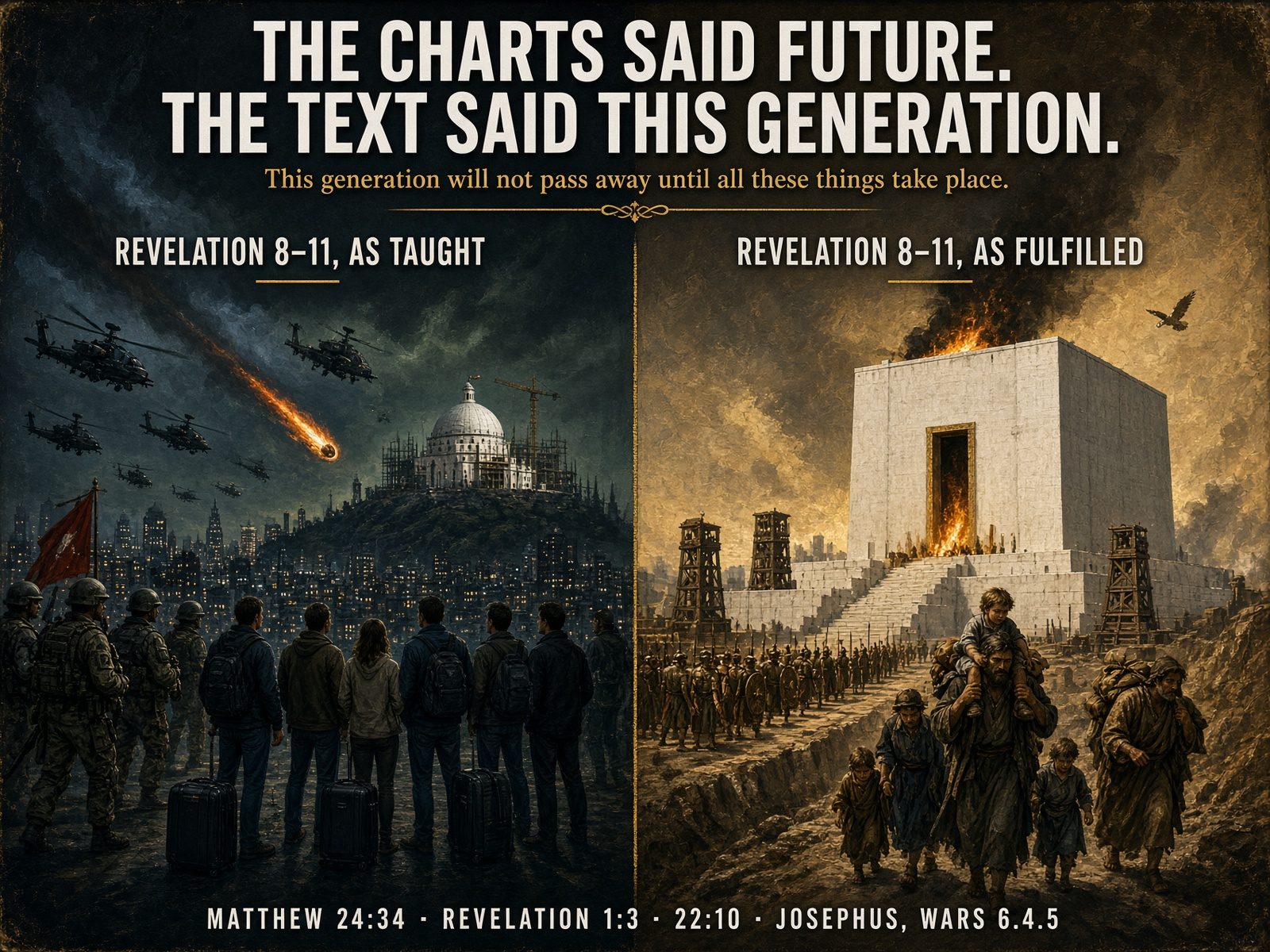
A trumpet is a warning. The seven trumpets warned the generation Jesus warned, and the city that killed the prophets.
Most of us were taught that the seven trumpets of Revelation are still ahead of us. Seven judgments on the whole planet, somewhere past the rapture, with a third of the oceans and a third of the sky and a demon army out of a pit. Thrilling to read. Terrifying to teach children. I'm going to argue, trumpet by trumpet, that this is already well behind us.
Let me start where the futurist and I agree, because it's the right place to start and both of us can agree on it. When God gave Israel silver trumpets, He told them what they were for: "you shall sound an alarm with the trumpets, that you may be remembered before the LORD your God, and you shall be saved from your enemies" (Numbers 10:9). A trumpet is a warning. Everyone agrees on that.
The whole question is who was being warned, and when. I think John told his first readers the trumpets were about to sound, and history shows they did. Scripture first, history second. I'm leaning on David Chilton's commentary on Revelation, The Days of Vengeance, because he works through every trumpet verse by verse in one of the best exegeses you'll find. Chilton claims that the trumpets fell on Jerusalem in the war that ended in AD 70, and I completely agree. (The whole commentary is free to read or download at the Internet Archive. Dominion Press released it online years ago, and every page number in this post is from that edition.) Robert Cruickshank has been walking through Revelation 8 verse by verse at Cruickshank's Corner (burrosofberea.com), tracing each image to its Old Testament source and then to Josephus, and I'll lean on him too.
Israel already knew what seven trumpets meant. Before Jericho fell, God told Joshua, "Seven priests shall bear seven trumpets of rams' horns before the ark. On the seventh day you shall march around the city seven times" (Joshua 6:4). At the last blast "the wall fell down flat" (6:20). John follows the same pattern. Under the sixth trumpet "a tenth of the city fell" (Revelation 11:13), and when the seventh sounds, "the ark of his covenant was seen within his temple" (11:19). Chilton quotes G. B. Caird on this: "John must have had this story in mind when he wrote" (Days of Vengeance, p. 234). Seven trumpets, an ark, and a falling city. Israel had seen that before. The only question is which city.
Trumpets did more than warn. They crowned kings: "blow the trumpet and say, 'Long live King Solomon!'" (1 Kings 1:34). The seventh trumpet in Revelation ends with a coronation, "The kingdom of the world has become the kingdom of our Lord and of his Christ" (Revelation 11:15). Trumpets also sounded against God's own people when they broke His covenant. Hosea wrote, "Set the trumpet to your lips! One like a vulture is over the house of the LORD, because they have transgressed my covenant and rebelled against my law" (Hosea 8:1). The Hebrew word is nesher, which the KJV renders "eagle," and the Greek Old Testament John's readers used has aetos there, the same word John uses for the eagle in 8:13. Hosea gives us a trumpet, an eagle over the house of the LORD, and a broken covenant. John gives us the same three: "I heard an eagle crying with a loud voice as it flew directly overhead, 'Woe, woe, woe to those who dwell on the earth'" (Revelation 8:13). Moses had put the same eagle in the covenant curses: "The LORD will bring a nation against you from far away, from the end of the earth, swooping down like the eagle" (Deuteronomy 28:49), and the eagle was the standard every Roman legion carried. Chilton put it plainly: "God is now ordering the trumpets of holy war blown against Israel herself" (p. 234).
The trumpets are God answering a prayer. Before a single trumpet sounds, an angel offers incense "with the prayers of the saints" and then fills his censer "with fire from the altar and threw it on the earth" (8:4-5). Which prayer was he holding? Two chapters earlier, the martyrs under the altar cried out, "how long before you will judge and avenge our blood on those who dwell on the earth?" (6:10). When the eagle cries woe in 8:13, it cries woe on the same people, "those who dwell on the earth." The trumpets are God's answer to the martyrs. Ezekiel had seen the same censer. Before Babylon came, a man in linen was told to "fill your hands with burning coals from between the cherubim, and scatter them over the city" (Ezekiel 10:2), and Babylon's swords followed. Cruickshank sets the two side by side, and the point is plain. In Ezekiel, Babylon's swords were the coals from the altar. In Revelation, Rome's swords are.
Jesus told us whose hands held that blood. Standing in the temple, He said to Jerusalem's leaders, "so that on you may come all the righteous blood shed on earth," and then, "Truly, I say to you, all these things will come upon this generation" (Matthew 23:35-36).
You'll sometimes hear that the first six trumpets are only warnings and not God's wrath. They are limited, and Chilton says why: "Because the Trumpets were essentially warnings, they took only a third of the Land; with the Chalices, the destruction is total" (pp. 395-396). They're warnings sent because God heard His martyrs, and the sixth seal, which comes before them, has already announced that "the great day of their wrath has come, and who can stand?" (6:17). Warnings, yes. Warnings inside the day of wrath.
When matters more than where. People argue about whether the trumpets come after the seals or inside them. Chapter breaks were added around AD 1227 and verse numbers in AD 1551, and Revelation tells the same story more than once from different angles, so people don't agree on where the trumpets sit. The question that settles it is when. John dates the whole book on its first page: "the things that must soon take place" (1:1), "for the time is near" (1:3). The trumpets are inside that book and the events contained within it were imminent.
The first four trumpets are Egypt's plagues, turned on Israel. Hail and fire mixed with blood (8:7) is Egypt's seventh plague, when "the LORD sent thunder and hail, and fire ran down to the earth" (Exodus 9:23). A third of the sea turning to blood (8:8) is the first plague, when "all the water in the Nile turned into blood" (Exodus 7:20). The darkened sun, moon and stars (8:12) is the ninth, "pitch darkness in all the land of Egypt three days" (10:22). Four trumpets strike the earth, the sea, the springs and the sky, the same four Revelation 14:7 names. Chilton saw what that means. God is bringing Egypt's plagues on the people He once brought out of Egypt. John even names the city for us later: "the great city that symbolically is called Sodom and Egypt, where their Lord was crucified" (11:8). One more detail helps. The word translated "earth" in these verses is gē, which also means "the land," and Chilton translates it that way here. As I read these verses, they have NOTHING to do with the entire world. They fall on the land and the city and the people in covenant with Him.
The second trumpet throws "something like a great mountain, burning with fire" into the sea (8:8). Israel was God's mountain. Chilton writes that "the nation of Israel was God's 'Holy Mountain'" (p. 238), and that God now speaks of Jerusalem the way He once spoke of Babylon: "Behold, I am against you, O destroying mountain... and make you a burnt mountain" (Jeremiah 51:25). Jesus said something very close during the week He cursed the fig tree outside Jerusalem: "if you say to this mountain, 'Be taken up and thrown into the sea,' it will happen" (Matthew 21:21). Chilton's point is that Jesus had more than scenery in mind. "He was still giving them a lesson about the fall of Israel" (p. 239). Jeremiah finishes the picture a few verses on: "The sea has come up on Babylon; she is covered with its tumultuous waves" (Jeremiah 51:42). A burning mountain thrown into the sea is Jeremiah's Babylon, and John hands the name to Jerusalem. John's burning mountain is no more literal than the mountains that "break forth into singing" in Isaiah 55:12. The sea itself was not spared, though. "A third of the sea became blood... and a third of the ships were destroyed" (8:8-9). Josephus records both. When Vespasian took Joppa, the rebels who had fled there had turned to piracy. A north wind wrecked their fleet at dawn, and "the sea was bloody a long way, and the maritime parts were full of dead bodies" (Wars 3.9.3). On the Sea of Galilee, after the fight at Tarichaeae, "one might then see the lake all bloody, and full of dead bodies, for not one of them escaped" (Wars 3.10.9).
The third trumpet's star is named Wormwood (8:11). That name comes from God's warnings to His own people: "I will feed this people with bitter food, and give them poisonous water to drink" (Jeremiah 9:15). The KJV reads "I will feed them, even this people, with wormwood." Chilton notes that Wormwood is "a term used in the Law and the Prophets to warn Israel of its destruction as a punishment for apostasy" (p. 240). They knew exactly what it meant and what was coming their way. Amos had said it of Israel's courts: "O you who turn justice to wormwood and cast down righteousness to the earth!" (Amos 5:7). Lamentations had already pictured Israel's glory thrown from heaven to earth: God "cast down from heaven unto the earth the beauty of Israel" (Lamentations 2:1, KJV). John's star falls "blazing like a torch" (8:10), and I read it as Israel's own glory coming down in judgment.
The fourth trumpet darkens a third of the sun, moon and stars (8:12). Isaiah used the same language when Babylon fell (Isaiah 13:10), and the stars stayed where they were. In the prophets, darkened lights mean fallen rulers. Chilton quotes F. W. Farrar's list of the rulers who fell in those years, from Gaius and Claudius through Nero, Galba, Otho and Vitellius to the Herods and "not a few of the leading High Priests of Jerusalem" (pp. 240-241). As I read it, these leaders were the darkened lights the prophets spoke of.
The land itself was also stripped. Josephus, who watched it happen, says the Romans cut down the trees around Jerusalem "for ninety furlongs round about," so that the places "which were before adorned with trees and pleasant gardens were now become a desolate country every way" (Wars 6.1.1).
These trumpets were warnings. They warned the generation and their children that Jesus warned, and the city that killed the prophets. If that's right, the scariest chapters in the Bible are not a forecast for your grandchildren. They're a record of a promise already kept.
Then an eagle cried three woes over the people of that land (8:13), and the last three trumpets get worse. These are the chapters the prophecy charts love: locusts that turn out to be attack helicopters, a 200-million-man Chinese army, a third of mankind killed. Here's what John's first readers would have seen in them.
The fifth trumpet opens the pit. "I saw a star fallen from heaven to earth, and he was given the key to the shaft of the bottomless pit" (9:1). I read the star as Satan, and the key is given to him, because Christ holds the keys (1:18). Chilton reads it that way too. He says Satan "had fallen to the earth like a star from heaven" during Christ's ministry, and "it is God who sends the demons as a scourge upon His rebellious people" (Days of Vengeance, p. 245).
The locusts that come up out of the smoke are forbidden to touch anything green and may harm "only those people who do not have the seal of God on their foreheads" (9:4). Chilton calls them "demons from the Abyss" (p. 244). Many futurist teachers agree they're demonic, whatever the charts drew. Where we differ is what generation they were sent to. Jesus had already told His own generation this was coming. When an unclean spirit leaves a man and finds the house empty, "it goes and brings with it seven other spirits more evil than itself, and they enter and dwell there, and the last state of that person is worse than the first. So also will it be with this evil generation" (Matthew 12:45). As I read it, the fifth trumpet is that house filling back up.
The five months line up with the spring the war began. The locusts may "torment them for five months, but not to kill them" (9:5). Chilton gives three reasons for the number, and he's careful to say the second one "may refer in part" to history. First, May through September was the normal locust season. Second, the Roman governor Gessius Florus spent five months in AD 66, beginning in May, provoking Judea into revolt (pp. 244-245). Josephus dates the start of the war to that same spring, "in the month of Artemisius" (Wars 2.14.4). Third, five in Scripture is tied to Israel's military ranks.
The locusts also have "hair like women's hair" (9:8). Chilton suggests the passage "may also refer, in part, to the Satanic gangs of murderous Zealots that preyed on the citizens of Jerusalem" (p. 246). Josephus describes those gangs in shocking terms. They "decked their hair, and put on women's garments," and "while their faces looked like the faces of women, they killed with their right hands" (Wars 4.9.10). I wouldn't hang much on that detail. The bigger point is that the people living inside Jerusalem in those years were tormented by their own.
The sealed were spared. In Egypt, God kept the plagues off Goshen. Here, the locusts can't touch the sealed. I read the church's escape from Jerusalem as that protection showing up in history. Jesus told His disciples, "when you see Jerusalem surrounded by armies... let those who are in Judea flee to the mountains" (Luke 21:20-21). Eusebius records that the church in Jerusalem was warned by a revelation before the war and left for Pella, a town across the Jordan (Church History 3.5.3). Some historians doubt the Pella story, and I hold that detail with an open hand. The promise behind it is Jesus' own (Luke 21:21).
The sixth trumpet brings an army from the Euphrates. "I heard a voice from the four horns of the golden altar before God, saying to the sixth angel who had the trumpet, 'Release the four angels who are bound at the great river Euphrates'" (9:13-14). The voice comes from the same altar where the martyrs' prayers were offered in 8:3, and the army is sent "to kill a third of mankind" (9:15). John describes the riders with "breastplates the color of fire and of sapphire and of sulfur, and the heads of the horses were like lions' heads" (9:17). Strip the vision down and that's a cavalryman in painted scale armor on a war horse, seen through a prophet's eyes. John hears the number "twice ten thousand times ten thousand" (9:16), the prophets' way of saying beyond counting, as when Daniel saw "ten thousand times ten thousand" standing before the throne (Daniel 7:10).
The Euphrates was the far border of the land God promised Abraham (Genesis 15:18), and it was the direction Assyria and Babylon came from when they invaded. In the fall of AD 66, the Syrian governor Cestius Gallus marched on Jerusalem with the Twelfth Legion, detachments from the others, and troops sent by Rome's client kings (Wars 2.18.9). One of those kings was Antiochus of Commagene, whose capital, Josephus says, "lies upon Euphrates" (Wars 7.7.1). Chilton ties the sixth trumpet to that invasion. The revolt against Florus "provoked Cestius' invasion of Palestine in the fall, with large numbers of mounted troops from the regions near the Euphrates" (p. 252). He adds a detail worth keeping: Cestius's army reached the gates of Jerusalem "in the month of Tishri, the month that begins with the Day of Trumpets" (p. 252). A trumpet army, in the trumpet month. When Titus came back to finish the job, he brought "three thousand drawn from those that guarded the river Euphrates" (Wars 5.1.6).
The verdict that follows is the saddest line in the chapter: they "did not repent of the works of their hands nor give up worshiping demons and idols of gold and silver and bronze and stone and wood" (9:20). Idols in Jerusalem? That's the fair question here. John is using the prophets' old charge, and Moses wrote it into the song he left as a witness against Israel: "They sacrificed to demons that were not God" (Deuteronomy 32:17). Jesus had already said His generation would end up filled with demons (Matthew 12:45), and the city's chief priests told Pilate, "We have no king but Caesar" (John 19:15). As I read it, that's the idolatry John means. It was a warning. They refused it.
The angel swore there would be no more delay. Between the sixth and seventh trumpets, a mighty angel raises his hand and swears "that there would be no more delay, but that in the days of the trumpet call to be sounded by the seventh angel, the mystery of God would be fulfilled, just as he announced to his servants the prophets" (10:6-7). If he said it to John, it was true for John. Paul uses "mystery" for more than one thing. One is the change at the last trumpet, "Behold! I tell you a mystery" (1 Corinthians 15:51). Another is this: "it has now been revealed to his holy apostles and prophets by the Spirit" (Ephesians 3:5), "that the Gentiles are fellow heirs, members of the same body" (3:6). Chilton reads 10:7 the same way, as the mystery of Jews and Gentiles made one people in Christ (p. 265), and says it again under the seventh trumpet: "He has placed Jews and Gentiles on equal footing in the Covenant" (p. 287). Paul said in his own day that it had "now been revealed." John was told when it would be finished.
The temple was still standing. John is told to "measure the temple of God and the altar and those who worship there," and that the nations "will trample the holy city for forty-two months" (11:1-2). As I read it, that's the temple still standing in Jerusalem when John wrote, with worshipers in it and a city about to be overrun. Measuring alone doesn't prove a building is standing. Ezekiel measured a temple fourteen years "after the city was struck down" (Ezekiel 40:1). What John adds is a city not yet trampled. The trampling is still ahead of him (11:2). Kenneth Gentry gathers scholars from across the spectrum who saw this in Before Jerusalem Fell. John A. T. Robinson, no conservative, wrote, "It is indeed generally agreed that this passage must bespeak a pre-70 situation" (quoted on p. 166). Scholars who date the book late often call these verses an older oracle John reused, and even that puts the oracle before 70. Remember the forty-two months. They come back below.
The witnesses die where their Lord died. Who the two witnesses are is one of the oldest arguments in the book, Moses and Elijah, the Law and the Prophets, the Spirit and the Word carried by God's people, and the argument isn't over. John leaves no room, though, on where they die. Their bodies lie "in the street of the great city that symbolically is called Sodom and Egypt, where their Lord was crucified" (11:8). Most futurists agree with me that this city is Jerusalem. The fight is over which Jerusalem and when, and "soon" answers that (1:1). Teachers who want "the great city" to be Rome, or America, or a future world capital, have to get past five words: "where their Lord was crucified." Only one city fits them. Then "a tenth of the city fell" (11:13), the Jericho pattern again, and the rest "gave glory to the God of heaven."
John adds, "The second woe has passed; behold, the third woe is soon to come" (Revelation 11:14). Then the seventh angel blows. This is the trumpet the futurist and I both care about most, because it's the one Paul called "the last trumpet," and it's the one that makes or breaks the whole reading.
The seventh trumpet crowns the King and judges the dead. Heaven sings the coronation we saw at the start, "The kingdom of the world has become the kingdom of our Lord and of his Christ" (11:15), and then the elders say what has come with it: "the nations raged, but your wrath came, and the time for the dead to be judged, and for rewarding your servants, the prophets and saints" (11:18). The prophets' blood is the same blood Jesus laid on Jerusalem in Matthew 23. The trumpets began with the martyrs asking "how long," and the seventh trumpet is the answer.
Here is where David Chilton, whose commentary I've leaned on throughout, and I part company, and I want to be straight about it. He reads 11:18 as God avenging the martyrs in AD 70, "not the final judgment at the Last Day, but rather the historical vindication and avenging of the martyred saints" (Days of Vengeance, p. 291). I agree with everything he affirms there. I think John says more. John ties "the time for the dead to be judged" to the seventh trumpet, and Paul ties the dead being raised to the last trumpet. I take those to be the same trumpet, and a good many futurists, the post-tribulation ones especially, say the same. I think they're right about that part. What follows is why it doesn't put the trumpet in our future.
Daniel 12 has a date on it. Many readers hear Daniel 12 behind the seventh trumpet. Daniel 12:1 is where Michael arises and "there shall be a time of trouble, such as never has been since there was a nation till that time." The next verse is the resurrection, "many of those who sleep in the dust of the earth shall awake" (12:2). Then the question comes, how long, and the answer comes with a date: "when the shattering of the power of the holy people comes to an end all these things would be finished" (12:7). The trouble, the deliverance and the resurrection are all inside "all these things," and all of it finishes when the holy people's power is shattered. I read that as AD 70. Some point to Bar Kokhba's revolt in AD 132 to 135 instead, but by then the temple, the priesthood and the sacrifices were already gone. Nothing in the last nineteen centuries has shattered the power of a "holy people" the way the fall of the temple did, and nothing in Daniel's words asks us to wait for a second shattering.
Jesus used Daniel's words for the great tribulation, and a common move is to grant Matthew 24:15-20 to AD 70 and start a still-future tribulation at 24:21. The verses themselves won't let us split them there: "Pray that your flight may not be in winter or on a Sabbath. For then there will be great tribulation, such as has not been from the beginning of the world until now, no, and never will be" (Matthew 24:20-21). The disciples were to pray about their flight because of the tribulation. The flight and the tribulation belong to the same days. "No, and never will be" also means history keeps going afterward, which doesn't fit the last week of the world.
The times of the Gentiles were forty-two months. Luke 21:24, "Jerusalem will be trampled underfoot by the Gentiles, until the times of the Gentiles are fulfilled," is the verse most often used to prove that a long stretch follows AD 70 before the end. Remember the forty-two months from above, when the nations trample the holy city in Revelation 11:2. Jesus and John use the same Greek verb for "trample" (pateō), and the same Greek word (ethnē) stands behind "Gentiles" and "nations." As I read it, John gives the times of the Gentiles a number, and he sets it while the temple is still standing. The futurist reply is that Luke's trampling comes after the city falls and its people are "led captive among all nations" (21:24), so it can't be John's forty-two months before the fall. That's a fair point about Luke's order. My answer is the deadline. Luke dates the whole speech a few verses later: "this generation will not pass away until all has taken place" (Luke 21:32). That line comes after the trampling and after the Son of Man coming in a cloud.
A second abomination needs a sacrifice that doesn't exist. Some keep Jesus' abomination in AD 70 and put a second one, from Daniel 12:11, in our future. Daniel 12:11 starts its count "from the time that the regular burnt offering is taken away." Josephus records the day that happened. During the siege, "the sacrifice called 'the Daily Sacrifice' had failed, and had not been offered to God, for want of men to offer it" (Wars 6.2.1). Today there's no regular burnt offering to take away, and Hebrews says "there is no longer any offering for sin" (Hebrews 10:18). A future Daniel 12:11 needs a sacrifice to stop. Dispensationalists supply one with a rebuilt temple and the altar fires lit again. The New Testament never promises that temple. Daniel 12:11 never mentions the image of Revelation 13:15. That connection comes from the charts, not the text.
The last trumpet was for them. Paul wrote, "We shall not all sleep, but we shall all be changed... at the last trumpet. For the trumpet will sound, and the dead will be raised imperishable, and we shall be changed" (1 Corinthians 15:51-52). He told the Thessalonians the same thing about "we who are alive, who are left until the coming of the Lord" (1 Thessalonians 4:15). The trumpet that gathers was already in the prophets: "in that day a great trumpet will be blown, and those who were lost in the land of Assyria and those who were driven out to the land of Egypt will come and worship the LORD on the holy mountain at Jerusalem" (Isaiah 27:13). It gathers people to Zion. Jesus put His trumpet in the same speech as His deadline: "he will send out his angels with a loud trumpet call, and they will gather his elect from the four winds" (Matthew 24:31), followed three verses later by "this generation will not pass away until all these things take place." The angel in Revelation 10 swore there would be no more delay before the seventh trumpet. John was told the time was near. Paul said "we."
Where this is contestable. The strongest objection to all of this is the one you're thinking: "the dead didn't rise in AD 70." It's the hardest part of my view, and I won't wave it off. I believe the resurrection John saw was real: "Death and Hades gave up the dead who were in them" (Revelation 20:13). I read it as a raising of the dead out of Hades. The hard text on the other side is Jesus' own: "an hour is coming when all who are in the tombs will hear his voice and come out" (John 5:28–29). My answer is Ezekiel 37, where God promises to "open your graves" for exiles who were still alive (37:12), and John 5:25, where that hour "is now here." What about everyone who has died since? I answer that here. The living are the other hard part. Paul says "we shall all be changed" (1 Corinthians 15:51), and nothing in his grammar splits what the dead received from what the living received. What the living experienced in AD 70 is the place where people in my own camp still disagree. I've written out the whole case here: thehereticalhorseman.com/posts/which-body. One more seam. I've matched the trumpets to the war by their images, and the history doesn't run in strict trumpet order. Florus and Cestius belong to AD 66, Joppa and Tarichaeae fell in 67, and the trees came down in 70. John's visions circle back over the same ground, so I read the trumpets as pictures of one war rather than a calendar.
The door never shuts. Some teach that when the seventh trumpet sounds, the door of mercy shuts, and they cite 22:11, "He that is unjust, let him be unjust still." The verse just before it says, "Do not seal up the words of the prophecy of this book, for the time is near" (22:10). Jesus told a first-century church, "I have set before you an open door, which no one is able to shut" (3:8), and the city's gates "will never be shut by day" (21:25). The door is wide open today. It has been open ever since the seventh trumpet sounded.
Seven trumpets. One city. A prayer answered, a king crowned, the dead judged, and the gates left open. Scripture says "soon," "near," "no more delay," and "this generation." I'm not asking anyone to take my word for it. I'm asking you to let those four phrases mean what they say.