The Second Coming already happened. You've been looking where He said not to look.
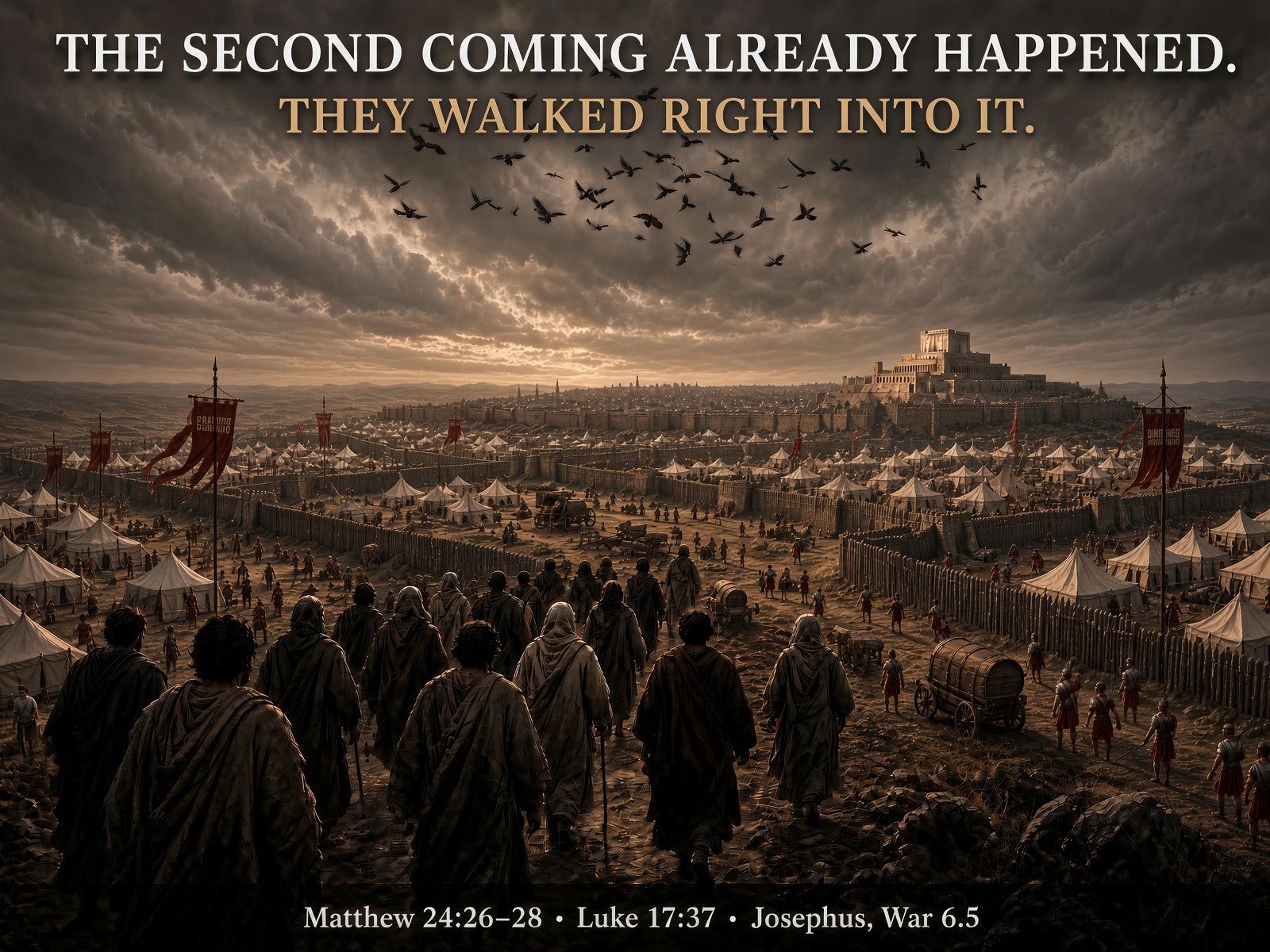
Don't lose me here. This might be one of the more important posts I've done on what the Second Coming looked like and what Jesus said it would be.
I was listening to a pastor teach through Matthew 24 last week, and a passage I've read a hundred times came through in a different key, because this pastor read it from an angle nearly no other pastor I've come across has. Here's what Jesus says, right after the abomination of desolation and the great tribulation: "Then if anyone says to you, 'Look, here is the Christ!' or 'There he is!' do not believe it. For false christs and false prophets will arise and perform great signs and wonders, so as to lead astray, if possible, even the elect. See, I have told you beforehand. So, if they say to you, 'Look, he is in the wilderness,' do not go out. If they say, 'Look, he is in the inner rooms,' do not believe it. For as the lightning comes from the east and shines as far as the west, so will be the coming of the Son of Man. Wherever the corpse is, there the vultures will gather" (Matthew 24:23–28).
Read it slowly. He isn't telling them where to find Him. He's telling them where not to look. Not here. Not there. Not the wilderness. Not the inner rooms. "See, I have told you beforehand."
Those weren't empty words, because that is exactly what happened over the next forty years. When Paul was arrested in Jerusalem, the Roman commander asked him, "Are you not the Egyptian, then, who recently stirred up a revolt and led the four thousand men of the Assassins out into the wilderness?" (Acts 21:38). A messiah in the wilderness, recorded in your Bible. Gamaliel mentions another: "Theudas rose up, claiming to be somebody," and his followers were scattered (Acts 5:36). Josephus, who lived through it, says the country filled with "deceivers" who led crowds into the desert promising signs of deliverance (War 2.13.4–5). Luke's version of the warning adds a verb: "Do not go after them" (Luke 21:8). They went after them anyway.
That brings us to the inner rooms. On the day the Temple burned, Josephus records that about six thousand people, women and children among them, had crowded into one of the Temple's own colonnades, because a false prophet "had made a public proclamation in the city that very day, that God commanded them to get up upon the temple, and that there they should receive miraculous signs of their deliverance" (War 6.5.2). The Romans set the colonnade on fire. Not one of them got out. Signs and wonders promised inside the sanctuary precinct, and Jesus had said, do not believe it.
So where would He be? The disciples asked Him that question directly in Luke's account. "Where, Lord?" He didn't name a place. He said: "Where the corpse is, there the vultures will gather" (Luke 17:37).
Look at what He put in place of a location. Lightning. It fills the sky from one horizon to the other and the cracks shake the ground and ring your ears. Lightning is the opposite of a rumor. That's the contrast He's drawing: not "he's in the desert, go check," but a judgment that announces itself. His coming would not be a man on the ground that you go looking for, and it wouldn't be Him leading a physical army to take over the world. It would be a judgment nobody could miss. In the Old Testament, that's exactly how God comes: "Behold, the LORD is riding on a swift cloud and comes to Egypt" (Isaiah 19:1). God came to Egypt, and nobody saw a body in the sky. They saw an army used by God. David: "He bowed the heavens and came down… he sent out his arrows and scattered them; he flashed forth lightnings" (Psalm 18:9, 14). This is the language Jesus had already used for Himself at His trial: "From now on you will see the Son of Man seated at the right hand of Power and coming on the clouds of heaven" (Matthew 26:64). Seated and coming, in one breath. Not descending to a spot on a map to begin an earthly reign.
Next, the birds. "Wherever the corpse is, there the vultures will gather." The Greek word is aetos, which covers both the vulture and the eagle, and every Roman legion marched under a golden eagle. Moses had warned Israel fourteen centuries earlier, in the curses of the covenant: "The LORD will bring a nation against you from far away, from the end of the earth, swooping down like the eagle, a nation whose language you do not understand" (Deuteronomy 28:49). Habakkuk saw the Chaldeans the same way: "they fly like an eagle swift to devour" (Habakkuk 1:8). The corpse was the old covenant order that had died with an apostate nation. The birds were Rome. You didn't need a rumor to find the Son of Man. You needed to look up and see what was circling the nation that had rejected its Rock.
Now listen to what Josephus recorded in the months before the end, signs he says the people ignored. The great eastern gate of the inner court, bronze, so heavy it took twenty men to close, "was seen to be opened of its own accord about the sixth hour of the night." Before sunset one day, "chariots and troops of soldiers in their armor were seen running about among the clouds, and surrounding of cities." At Pentecost, as the priests entered the inner court at night, they felt the ground shake and "heard a sound as of a great multitude, saying, 'Let us remove hence'" (War 6.5.3). Tacitus, a Roman with no love for Jews or Christians, records the same: armies contending in the sky, the Temple doors flying open, and a voice "more than human" announcing that the gods were departing (Histories 5.13).
Jesus had already said it from inside that building. "See, your house is left to you desolate" (Matthew 23:38). Then He walked out and sat down on the Mount of Olives (24:1–3). Forty years later, the house was empty, and the armies that filled the sky in the vision were standing in the courts.
What was He actually telling them? Stop looking for a man in the desert. Stop believing the voices promising signs in the inner rooms. When you see the birds gathering, when "you see Jerusalem surrounded by armies, then know that its desolation has come near. Then let those who are in Judea flee to the mountains" (Luke 21:20–21). The ones who listened got out; history records the Jerusalem church leaving before the end. The ones who went looking in the wilderness and the inner rooms died there.
Two thousand years later we're still being told where to look. "He's about to appear. Look at Israel. Look at this headline. Look at the blood moon. Watch Iran." He told us beforehand what to do with that. "Do not believe it."
He told them where not to look and they walked right into it. The question is whether we'll stop looking there and recognize the Coming He already gave us. He isn't hiding in a headline. He's on the throne, and the work He left us is in front of us.