Revelation was written before the Temple fell.
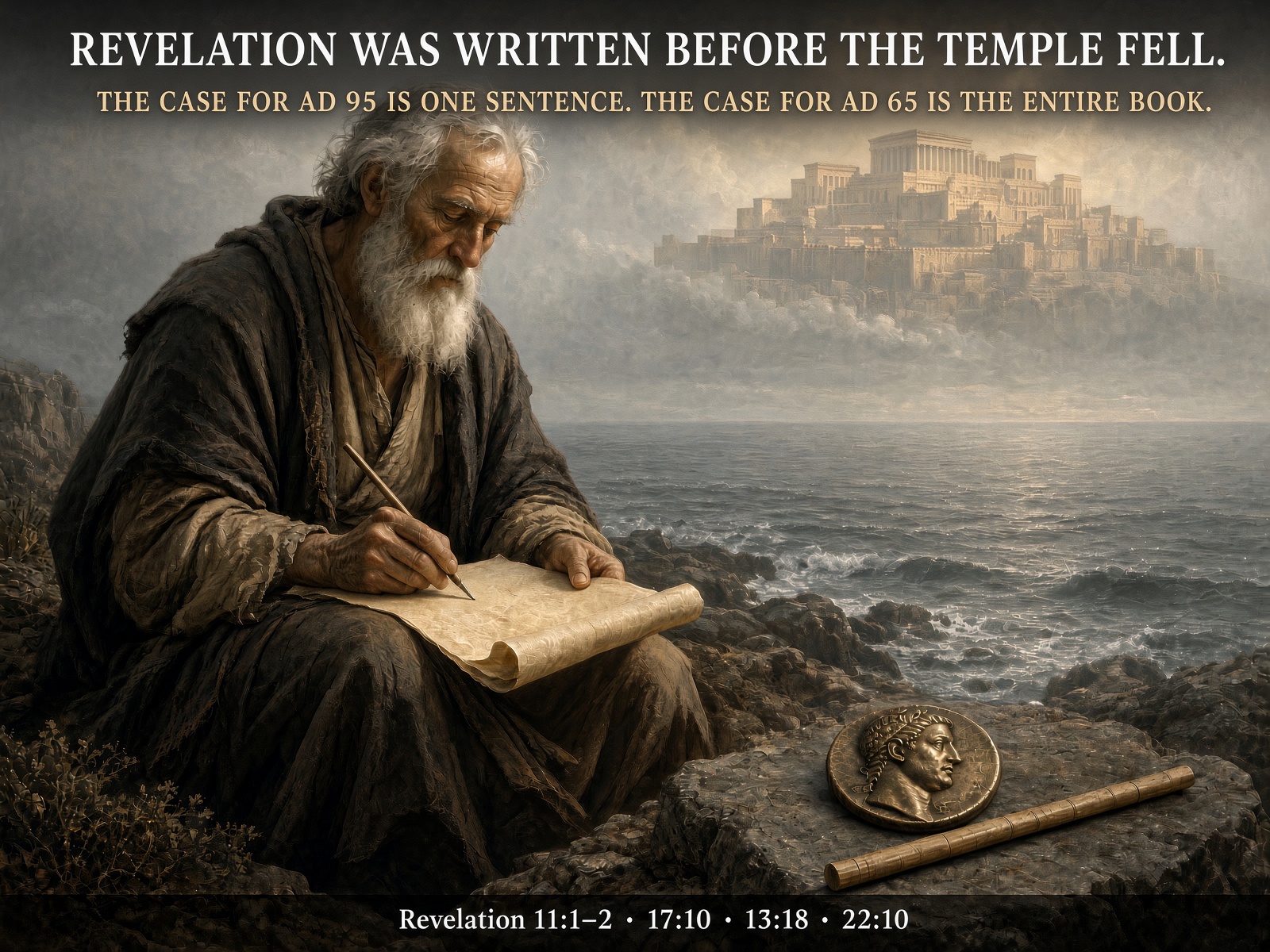
The case for AD 95 is one sentence. The case for AD 65 is the entire book.
Every prepared futurist opens the same way: "Irenaeus says Revelation was written under Domitian, around AD 95, so it can't be about AD 70." It's the first move, because if the book was written twenty-five years after Jerusalem fell, the whole preterist reading is dead on arrival. Fair enough. Let's look at the proof.
Irenaeus, writing around AD 180, is discussing the number 666 and says that if its meaning needed to be known, "it would have been announced by him who beheld the apocalyptic vision. For that was seen no very long time since, but almost in our day, towards the end of Domitian's reign" (Against Heresies 5.30.3). That is the entire external case. David Chilton put it bluntly in Days of Vengeance: Irenaeus "is the only source for this late dating of Revelation; all other 'sources' are simply quoting from him."
Here's the problem with the one source. The Greek of that sentence survives because Eusebius quoted it, and the verb "was seen" has no stated subject. Was the vision seen near the end of Domitian's reign, or was John seen then, still alive and available to explain the number? F. J. A. Hort, one of the great textual critics of the nineteenth century, noted that reading it as "John was seen" is "in accordance with his favourite phraseology." The logic of the passage runs that way: Irenaeus's point is that the author lived nearly into his own day, so if the number had needed explaining, the author could have explained it. James Macdonald: "The scope requires this nominative and no other."
One ambiguous verb, read one way. That is the whole case for the late date.
Now the book of Revelation itself. It dates itself five ways, and none of them is ambiguous.
The Temple is standing. "Rise and measure the temple of God and the altar and those who worship there, but do not measure the court outside the temple; leave that out, for it is given over to the nations, and they will trample the holy city for forty-two months" (Revelation 11:1–2). You cannot measure a temple that has been a pile of rubble for twenty-five years, and you cannot predict the trampling of a city already trampled. Charles Torrey, no friend of conservative readings: "This was written before the year 70, as all students of the book agree."
The sixth emperor is on the throne. "The seven heads are seven mountains on which the woman is seated; they are also seven kings, five of whom have fallen, one is, the other has not yet come, and when he does come he must remain only a little while" (17:9–10). Count the Caesars the way Suetonius did in The Twelve Caesars and the way Jewish writers of the period did in 4 Ezra and the Sibylline Oracles, starting with Julius: Julius, Augustus, Tiberius, Caligula, Claudius. Five fallen. The sixth, the one who "is": Nero. The seventh, who "must remain only a little while": Galba, who lasted seven months. John tells you who was emperor when he wrote. It wasn't Domitian. Domitian is twelfth.
The number is Nero's. "Let the one who has understanding calculate the number of the beast, for it is the number of a man, and his number is 666" (13:18). Write "Nero Caesar" in Hebrew letters, Nrwn Qsr, and add them up the way every first-century reader knew how to: 666. An Aramaic document found at Murabba'at near the Dead Sea, dated to "the second year of the emperor Nero," spells his name exactly that way. Some early manuscripts of Revelation read 616 instead of 666, and Irenaeus himself knew about them; 616 is what you get when you spell it the Latin way, Nero without the final n. Two spellings, same man.
Revelation says it's soon. "The things that must soon take place" (1:1). "The time is near" (1:3). "Do not seal up the words of the prophecy of this book, for the time is near" (22:10). A book written in AD 95 about events still two thousand years off would be the one prophecy in Scripture that said "near" and meant "not for a hundred generations."
The persecution is Nero's. The late date needs a Domitianic persecution to account for the book's martyrs, and the evidence for one is thin. Suetonius, who lists punishing Christians among Nero's acts, never mentions Domitian doing it. Tertullian: "At Rome Nero was the first who stained with blood the rising faith." Even Leon Morris, who holds the late date, concedes that the evidence for a general persecution under Domitian "is not easy to find."
John A. T. Robinson, a liberal Cambridge scholar with no preterist axe to grind, noticed that the single most datable event of the century, the fall of Jerusalem, "is never once mentioned as a past fact" anywhere in the New Testament. Not in Revelation, not in Hebrews, not in Acts. He called it the dog that did not bark, and his conclusion was that the whole New Testament was written before it. Twenty-seven books, and not one of them looks back at the Temple's destruction.
Where this is contestable. The external testimony of the early church leans toward Domitian, and that is the single point most scholars hold against the early date. The "John was seen" reading of Irenaeus is a minority view, and I don't rest the case on it. I rest it on the inspired book of Revelation. If you want to argue the date, argue Revelation 11:1–2 and 17:10 with me, because those are the verses that have to be explained away for AD 95 to work.
Here is where that leaves the claim. The late date rests on one sentence with an ambiguous verb, read against its own logic. The early date rests on a standing Temple, a named emperor, a number that only works for Nero, a book that calls itself urgent, and a persecution the historians actually recorded. If Revelation was written around AD 65, under Nero, with Jerusalem still standing and the war about to begin, then every "soon" in it points at the city, and the book is what it says it is: the revelation of what was about to happen to the generation that crucified Him.
The futurist needs AD 95. The book won't give it to him.