Babylon is not America.
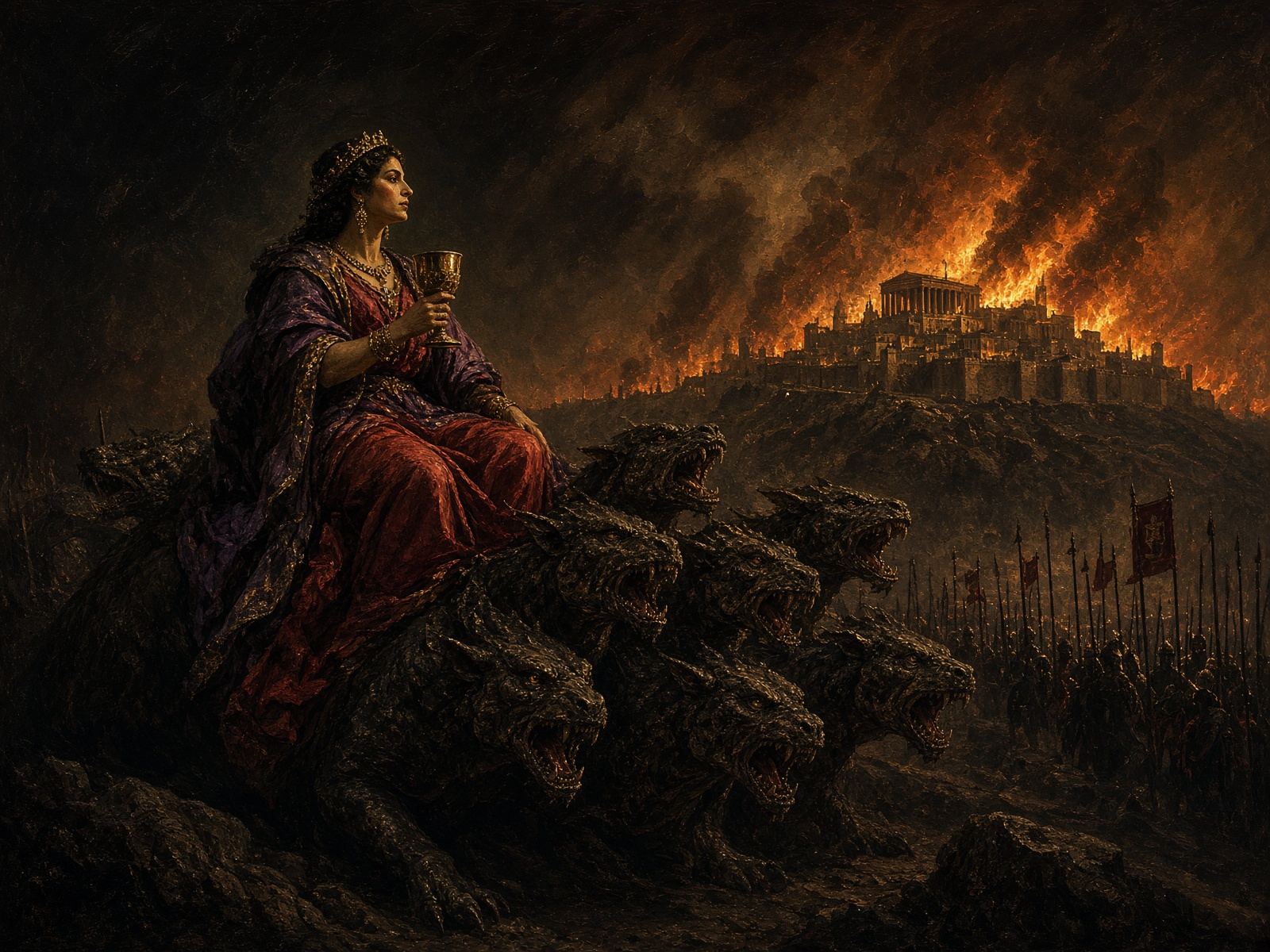
Every few months someone identifies Revelation's Babylon as America, or New York, or whatever nation looks powerful and corrupt this year. But John didn't leave Babylon unidentified. He gave her a description. So instead of asking "who looks like Babylon today?", let the book answer for itself.
Start with her name. Revelation 18 calls Babylon "the great city" five times (18:10, 16, 18, 19, 21). But John had already told us which city that is, seven chapters earlier: "the great city that symbolically is called Sodom and Egypt, where their Lord was crucified" (Revelation 11:8). Where was Jesus crucified? Not in America. In Jerusalem. John introduced the great city, named its crime, and then kept using the title.
Then her character. Babylon is a harlot, and to a Jewish reader that word was not random. It was the prophets' standard charge against covenant-breaking Jerusalem: "How the faithful city has become a whore" (Isaiah 1:21). Ezekiel 16 and 23 spend two whole chapters on it. You don't accuse a nation of adultery unless she was married, and only one city on earth was ever called God's wife. Look at what she wears, too: "purple and scarlet, and adorned with gold and jewels and pearls, holding in her hand a golden cup" (Revelation 17:4). Those are the colors of the priesthood (Exodus 28:5–6). This is a woman dressed like the temple.
Then her crime. "In her was found the blood of prophets and of saints, and of all who have been slain on earth" (Revelation 18:24). Now listen to Jesus: "O Jerusalem, Jerusalem, the city that kills the prophets and stones those who are sent to it" (Matthew 23:37), "that on you may come all the righteous blood shed on earth" (23:35). And He gave the timing: "Truly, I say to you, all these things will come upon this generation" (23:36). John's charge against Babylon is Jesus' charge against Jerusalem, almost word for word, with the same due date.
Then her relationship to the Beast, which gets overlooked constantly. Babylon is not the Beast. She rides it (Revelation 17:3). Then the Beast turns on her, "will make her desolate and naked, and devour her flesh and burn her up with fire" (17:16). So Babylon can't simply be Rome; Rome is what she's sitting on. And "the seven heads are seven mountains on which the woman is seated" (17:9) confirms it: the seven hills belong to the Beast, and the woman is perched on top of them. Rome is the beast from the sea (13:1); the second beast rises "out of the earth," the land (13:11), looks like a lamb, talks like the dragon, and makes the land worship Rome. That's Jerusalem's leadership. The harlot is the city they sold. She said "We have no king but Caesar" (John 19:15) in AD 30, and Caesar's legions burned her in AD 70.
Then her timing. Revelation opens with "the things that must soon take place" (1:1) and "the time is near" (1:3), and closes with "Do not seal up the words of the prophecy of this book, for the time is near" (22:10). Daniel was told to seal his book because the fulfillment was far off. John was told not to, because it wasn't. A judgment on a nation that wouldn't exist for seventeen centuries cannot be "near" for seven churches in first-century Asia.
So before you name America, run the checklist John gave you. Was Jesus crucified there? Was it the covenant wife the prophets called a harlot? Did Jesus charge it with killing the prophets and say the blood would be required within His generation? Was it carried by the Beast and then burned by the Beast? And how was any of it "soon" for John's readers?
Two objections, answered honestly. "Revelation 18 is all sea trade; Jerusalem wasn't a port." John is quoting Ezekiel 26–27, the lament over Tyre, as prophetic idiom, the same way he borrowed Sodom and Egypt in 11:8; and 18:22–23, the mill and the lamp and the voice of bride and bridegroom, is Jeremiah 25:10, spoken over Jerusalem. "She reigns over the kings of the earth" (17:18). "The earth" is the land throughout Revelation, and Jerusalem's religious authority reached the whole diaspora; that one is the reading I find most faithful, not a knock-down, and I'll say so.
We don't need today's headlines to identify Babylon. We need the text, and the text points to the covenant city that rejected her Messiah, killed His prophets, leaned on Rome, and was burned by Rome in that generation. Babylon was apostate Jerusalem.