The resurrection already happened. Here's what changed for the people who didn't die.
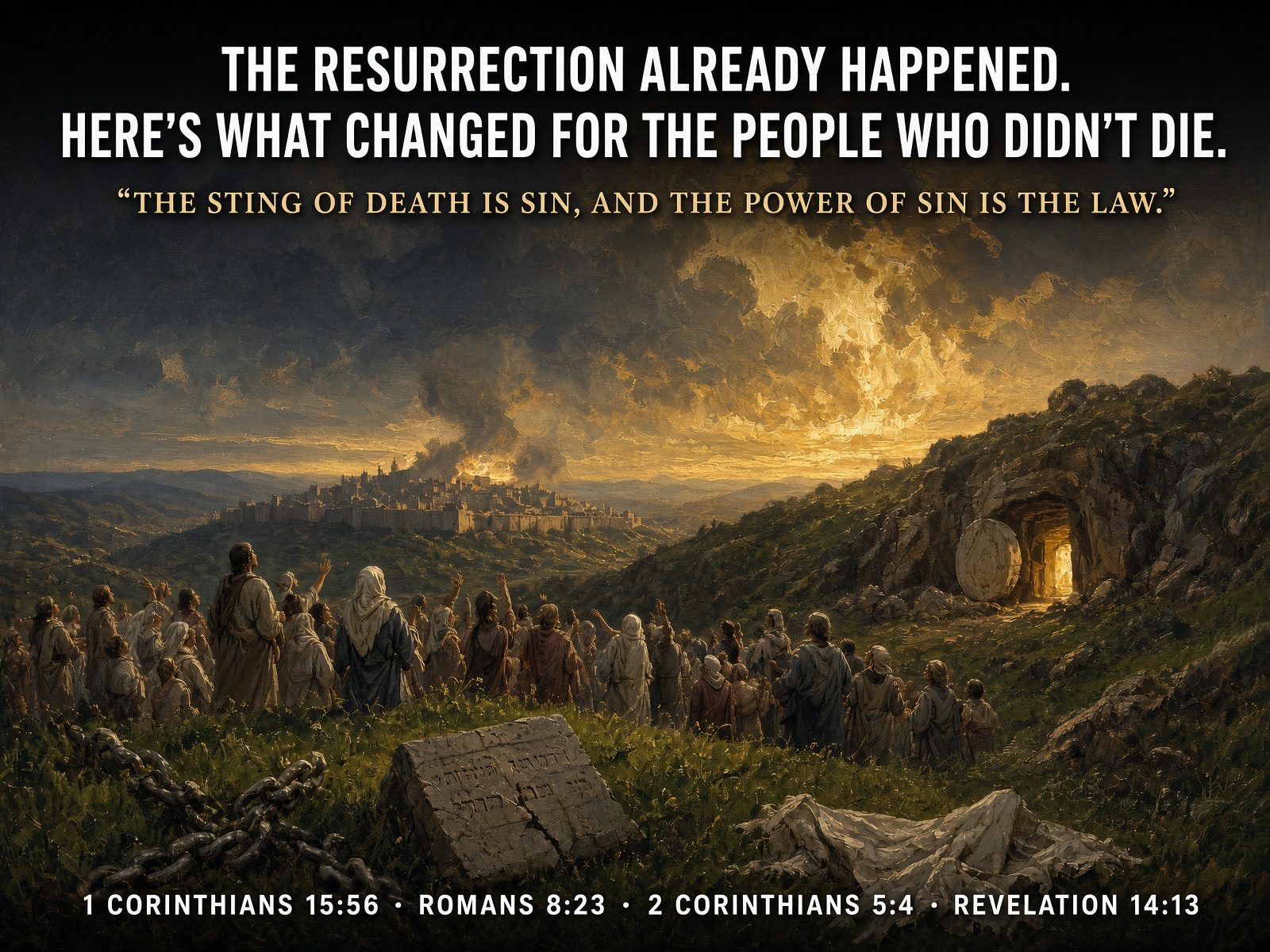
They were told to wait. They were told it was near. Then it came. If you want to know what it was, read what they were waiting for.
A reader named Julian asked me the question that's supposed to end this conversation. "Preterists believe everything has been fulfilled. Which do we have now, heavenly bodies or earthly bodies?" He quoted 1 Corinthians 15: sown a natural body, raised a spiritual body. If the resurrection happened, where's mine? I have been working for a long time to truly grasp this topic and wrestle with it. It's not a text to take lightly, and the question must be answered.
The plain answer is that you and I have earthly bodies. Nobody walking around today has the resurrection body, on my reading or on the futurist's, because the chapter is about "the resurrection of the dead" (15:12, 13, 21, 42), and Paul's own question is "how are the dead raised?" (15:35). The question that separates the views is a different one: where are the dead in Christ right now, and what did the living receive when He came? I want to answer both, slowly, because the second one is the one I've left as a major topic of study, and so many of you have asked the same thing.
Start with the expectation, because it's everywhere. The New Testament is written to people who were waiting for something, and the writers kept telling them it was close. "The glory that is to be revealed to us" (Romans 8:18). "We ourselves, who have the firstfruits of the Spirit, groan inwardly as we wait eagerly for adoption as sons, the redemption of our bodies" (8:23). "Salvation is nearer to us now than when we first believed" (13:11). "You wait for the revealing of our Lord Jesus Christ, who will sustain you to the end" (1 Corinthians 1:7–8). "We await a Savior… who will transform our lowly body to be like his glorious body" (Philippians 3:20–21). "When Christ who is your life appears, then you also will appear with him in glory" (Colossians 3:4). "To wait for his Son from heaven" (1 Thessalonians 1:10). "Sealed for the day of redemption" (Ephesians 4:30). "A salvation ready to be revealed in the last time" (1 Peter 1:5). "He will appear a second time… to save those who are eagerly waiting for him" (Hebrews 9:28). "Yet a little while, and the coming one will come and will not delay" (10:37). "When he appears we shall be like him" (1 John 3:2).
Read that list as if you were the people it was originally intended for. God had already "made us alive together with Christ… and raised us up with him and seated us with him in the heavenly places" (Ephesians 2:5–6). Already raised, and still waiting. Paul calls the Spirit the "guarantee of our inheritance until we acquire possession of it" (1:14). A down payment is for something that hasn't been handed over yet. Something was coming to the living, and the apostles said it was near.
What they were waiting for had a date on it. Paul puts the change of the living "at the last trumpet" (1 Corinthians 15:52) and "at his coming" (15:23). Jesus put the trumpet and the gathering "immediately after the tribulation of those days" and inside "this generation" (Matthew 24:29–31, 34). Paul writes "we who are alive, who are left" (1 Thessalonians 4:15, 17), and he means the people reading the letter. James: "the coming of the Lord is at hand" (5:8). Peter: "the end of all things is at hand" (4:7). The people who were waiting had been given a window, and the window closed in AD 70. Futurist friends read these lines as nearness with no date attached, and they believe the apostles were inspired as much as I do. My problem is that the apostles didn't leave the date open. "This generation" and "we who are alive" put the waiting inside the lives of the people holding the letters. If nothing arrived inside that window, then "a little while" meant two thousand years, and I can't stretch the words that far.
The dead first, because Paul says so. "The dead in Christ will rise first" (1 Thessalonians 4:16). Where were they? Waiting. Israel's faithful dead were in Hades, Sheol, the place of the dead (Acts 2:27). The first believers who died in Christ were with Him and still asleep, told to "rest a little longer" (Revelation 6:11). Daniel was told when the waiting would end: "many of those who sleep in the dust of the earth shall awake," and "when the shattering of the power of the holy people comes to an end all these things would be finished" (Daniel 12:2, 7). As I read it, the shattering of the holy people's power ended in AD 70. John saw the moment from the other side: "Death and Hades gave up the dead who were in them" (Revelation 20:13). Hebrews says the Old Testament saints could not be finished without the first-century believers: "God had provided something better for us, that apart from us they should not be made perfect" (11:40), and then puts them in Zion: "the spirits of the righteous made perfect" (12:23). I read it this way: the righteous dead were raised out of Hades into the glorified bodies Paul describes, the kind Jesus said are "equal to angels" and "cannot die anymore" (Luke 20:36). That's the resurrection John saw in 20:13. It emptied the waiting room in Sheol.
Then John puts a hinge in history. "Blessed are the dead who die in the Lord from now on" (Revelation 14:13). From now on. After the hinge, dying in the Lord means arriving somewhere much better, with no wait. Jesus had said it in advance: "everyone who lives and believes in me shall never die" (John 11:26). The believer who dies today is raised into His presence the way the first ones were. One resurrection, with a door that stayed open and will never be closed. That is also my answer to "what about Grandma," and it's the only answer I've found that lets John 11:26 and Revelation 14:13 mean what they say.
Now the living, and what Paul says the change was. Paul has just shouted "Death is swallowed up in victory. O death, where is your victory? O death, where is your sting?" (1 Corinthians 15:54–55). Then, in the verse too many readers rush past, he explains the sting: "The sting of death is sin, and the power of sin is the law" (15:56). The law didn't define death. It gave death its sting, by giving sin its power. Paul calls the Mosaic covenant "the ministry of death, carved in letters on stone" (2 Corinthians 3:7). I read "the law of sin and death" (Romans 8:2) the same way, though many take "law" there as a ruling principle, and I read "this body of death" (7:24) as the condition that covenant exposed. Hebrews, most likely written in the 60s, says that covenant was "becoming obsolete and growing old" and "ready to vanish away" (8:13). It vanished with the Temple. As I read it, the victory over death Paul describes is the removal of what gave death its sting. That is what the living were changed out of.
Paul's two Old Testament quotations show what the victory meant to him. "Death is swallowed up in victory" is Isaiah 25:8, where God, "on this mountain," destroys "the veil that is spread over all nations" and takes away "the reproach of his people." "O death, where is your sting?" is Hosea 13:14, which is about Israel's death under judgment, with her restoration promised in the next chapter, "I will heal their apostasy" (14:4). The dry bones of Ezekiel 37 are the same idea, "I will open your graves and raise you from your graves, O my people" (37:12). When Paul reached for texts to explain the resurrection, he reached for two about a covenant people's death and restoration. He didn't reach for a biology text.
"Flesh and blood cannot inherit the kingdom of God" (15:50) means what it means everywhere else. "Flesh and blood has not revealed this to you" (Matthew 16:17). "We do not wrestle against flesh and blood" (Ephesians 6:12). Paul says he did not consult "flesh and blood" when he was converted (Galatians 1:16, literally). It's the Hebrew idiom for mortal humanity, man as he is in Adam, frail and dying. Christ Himself shared flesh and blood (Hebrews 2:14), so the phrase can't mean being cut off from God. Adam's humanity couldn't inherit the kingdom. The living had to be changed, taken out of Adam's condition and fully into Christ's gathering, "we shall all be changed, in a moment, in the twinkling of an eye, at the last trumpet" (15:51–52).
Paul describes the same event from the inside in 2 Corinthians 5. "We have a building from God, a house not made with hands… we groan, being burdened, not that we would be unclothed, but that we would be further clothed, so that what is mortal may be swallowed up by life" (5:1–4). "Swallowed up" is the 1 Corinthians 15:54 word. "Mortal" is the 15:53 word. Paul is telling you what the living were about to receive: mortality swallowed by life, with God's Spirit already given "as a guarantee" (5:5). The mortal thing is the body. Paul uses that word six times and it means the body or the flesh every time. He had just told this church that the life of Jesus was being shown "in our mortal flesh" (4:11). That is mortal flesh already carrying His life, with the Spirit as the down payment on the rest (5:5). The death that was swallowed at the trumpet (1 Corinthians 15:54) is the death Adam died "in the day" he ate (Genesis 2:17), the death that "spread to all men" (Romans 5:12), the separation from God that the law could expose but never cure. The body follows the way Paul said it must. "What you sow does not come to life unless it dies" (15:36). Paul's "redemption of our bodies," as I read it, was the whole body of Christ brought out of Adam's covenant of death and fully into life. Paul calls it "adoption as sons" in the same breath (8:23), and adoption is what he says belonged to Israel as a people (9:4). "Redemption" is the word Jesus used when He told that generation, "your redemption is drawing near" (Luke 21:28). The groaning stopped because the thing they groaned for arrived. The building itself, "eternal in the heavens," each believer puts on when this tent comes down (5:1), which is why Paul could say, "we would rather be away from the body and at home with the Lord" (5:8).
What "spiritual body" does and doesn't mean. Julian assumed, as most do, that "spiritual" means non-physical. The word is pneumatikos, and Paul uses it in the same letter for the manna, "spiritual food," and the water from the rock, "spiritual drink" (10:3–4), and for a mature believer, "the spiritual person" (2:15). None of those is a ghost. A spiritual body is a body governed by the Spirit rather than by the flesh, the way a "natural body" is governed by the psychē, the Adamic life. Jesus has a body. It was handled (Luke 24:39), and He is seated at the right hand (Hebrews 8:1). The raised are "like him" (1 John 3:2). I hold a Spirit-governed resurrection, which is what Paul wrote, and I reject an immaterial one.
Where this is contestable. Most readers take "this mortal body must put on immortality" (15:53) as the physical body, and that is the natural first reading of the sentence by itself. The reasons I don't read it that way: Paul names the law as the power behind death's sting (15:56), chooses two covenant texts to explain the victory (Isaiah 25, Hosea 13), uses "flesh and blood" for mortal humanity, and dates the whole thing to a trumpet Jesus put inside a generation. Paul puts the change of the living at that trumpet. What the change was, Paul tells us in 15:53-56 and in 2 Corinthians 5:1-4. I'll grant there's no marker in 15:51-54 that separates what the dead received from what the living received. My reading of the living leans on 2 Corinthians 5: the sting and the covenant of death removed at the trumpet, and the building from God put on when each tent comes down. The change at the trumpet was a change of head, from the man of dust to the man of heaven (15:49), and a change in what death is for a believer. Jesus said both halves in one breath. "Though he die, yet shall he live, and everyone who lives and believes in me shall never die" (John 11:25-26). People disagree on the details, and I'd stake the post on the dating before the details, because the time statements are the plainest thing in the chapter. The strongest form of the other reading is the firstfruits. Christ's own body left the tomb (15:4, 20), and a harvest normally matches its firstfruits. Peter and Paul both prove He rose by pointing at a body that did not decay (Acts 2:29-31; 13:36-37), and a critic will turn that test on every grave. It's a fair push. Scripture also marks His body as the exception. David "saw corruption, but he whom God raised up did not see corruption" (Acts 13:36-37). I agree the raised are like Him (1 John 3:2): raised out of Hades into Spirit-governed bodies like His, which is why I don't hold an immaterial resurrection. I also won't lean on the singular "body" in Romans 8:23. Greek often uses one noun for what each person has, and Paul says "your mortal bodies," plural, a few verses earlier (8:11). Philippians 3:21 says He "will transform our lowly body." Ten verses earlier Paul says how he expected to get there. "Becoming like him in his death, that by any means possible I may attain the resurrection from the dead" (3:10-11). Someone will raise 2 Timothy 2:18, Hymenaeus saying the resurrection "has already happened." I answer it on my Tough Verses page, and the short answer is that Paul condemned men saying it was past before the coming, in the 60s. Paul himself still spoke of it as future. "There will be a resurrection of both the just and the unjust" (Acts 24:15), and in this same letter Christ "is to judge the living and the dead" (2 Timothy 4:1). The Greek verb in both is mellō, which can mean "about to." The word alone doesn't prove that, and I won't lean on it. Peter says of the same judgment that Christ "is ready to judge the living and the dead," and two verses later, "The end of all things is at hand" (1 Peter 4:5, 7). Read beside Peter, "about to" is a fair reading. Isaiah 65:20 is the reason I'm not embarrassed that people still physically die: the prophet who promised the new earth put funerals in it.
Four more texts push hard on this post, and they deserve straight answers. The first is in my own proof text. In 2 Corinthians 5 the tent is the physical body (5:1, 6, 8), and Romans 8:11 says the Spirit "will also give life to your mortal bodies." I read "what is mortal" in 2 Corinthians 5:4 as more than biology, and plenty of people disagree with me there. The second is Hebrews 12:23, which calls the righteous dead "spirits," the futurist's best verse for a bodiless wait. I get the building from God out of 2 Corinthians 5:1, and I'll grant that 12:23 by itself doesn't settle the body question. The third is Isaiah 26:19, in the same prophecy as 25:8: "Your dead shall live; their bodies shall rise." I grant it, which is why I hold a real resurrection out of Hades and never shrink it to a change of status. The fourth is John 5:28-29, "all who are in the tombs will hear his voice and come out." Jesus said the same hour "is coming, and is now here" (5:25), and Ezekiel's "I will open your graves" was spoken over living exiles, so I read the tombs as Hades emptied at the end of the age, with every believer since walking straight through the open door (Revelation 14:13). That one is on the Grandma answer. Revelation 20:13 also comes after the thousand years. I take the thousand as a symbolic full term that closed at His coming, never a literal forty years, and I lay that out under Revelation 20.
Brothers and sisters, which body do we have now? Earthly, all of us. The dead in Christ have the other kind, and they are not waiting. The living in AD 70 were taken out of the covenant that made death deadly, which is what they'd been groaning for, and we were born into a world where that work was already done. The question I'd hand back is where you think the dead in Christ are right now, and whether they're in a body. Paul said he did not want to be "found naked" (2 Corinthians 5:3). Futurist friends answer that being with Christ is "far better" (Philippians 1:23), and they're right that it beats here. My question is whether Paul, groaning to be "further clothed" (5:4), expected the unclothed state to run twenty centuries. I think he expected better, and sooner, and I think he got exactly what he and others were groaning for. Boy did they wait for it.
They were waiting. He came. The waiting ended, and the door stayed open.