Moses wrote the indictment. Jesus read it aloud.
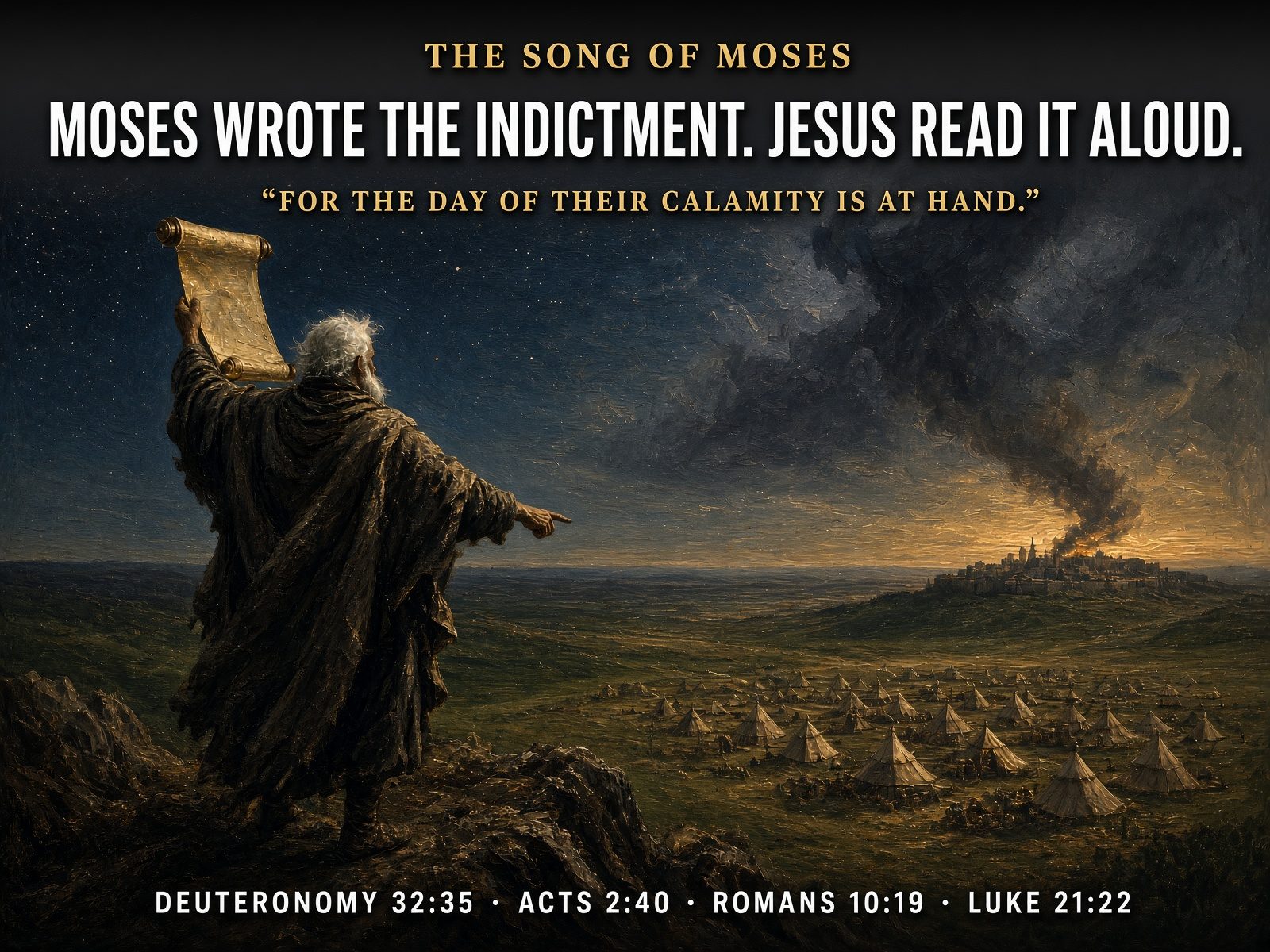
The generation that crucified Him may well have heard its own indictment sung in the Temple every six weeks.
Fourteen hundred years before the cross, before Israel had set foot in the land, God told Moses how the story would end. They would break the covenant. He would hide His face. A song would stand as a witness against them when it happened: "this song shall confront them as a witness" (Deuteronomy 31:21). Then Moses wrote the song. It's Deuteronomy 32, and I'd argue it's the most-quoted chapter in the New Testament that nobody preaches on.
It's written as a lawsuit. Ancient treaties had a form, and when the vassal broke faith the king filed suit in the same form: summon the witnesses, recite what you did for them, read the charges, pronounce the sentence. Moses summons heaven and earth (32:1), recites the exodus (32:7–14), reads the charges (32:15–18), and pronounces sentence (32:19–43). Isaiah and Micah refiled the same suit against Judah (Isaiah 1:2; Micah 6:1–2). As I read it, Jesus filed it the last time in Matthew 23.
Here's the part that got me. Rabbinic tradition records that the Levites sang this song in the Temple at the Sabbath offering, six sections over six Sabbaths (Rosh Hashanah 31a). If that tradition reaches back to the Second Temple, the men who crucified Jesus heard their own indictment sung every six weeks, and didn't know it was about them. Moses had said they wouldn't: "If they were wise, they would understand this; they would discern their latter end!" (32:29). Jesus wept over the same blindness: "Would that you, even you, had known on this day the things that make for peace! But now they are hidden from your eyes" (Luke 19:42).
I'm not going to read AD 70 into Deuteronomy. I'm going to show you the apostles doing it. Where the New Testament writers put a date on this song, they put it on their own generation. Not one of them dates it to a far future. Watch.
The charge. "A crooked and twisted generation" (32:5). The Greek Old Testament reads genea skolia kai diestrammenē. Jesus to the crowd, with the second word: "O faithless and twisted generation" (Matthew 17:17). Peter to the Pentecost crowd in Jerusalem, with the first: "Save yourselves from this crooked generation" (Acts 2:40). Paul, both words, for the world his Philippian readers lived in: "a crooked and twisted generation" (Philippians 2:15). Moses' phrase for the generation under judgment is the phrase Jesus, Peter, and Paul used for the people around them. When Jesus and Peter used it in Jerusalem, they meant the same people Jesus had in view when He said, "this generation will not pass away" (Matthew 24:34).
The charge, read to the court. Stephen stood in front of the council in Jerusalem and used Moses' words on them. "You stiff-necked people, uncircumcised in heart and ears, you always resist the Holy Spirit. As your fathers did, so do you" (Acts 7:51). Moses had said both things to Israel. "Circumcise therefore the foreskin of your heart, and be no longer stubborn" (Deuteronomy 10:16), and in the chapter where he hands them the song, "I know how rebellious and stubborn you are" (31:27). The ESV says "stubborn." The Hebrew in both verses is the stiff neck, and the King James keeps it. Stephen ended on the law, "you who received the law as delivered by angels and did not keep it" (7:53). They stoned him that day.
The charges, read to a church. Paul echoes the song twice in one chapter. "What pagans sacrifice they offer to demons and not to God" (1 Corinthians 10:20) is 32:17. "Shall we provoke the Lord to jealousy?" (10:22) is 32:21. A few verses earlier he says "the Rock was Christ" (10:4). That's the rock in the wilderness, and "Rock" is also the song's name for God (32:4, 15, 18). In the middle he tells the Corinthians why Israel's wilderness story was their business: "they were written down for our instruction, on whom the end of the ages has come" (10:11). Paul read Moses to a first-century church and said the ages were ending on them.
The sentence. "I will make them jealous with those who are no people" (32:21). Paul quotes it in Romans 10:19, "I will make you jealous of those who are not a nation," to explain why Israel refused the gospel and the Gentiles received it, and he builds Romans 11 on it: "through their trespass salvation has come to the Gentiles, so as to make Israel jealous" (11:11). Peter says the same thing in Hosea's words: "Once you were not a people, but now you are God's people" (1 Peter 2:10). The "no people" of the song was being called in while Paul wrote.
As I read them, the Gospels and Revelation keep echoing the rest of the sentence. "The kingdom of God will be taken away from you and given to a people producing its fruits" (Matthew 21:43) echoes 32:19, the sons spurned. "Your house is left to you desolate" (23:38) picks up Jeremiah's "this house shall become a desolation" (Jeremiah 22:5) and the song's hidden face (32:20). "Even now the axe is laid to the root of the trees… the chaff he will burn with unquenchable fire" (3:10–12) echoes 32:22, the fire. The fourth horseman, sent "to kill with sword and with famine and with pestilence and by wild beasts of the earth" (Revelation 6:8), is 32:24–25 by way of Ezekiel 14:21, the four judgments on the land. Josephus describes the sword, the famine, and the pestilence inside the walls (Wars 5.12.3; 6.3.3).
The verse everyone quotes and nobody dates. "Vengeance is mine, and recompense… for the day of their calamity is at hand" (32:35). Paul quotes it in Romans 12:19, and a chapter later tells the same readers, "The night is far gone; the day is at hand" (13:12). Hebrews quotes it in 10:30, along with the next verse, "The Lord will judge his people," and aims both at God's own people. Those readers could "see the Day drawing near" (10:25) and were told, "Yet a little while, and the coming one will come and will not delay" (10:37). Then Jesus named the day: "these are days of vengeance, to fulfill all that is written" (Luke 21:22), said of armies around Jerusalem (21:20), inside "this generation" (21:32). In the song itself, whose foot slips in 32:35 is debated, and the closing verses turn the vengeance on God's "adversaries" (32:43). Hebrews settles it for me, because it applies the verse to God's own people. I read Jesus' "all that is written" as including it, which puts its fulfillment at the fall of Jerusalem.
The vindication. "The LORD will vindicate his people… when he sees that their power is gone" (32:36). Hebrews quotes that line too, from the Greek, as "The Lord will judge his people" (10:30). Now put it beside Daniel: "when the shattering of the power of the holy people comes to an end all these things would be finished" (Daniel 12:7). Moses: when their power is gone, God acts. Daniel: when the holy people's power is shattered, everything is finished, and Daniel's "all these things" includes the resurrection of 12:2. I read those as the same terminus. Three verses later the song says, "I kill and I make alive" (32:39), the line Hannah sang (1 Samuel 2:6), Hosea built the resurrection hope on (6:2), and Jesus claimed as His own: "the Son gives life to whom he will" (John 5:21).
The oath. "I lift up my hand to heaven and swear, As I live forever" (32:40). John saw this verse acted out. The angel "raised his right hand to heaven and swore by him who lives forever and ever… that there would be no more delay" (Revelation 10:5–6). Moses swore the vengeance would come. Daniel was told to seal it up, "for the words are shut up and sealed until the time of the end" (12:9). John was told, "Do not seal up the words of the prophecy of this book, for the time is near" (22:10). Far off. Sealed. Near. The same day of vengeance moves from the horizon to the doorstep across the whole Bible, and if John's "near" means two thousand years, then Daniel's "seal it, it's far off" was nearer than John's "don't seal it, it's near." I can only read that progression one way.
The last verse. The song ends with an invitation. In the Greek Old Testament, the version Paul quotes, it reads, "Rejoice, O Gentiles, with his people" (32:43). Paul quotes it in Romans 15:10 to show the Gentiles were always meant to worship alongside Israel, and a few verses later he calls himself "a minister of Christ Jesus to the Gentiles" (15:16). Hebrews quotes another line of the same Greek verse, "Let all God's angels worship him" (1:6), of the Son brought "into the world." The two New Testament uses of the song's last verse are the nations brought in and the Son honored, and Paul was watching the first happen in his own ministry.
The song, by name. John hears it sung. Just before the seven plagues "which are the last" (Revelation 15:1), those who had conquered the beast "sing the song of Moses, the servant of God, and the song of the Lamb" (15:3). They sing, "Just and true are your ways," and the song Moses wrote says of God, "all his ways are justice… just and upright is he" (32:4). They sing, "All nations will come and worship you" (15:4), which is where Moses' last verse was headed. John was told these things "must soon take place" (1:1).
Where this is contestable. Someone will say the "days to come" of 31:29 were the judges and the exile, and they're partly right. The prophets applied the song to Judah before Babylon. The apostles knew the exile had happened, and they still quoted the song's closing verses as live for their own generation, and Jesus said the days of vengeance would "fulfill all that is written." By their usage Babylon was an application and AD 70 was the fulfillment. Babylon never brought in a "no people" or had the Gentiles rejoicing with His people. Someone will say "generation" in 32:5 means a kind of people. The New Testament's "this generation," with the word "this" on it, answers that (more on genea). Someone will also say quoting isn't dating. Paul's "Vengeance is mine" in Romans 12 is a rule for how Christians treat enemies in any century, and 1 Corinthians 10 calls the wilderness story an "example." I grant both. That's why I lean on the places where a date sits right next to the song: "this crooked generation," "the Day drawing near," "days of vengeance" inside "this generation." Daniel 12:2 puts the resurrection at that same terminus, which raises the question of everyone who has died since AD 70, and I answer that on the Tough Verses page. Someone will say the song of Moses in Revelation 15:3 is the one at the sea (Exodus 15), and they have a point. John's singers are standing beside a sea (15:2). Moses has two songs and I can't rule the first one out. The words they sing sit closer to Deuteronomy 32:4, which is why I bring it in. Stephen's "stiff-necked" is also God's word for Israel at the golden calf (Exodus 32:9), so it reaches wider than the song. I'll say plainly which parts are proof and which are reading. Proof, resting on apostolic statements: the crooked generation is the one Jesus and Peter addressed, the "no people" is the Gentile church of Paul's day, and the days of vengeance fell inside that generation (Luke 21:22, 32). Reading: the vengeance of 32:35 as Jerusalem's, Paul's "at hand" as the song's "at hand," heaven and earth as the covenant order, the fire as the Temple, the beasts as Rome, 32:36 with Daniel 12:7 as one event, and Revelation 15:3 as this song. I lead with the first list, and I'll change my mind for a better answer from the text.
Moses wrote the indictment and told them it was for the days to come. Daniel was told to seal the day it pointed to. The Levites sang it. Jesus read it aloud to the men it was written about, and Peter told them how to escape it. Then it was served.
Who did Peter tell to escape "this crooked generation"? Read Acts 2:40 and give it a straight answer.