God filed a lawsuit against His own people. Jesus read the verdict.
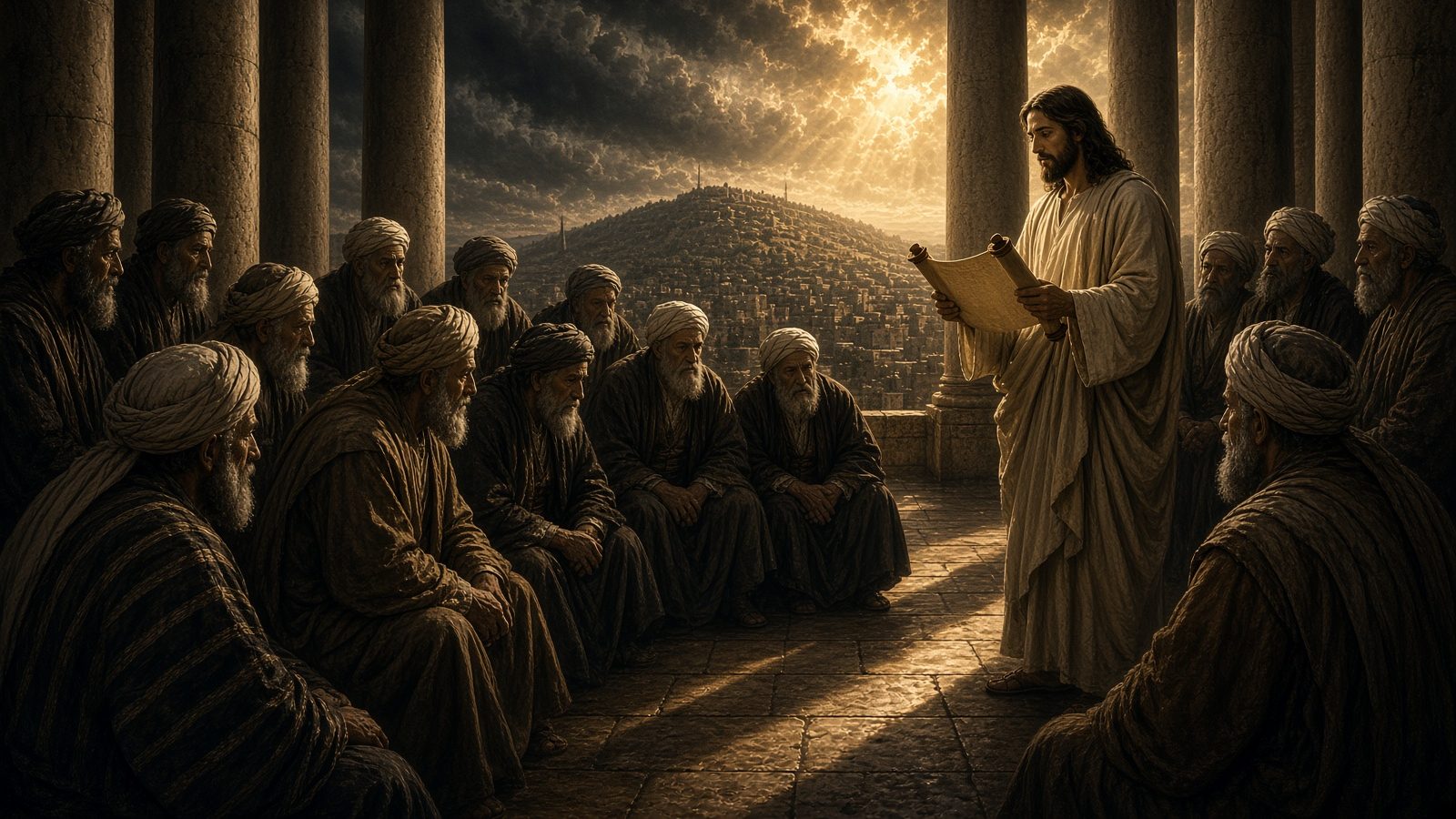
The prophets didn't bring new law. They brought the old covenant into court.
Most of us were taught to read the prophets for clues about our future, holding Isaiah up against the evening news to see how close we're getting. When I finally read them for myself, I found a prosecutor long before I found a fortune teller.
"Hear what the LORD says: Arise, plead your case before the mountains, and let the hills hear your voice. Hear, you mountains, the indictment of the LORD, and you enduring foundations of the earth, for the LORD has an indictment against his people, and he will contend with Israel" (Micah 6:1–2).
God was taking His own people to court. "Plead your case," "the indictment," and "an indictment" all come from one Hebrew word family, rîb, the word for bringing a case against someone, three times in two verses. "He will contend" stacks a second legal verb on top of it. Hosea 4 opens the same way: "the LORD has a controversy with the inhabitants of the land" (Hosea 4:1). Jeremiah uses it too: "I still contend with you, declares the LORD, and with your children's children I will contend" (Jeremiah 2:9). Scholars call this the covenant lawsuit. The label helps, but what you really need to know is what a covenant was in Moses' world. Over four posts I want to walk this case from the day it was filed to the day it closed.
The charges were written before Israel ever crossed the Jordan. When God made His covenant with Israel, He used a form the ancient world already knew. Kings made treaties with the nations under them. The treaty named the king, recited what he had done for them, laid down the terms, listed blessings for keeping it and curses for breaking it, and called witnesses. In the Hittite treaties of the late second millennium BC the witnesses were gods, and in one treaty the list closes with "the mountains, the rivers, the springs, the great Sea, heaven and earth, the winds (and) the clouds" (treaty of Mursili II with Duppi-Teshub). Israel had one God, so Moses called a different pair of witnesses, three times in Deuteronomy (4:26; 30:19; 31:28). Who they were, and what happened to them, is the next post.
Moses also put the covenant itself on the witness stand. God told him to write a song "that this song may be a witness for me against the people of Israel" (31:19), and "when many evils and troubles have come upon them, this song shall confront them as a witness" (31:21). The Book of the Law went "by the side of the ark of the covenant of the LORD your God, that it may be there for a witness against you" (31:26). The witnesses were sworn in and the charges written down before the case ever began. God told Moses how it would end.
The prophets read that covenant back to the people who swore to it. When a vassal broke faith, the king went back to the treaty he already had, and the prophets did exactly the same thing. Micah 6 has every part of it. The witnesses are summoned: "Hear, you mountains, the indictment of the LORD" (6:2). The plaintiff recites what he did for them: "O my people, what have I done to you? How have I wearied you? Answer me! For I brought you up from the land of Egypt and redeemed you from the house of slavery, and I sent before you Moses, Aaron, and Miriam" (6:3–4). The charges are read: dishonest scales, violence, lies (6:10–12). Then the sentence: "You shall eat, but not be satisfied … you shall sow, but not reap" (6:14–15), the covenant curses read back to them (compare Leviticus 26:26; Deuteronomy 28:38–40).
Psalm 50 holds the same court: "He calls to the heavens above and to the earth, that he may judge his people … O Israel, I will testify against you" (Psalm 50:4, 7). David Chilton, writing as a partial preterist, put it plainly: "To a man, the prophets were God's legal emissaries to Israel and the nations, acting as prosecuting attorneys" (The Days of Vengeance, p. 11). That changes how you read them. A prosecutor charges the people in front of him under a covenant they already agreed to. Even when the prophets looked far ahead, like Micah naming Bethlehem (5:2), the prediction came inside the case.
God kept the case open a long time. "I still contend with you … and with your children's children I will contend" (Jeremiah 2:9). Isaiah's first chapter moves from the charge to an offer: "Come now, let us reason together, says the LORD: though your sins are like scarlet, they shall be as white as snow" (Isaiah 1:18). "Reason together" is courtroom language too, a plaintiff offering terms before the verdict. Babylon was one sentence carried out under this covenant, and Samaria's fall to Assyria was another, but neither one closed the file. The song Moses wrote builds to vengeance (Deuteronomy 32:35, 41–43) and to the line Paul quotes, "Rejoice, O Gentiles, with his people" (Romans 15:10, from 32:43). After 586 BC the nations weren't rejoicing with anybody. Paul heard that line coming true in his own mission to the Gentiles (Romans 15:10), and the vengeance in the same verse fell on his generation. The final hearing was still ahead.
Then Jesus stepped into the same courtroom. Isaiah once sang about a vineyard. God planted it, fenced it, built a tower and a winepress, and it gave Him wild grapes. Then Isaiah turned to his hearers: "And now, O inhabitants of Jerusalem and men of Judah, judge between me and my vineyard" (Isaiah 5:3). He made the accused sit as the jury.
In the last week of His life, standing in the temple courts, Jesus told that story again. "There was a master of a house who planted a vineyard and put a fence around it and dug a winepress in it and built a tower" (Matthew 21:33). Each of those details comes from Isaiah's song (5:2, 5). This time the tenants beat the servants and kill the son. Jesus asks the jury, "When therefore the owner of the vineyard comes, what will he do to those tenants?" (21:40), and they pronounce the sentence on themselves: "He will put those wretches to a miserable death" (21:41). He answers, "the kingdom of God will be taken away from you and given to a people producing its fruits" (21:43). Matthew adds, "they perceived that he was speaking about them" (21:45).
Two chapters later He tells the scribes and Pharisees, "you witness against yourselves" (Matthew 23:31). Those words echo the day Israel renewed the covenant under Joshua: "You are witnesses against yourselves that you have chosen the LORD, to serve him. And they said, 'We are witnesses'" (Joshua 24:22). Then comes the sentence, with a date on it: "on you may come all the righteous blood shed on earth, from the blood of righteous Abel to the blood of Zechariah … Truly, I say to you, all these things will come upon this generation" (Matthew 23:35–36).
He even named the prosecutor. "Do not think that I will accuse you to the Father. There is one who accuses you: Moses, on whom you have set your hope" (John 5:45). The Book Moses set beside the ark as a witness against them was still on the stand. Stephen made the same case when the council put him on trial. He walked through Israel's whole history from Abraham to Solomon's temple (Acts 7:2–50), then read the charge: "you who received the law as delivered by angels and did not keep it" (7:53). They stoned him for it.
The verdict came in that generation. Jesus said when the sentence would fall and whose words it would fulfill. "When you see Jerusalem surrounded by armies, then know that its desolation has come near … for these are days of vengeance, to fulfill all that is written" (Luke 21:20, 22). "Vengeance" is the word of Moses' song: "Vengeance is mine, and recompense" (Deuteronomy 32:35). Paul quotes that line (Romans 12:19). Hebrews quotes it with the next one, "The Lord will judge his people," to readers who could "see the Day drawing near" (Hebrews 10:25, 30).
Revelation closes the file. The martyrs ask, "how long before you will judge and avenge our blood" (Revelation 6:10). The victors "sing the song of Moses, the servant of God, and the song of the Lamb" (15:3). When the city falls, the city I read as Jerusalem, heaven is told to celebrate: "Rejoice over her, O heaven, and you saints and apostles and prophets, for God has given judgment for you against her!" (18:20), because "in her was found the blood of prophets and of saints" (18:24). That's the charge Jesus read in Matthew 23, and Moses' song ends the same way: "he avenges the blood of his children" (Deuteronomy 32:43).
The lawsuit that opened on the plains of Moab closed in the generation Jesus named. God kept His covenant, the blessings and the curses, exactly as He said He would.
Where this is contestable. I'll grant that "covenant lawsuit" is a scholar's label, and some scholars question whether the prophets followed a fixed form. The legal words are in the text either way: plead, indictment, contend, witness, testify, judge. The prophets also predicted, and some of it reached well past their own day. Micah, the book this post opened with, names Bethlehem (5:2) and says that "in the latter days" peoples will flow to the house of the LORD (4:1). I read those latter days as the last days the apostles said they were living in (Hebrews 1:2; Acts 2:16–17), with the nations still flowing in today (more on that here). Reading Revelation's fallen city as Jerusalem is my reading too, and I make that case in Babylon is not America. I'm also not claiming AD 70 was the only sentence carried out under this covenant. My point is narrower. Jesus put the last hearing, and the blood of all the prophets, on His own generation (Matthew 23:36), and called it the days that would "fulfill all that is written" (Luke 21:22).
For anyone in Christ, the God who brought the charge also provided the defense. "Who shall bring any charge against God's elect? It is God who justifies" (Romans 8:33). The covenant that convicted Jerusalem was fulfilled by the One they crucified, and every charge the law could bring against you was answered at the cross.
The prophets were reading Moses back to the people who had sworn to keep it. Start there, before you hold them up to the evening news. When you read Isaiah, Micah, or Jeremiah this week, ask the prosecutor's question. Who is on trial here, and under what covenant?
Next, in part 2: Moses called heaven and earth to the witness stand. What happened to those witnesses when the case closed?