His feet already stood on the Mount of Olives. So did Rome's army.
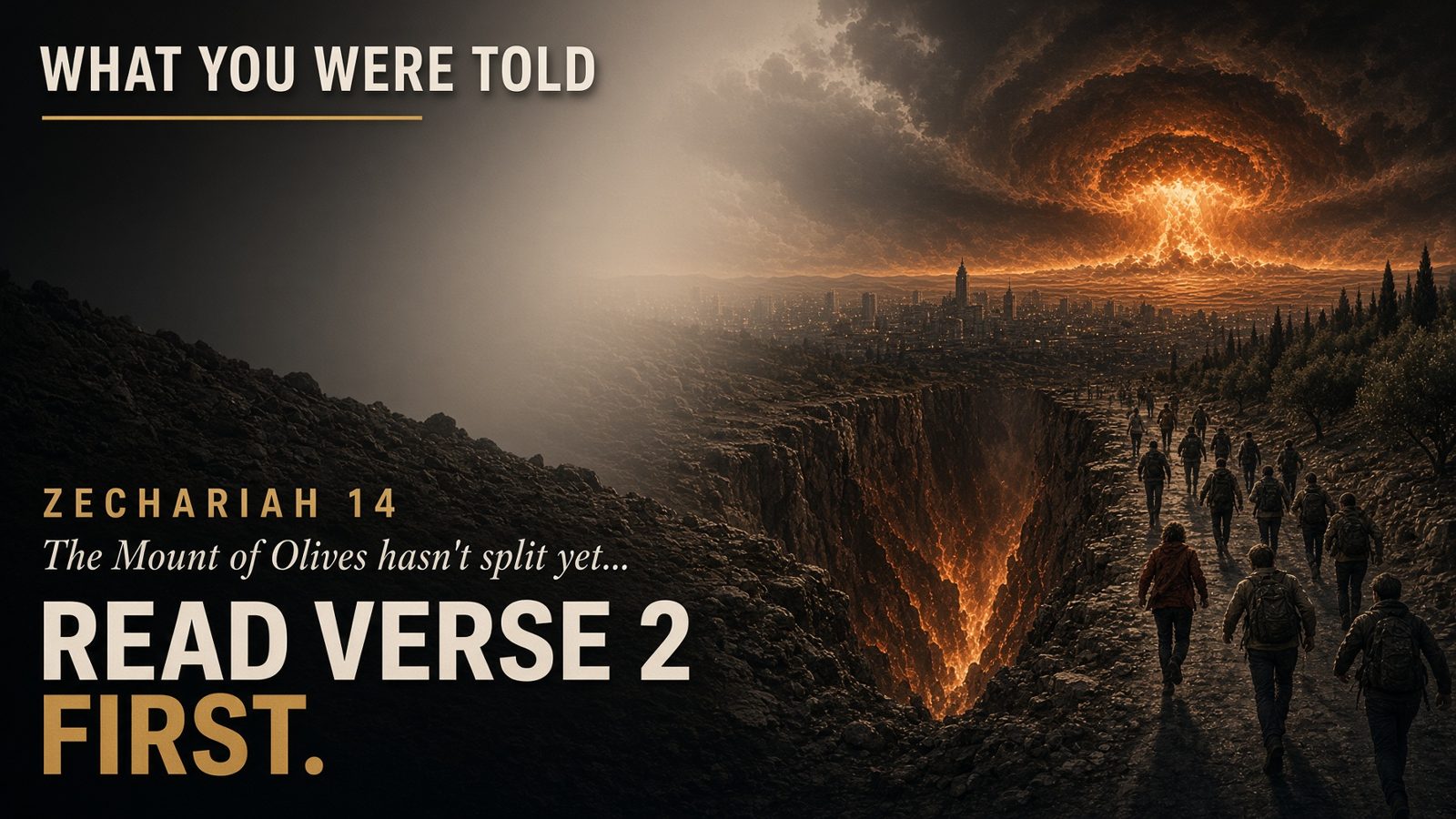
If you grew up on the end-times timeline, you know the verse. "On that day his feet shall stand on the Mount of Olives that lies before Jerusalem on the east, and the Mount of Olives shall be split in two from east to west by a very wide valley" (Zechariah 14:4). Put it beside Acts 1, where the disciples "returned to Jerusalem from the mount called Olivet" (Acts 1:12) after watching Him go, and you have the futurist's go-to verse: He left from that mountain, He will land on that mountain, and the mountain will split.
I'll grant that it's a strong-looking pair, and I'll grant something else up front. Verse 4 is the one verse in this chapter I can't settle with a history book. Before you plant a flag on it, though, read verses 1 through 3, and then follow Jesus across that ridge in the last week of His life.
Zechariah starts with Jerusalem falling. "Behold, a day is coming for the LORD, when the spoil taken from you will be divided in your midst. For I will gather all the nations against Jerusalem to battle, and the city shall be taken and the houses plundered and the women raped. Half of the city shall go out into exile, but the rest of the people shall not be cut off from the city" (Zechariah 14:1–2).
Zechariah 14 doesn't open with Jerusalem rescued. It opens with Jerusalem taken.
Any reading that puts verse 4 in our future has to put verse 2 there too: a coming sack of Jerusalem, homes looted, women raped, half the city marched away, all before His feet touch the mountain. Dispensationalists do put verse 2 in our future, as one last siege before Armageddon. I'll still ask: is that the future you're waiting for? I hope not, because I believe it already happened, and Jesus told His own generation it would. Even J. Dwight Pentecost, a dispensationalist, granted that the disciples who heard Jesus on the Mount of Olives took His words about the city's destruction as the destruction Zechariah described (Thy Kingdom Come, p. 248).
Jesus described that day to His own generation. "When you see Jerusalem surrounded by armies, then know that its desolation has come near. … They will fall by the edge of the sword and be led captive among all nations, and Jerusalem will be trampled underfoot by the Gentiles" (Luke 21:20, 24). That's Zechariah's sequence, the city surrounded and its people led captive, in Jesus' own mouth and inside "this generation" (21:32). Josephus counts 97,000 captives and says those over seventeen were sent in chains to the works in Egypt (Wars 6.9.2–3), the ending Moses had threatened: "the LORD will bring you back in ships to Egypt … and there you shall offer yourselves for sale to your enemies as male and female slaves, but there will be no buyer" (Deuteronomy 28:68). Josephus's numbers run high, and historians like Steve Mason discount them, but the sack and the slave markets are well attested.
"All the nations" is how the prophets spoke of an empire's army. Jeremiah used it of Babylon: "Nebuchadnezzar king of Babylon and all his army and all the kingdoms of the earth under his dominion and all the peoples were fighting against Jerusalem" (Jeremiah 34:1). Rome's army was built the same way, with legions drawn from across the provinces and auxiliaries sent by client kings, Antiochus, Agrippa, Sohemus, and Malchus among them (Josephus, Wars 3.4.2; 5.1.6).
Verse 3 is where the futurist leans hardest. "Then the LORD will go out and fight against those nations as when he fights on a day of battle" (14:3). In AD 70 Rome won, so how was the Lord fighting Rome? The Hebrew preposition usually reads "against" in a line like this, though George Klein notes the preposition commonly means "in" or "among," and the Septuagint and even Darby's translation read "fight with those nations." That's the minority reading, so I don't rest the case on a preposition. Isaiah gives the pattern without it. Assyria was "the rod of my anger," sent "against a godless nation," and only "when the Lord has finished all his work on Mount Zion and on Jerusalem" would He punish Assyria's king (Isaiah 10:5–6, 12). God fought Jerusalem with an empire, then judged the empire. Theodoret of Cyrus read verse 3 that way in the fifth century: the Lord arrays for battle, "not fighting for the Jews, but leading the army against them."
Now follow Jesus across the Mount of Olives. Zechariah 14:4 is the last time the Old Testament names the Mount of Olives. Robert Cruickshank noticed that Matthew 21:1 is the first time Matthew names it, and from that verse on, Jesus' last week never leaves Zechariah.
He comes down the Mount of Olives on a donkey, and Matthew says it happened "to fulfill what was spoken by the prophet" (Matthew 21:4–5, quoting Zechariah 9:9). On the way down that same slope He weeps over the city and tells it, "the days will come upon you, when your enemies will set up a barricade around you and surround you and hem you in on every side and tear you down to the ground, you and your children within you" (Luke 19:37, 41–44). That's Zechariah 14:2, announced from Zechariah 14:4's mountain.
Walking in from Bethany, on the far side of that ridge, He tells the disciples that if they say "to this mountain, 'Be taken up and thrown into the sea,'" it will happen (Matthew 21:21). F. F. Bruce, who was no preterist, saw what mountain He meant: "if Mark's setting is right, 'this mountain' could only have been the Mount of Olives, which, according to Zechariah xiv. 4, was to be cleft asunder on the Day of the Lord." Days later Jesus "sat on the Mount of Olives" and told the disciples the temple would fall before their generation passed (Matthew 24:3, 34).
After the Last Supper, "they went out to the Mount of Olives. Then Jesus said to them, 'You will all fall away because of me this night. For it is written, "I will strike the shepherd, and the sheep of the flock will be scattered"'" (Matthew 26:30–31). That's Zechariah 13:7, the line that opens the short unit (13:7–9) running straight into chapter 14, where the shepherd is struck, two-thirds of the land are cut off and one-third refined (13:8–9), and then the city is taken and half of it exiled (14:1–2). He quoted the first line of that sequence on the mountain where it ends. Forty days after the resurrection, He left from the same place (Acts 1:12).
None of that settles verse 4 by itself, and neither will the Roman legion I'm about to mention. What it shows is that when Jesus stood on the Mount of Olives, Zechariah 9–14 was the script He was reading, and what He read there was Jerusalem's fall in His own generation. Cruickshank's line is worth repeating: "Jesus plants His feet on the exact spot where Zechariah said He would as He redelivers Zechariah's message."
The earliest Christian readers went the same direction. Tertullian tied "at night He went out to the Mount of Olives" to "His feet shall stand in that day on the Mount of Olives" (Against Marcion 4.40). Eusebius read the feet as "the Word of God Himself" standing "firm, upon His Church, which is here metaphorically called the Mount of Olives," and the split mountain as the church spreading east and west through "the whole inhabited world" (Proof of the Gospel, Book VI). He read verse 4 more than one way, and none of his readings put it in the future.
In AD 70 an army camped on the same ridge. When Titus came to besiege the city in the spring of 70, he ordered the Tenth Legion "to encamp at the distance of six furlongs from Jerusalem, at the mount called the Mount of Olives, which lies over against the city on the east side" (Josephus, Wars 5.2.3). Zechariah's words were "the Mount of Olives that lies before Jerusalem on the east" (14:4). The defenders broke out and hit that camp, and Josephus says they put the legion to flight from it (5.2.4).
I'm not calling a Roman legion "his feet." The prophets described the LORD coming in judgment through an army He sent, the way Isaiah described Assyria, and in AD 70 the army God sent against the city camped where Zechariah put the Lord. Cyril of Alexandria said verse 4 "adopts the metaphor of a noble general" directing the fight, God "positioned in the ranks with the nations devastating Judea." Theodoret said that from the place where He was taken up into heaven, "he gives the victory to those who campaign against the Jews." Neither man needed a fault line.
Split mountains are how the prophets talk. Micah used the same picture for Samaria: "the LORD is coming out of his place, and will come down and tread upon the high places of the earth. And the mountains will melt under him, and the valleys will split open, like wax before the fire. … All this is for the transgression of Jacob" (Micah 1:3–5). Samaria fell to Assyria in 722 BC. Nobody saw feet, and the valleys stayed where they were.
Zechariah gives his own template in verse 5: "you shall flee as you fled from the earthquake in the days of Uzziah king of Judah." Amos dated his whole book by that quake, "two years before the earthquake" (Amos 1:1). Josephus preserves the Jewish memory of what it did outside the city: "before the city, at a place called Eroge, half the mountain broke off from the rest on the west, and rolled itself four furlongs, and stood still at the east mountain, till the roads, as well as the king's gardens, were spoiled by the obstruction" (Antiquities 9.10.4). Zechariah's hearers already carried a picture of half a mountain shearing off near Jerusalem and people running for their lives. He drew the coming day with a remembered one.
The point of the split is the valley, and the point of the valley is the way out: "you shall flee to the valley of my mountains" (14:5). Jesus gave the same instruction: "let those who are in Judea flee to the mountains" (Luke 21:21). Eusebius records that the Jerusalem church left before the war for Pella, across the Jordan (Church History 3.5.3), and Theodoret tied that flight to this chapter: "the faithful at that time left the city by a revelation," and "concerning these things he also prophesied through the blessed Zechariah." Some historians question the details of the Pella tradition, though the church's memory of obeying Luke 21 is old.
The verse ends, "Then the LORD my God will come, and all the holy ones with him." Jesus put that coming inside the lifetimes of the men in front of Him: "the Son of Man is going to come with his angels in the glory of his Father … there are some standing here who will not taste death until they see the Son of Man coming in his kingdom" (Matthew 16:27–28).
Verses 6 and 7 describe a day that was neither day nor night. "On that day there shall be no light, cold, or frost. And there shall be a unique day, which is known to the LORD, neither day nor night, but at evening time there shall be light" (14:6–7). Theodoret read this as the day of the cross, and so did Cyril of Jerusalem: "From the sixth hour there was darkness over all the land until the ninth hour" (Matthew 27:45). Noon went black, and by evening the light was back. Both men pointed to the cold of that same night, when Peter stood warming himself by a fire (John 18:18). No New Testament writer quotes verses 6 and 7, so here I'm following the early church, and I'd ask you to name a day in history that fits "neither day nor night" better.
The living water is already flowing. "On that day living waters shall flow out from Jerusalem" (14:8). In a ruling the Talmud preserves from the early rabbis, Zechariah 14 is the prophetic reading for the first day of the Feast of Booths (Babylonian Talmud, Megillah 31a). Nobody can prove that custom reaches back to Jesus' day, but the link between this chapter and this feast is old. On the last day of that feast Jesus stood up and cried out, "If anyone thirsts, let him come to me and drink. Whoever believes in me, as the Scripture has said, 'Out of his heart will flow rivers of living water'" (John 7:37–38). Scholars have hunted for the single verse He was quoting, and Maarten Menken concluded that Zechariah 14:8 is the passage that "best explains the final words of John 7:38." John tells us what it meant: "Now this he said about the Spirit, whom those who believed in him were to receive, for as yet the Spirit had not been given, because Jesus was not yet glorified" (7:39). Jesus has been glorified and the Spirit has been given, and the water has been flowing ever since.
"The LORD will be king over all the earth" (14:9) is what the risen Jesus claimed on another mountain: "All authority in heaven and on earth has been given to me" (Matthew 28:18). "The whole land shall be turned into a plain from Geba to Rimmon south of Jerusalem. But Jerusalem shall remain aloft on its site" (14:10). Isaiah used the same picture, "every valley shall be lifted up, and every mountain and hill be made low" (Isaiah 40:4), and Luke says that happened in John the Baptist's preaching (Luke 3:4–6) without anyone moving a shovel of dirt. Isaiah also saw the mountain of the LORD lifted "as the highest of the mountains" (Isaiah 2:2). Hebrews tells believers, "you have come to Mount Zion and to the city of the living God, the heavenly Jerusalem" (Hebrews 12:22). The city lifted above the land is the one we've already come to.
"There shall never again be a decree of utter destruction" (14:11) uses the word cherem, the thing devoted to destruction that Israel was forbidden to bring home (Deuteronomy 7:26), not the curse word of Genesis 3. The Greek Old Testament renders it anathema, and John uses a form of the same word for the city he saw: "No longer will there be anything accursed" (Revelation 22:3).
Why did Zechariah pick the Feast of Booths? He says the survivors of the nations will "go up year after year to worship the King, the LORD of hosts, and to keep the Feast of Booths" (14:16). Numbers 29 commands thirteen bulls on the first day of Booths, twelve on the second, and one fewer each day down to seven on the seventh, seventy in all. No other feast comes close. The rabbis knew why: "To what do these seventy bullocks correspond? To the seventy nations" (Babylonian Talmud, Sukkah 55b), the nations of the table in Genesis 10. I'll grant plainly that the link between the bulls and the nations is the rabbis' reading, not something Numbers says. Booths was already the feast where Israel's altar carried the nations, and when Zechariah wanted a picture of the nations coming to worship Israel's King, he chose the feast that had the nations built into it. John says the Word "became flesh and dwelt among us" (John 1:14), and the verb is "tabernacled." The fulfillment of Booths walked into the feast and offered the water.
As I read it, the penalty is covenant language. "If any of the families of the earth do not go up to Jerusalem to worship the King, the LORD of hosts, there will be no rain on them" (14:17), and Egypt is named (14:18). Moses told Israel its land "drinks water by the rain from heaven," unlike Egypt, "where you sowed your seed and irrigated it" (Deuteronomy 11:10–11). Verse 18 adds a plague for Egypt, and a literal reader can fairly say Zechariah knew Egypt doesn't live on rain and gave it a different penalty. I still read the rain the way Moses used the word, "May my teaching drop as the rain" (Deuteronomy 32:2). The nations that won't come up to worship the King go without His word.
The chapter ends with everything holy and the traders gone. "Holy to the LORD" was engraved on the plate of the high priest's turban (Exodus 28:36), and Zechariah puts it on horse bells and cooking pots (14:20–21), the common things made holy. Peter calls the whole church "a royal priesthood" (1 Peter 2:9). The same verse says "all who sacrifice may come," which is a problem for a literal future temple and not for me: "there is no longer any offering for sin" (Hebrews 10:18).
The last line is "there shall no longer be a trader in the house of the LORD of hosts on that day" (14:21). Jesus drove the traders out of that house. John records His words at the first cleansing: "do not make my Father's house a house of trade" (John 2:16). In His last week He cleared it again (Matthew 21:12–13). N. T. Wright, who is not a preterist, says there should be no doubt that Jesus knew this whole passage and saw it as "centrally constructive of his own vocation." Days after that second cleansing, He told the same building it would fall.
Verse 12 is the hardest verse in the chapter. "This shall be the plague with which the LORD will strike all the peoples that wage war against Jerusalem: their flesh will rot while they are still standing on their feet, their eyes will rot in their sockets, and their tongues will rot in their mouths" (14:12). Futurists love this verse. Rome's flesh didn't rot in AD 70, so whose did?
Look at who made war on Jerusalem from inside her own walls. The Zealots opened the gates to an Idumean army, and it killed the chief priests Ananus and Jesus and thousands of the city's people (Josephus, Wars 4.5.1–3). Josephus called Ananus's death "the beginning of the destruction of the city." Then the city "parted into three factions, and one faction fought against the other" (Wars 5.1.1). John of Gischala and Simon bar Giora set fire to "those houses that were full of corn," grain "which would have been sufficient for a siege of many years," and "they were taken by the means of the famine" (Wars 5.1.4). As I read verse 12, those were the peoples making war on Jerusalem, and they wasted away inside her. That's contestable, since the "peoples" of verse 2 are the armies outside the walls. Verse 13 follows right on: "the hand of one will be raised against the hand of another." Then verse 14: "Even Judah will fight at Jerusalem."
Gary DeMar and Robert Cruickshank both land on the famine inside the city, and their history on it is the best I've read. Cruickshank gets there through the Hebrew preposition, reading "on account of Jerusalem." I don't need that step. Isaiah uses the same words for the nations "that fight against Mount Zion" (Isaiah 29:8), so I keep "against" and let Josephus tell us who was fighting. Theodoret read verse 12 differently. He jumped to Gog and Magog, a later army struck down while Israel plundered it. If you read verse 12 as a blow on the army that attacked the city, verse 3 already gave the answer: God judges the rod after He's done using it, the way He judged Assyria.
The church never had one reading of Zechariah 14, and I won't pretend it did. Ephraem the Syrian and Theodore of Mopsuestia read most of it as the Maccabean wars. Luther wrote, "In this chapter, I give up, for I am not sure what the prophet is talking about." Others read it in the first century. Eusebius said Zechariah was "foretelling the final siege of the people by the Romans," and Didymus the Blind, Cyril of Alexandria, and Theodoret read its opening the same way. None of them were preterists, and Eusebius and Theodoret both looked for a future appearing of Christ. The first-century reading isn't a modern invention, and it was never a consensus either.
Where this is contestable. A futurist will put Acts 1:11–12 beside 14:4, and that's his strongest pairing. My answer is that Acts 1 doesn't cite Zechariah, Zechariah puts the city's fall before the feet, and the angels' "in the same way" points to the cloud Luke had already dated inside "this generation" (Luke 21:27, 32). The fuller answer is on the Tough Verses. The chapter has its own hard spots too. Verse 2 says "the rest of the people shall not be cut off from the city," and AD 70 left no one standing in it. I read that remnant with Theodoret, as the faithful who got out before the siege. Verse 14 says "the wealth of all the surrounding nations shall be collected," and DeMar and Cruickshank read it as the plunder and pay piling up in the Roman camp while the city starved (Josephus, Wars 5.9.1). A futurist will say I'm reading the city as earthly Jerusalem in some verses and the heavenly one in others. He has a point, and my answer is that the chapter moves from judgment (verses 1 to 15) to worship (16 to 21), and the nations come up to a different city than the one that fell. Last, verses 9 and 16 do not describe a finished utopia in AD 70. "Year after year" is a kingdom still growing, the way Isaiah's mountain grows (Isaiah 2 on the Tough Verses). This is the most faithful way I know to read the chapter, and I'll change my mind for a better one from the text.
Much of the verse-by-verse work here follows Gary DeMar and Robert E. Cruickshank Jr., Making Prophetic Sense of Zechariah 14 (American Vision, 2026), which is where the Tertullian, Eusebius, Theodoret, Didymus, both Cyrils, Bruce, Menken, Wright, Pentecost, and Luther citations come from, as quoted there. DeMar calls himself a partial preterist (he has declined the "three questions" but rejects the full-preterist label), and I cite him for this chapter, not for everything on this site. I cite Cruickshank for Zechariah, not for the resurrection. Timothy Gray noticed the Zechariah cluster around Mark 14:26–28. Cruickshank raised the seventy bulls, and the Egypt-and-rain point is George Klein's. The Tenth Legion, Luke 19 from the Mount of Olives, Isaiah 29:8, the Idumeans and factions in verse 12, and the Sukkah 55b source and count are my own additions. Check them.