Acts 1: They expected Him to restore the kingdom of Israel.
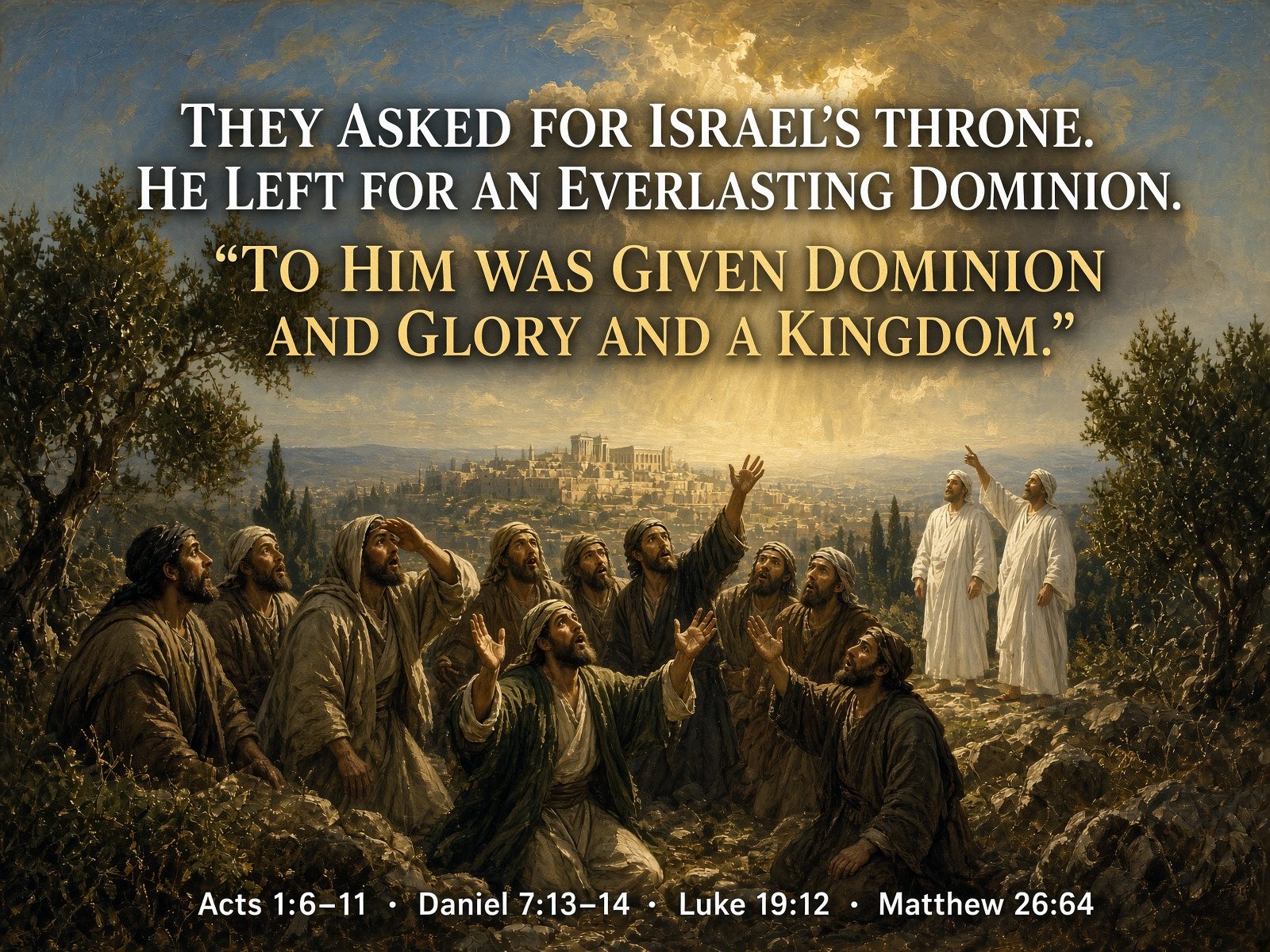
For forty days the risen Christ taught His disciples, and Luke tells us exactly what about: "speaking about the kingdom of God" (Acts 1:3). Then they gathered on the Mount of Olives and asked their question: "Lord, will you at this time restore the kingdom to Israel?" (1:6). Think about why they'd ask that. They didn't expect Him to leave. They expected Him to reign, physically, from Jerusalem.
He had been teaching them about the kingdom of God the entire time, and they were still asking about the kingdom of Israel. A throne in Jerusalem, Rome thrown out, David's house back in charge. Jesus had already told Pilate that wasn't the kingdom: "My kingdom is not of this world. If my kingdom were of this world, my servants would have been fighting" (John 18:36).
Luke tells the same story twice. A reader pointed me to the first telling, and it's the Emmaus road. Two disciples, three days after the cross, say to the stranger walking with them, "we had hoped that he was the one to redeem Israel" (Luke 24:21). Forty days later on the Mount of Olives, the eleven ask, "will you at this time restore the kingdom to Israel?" Same hope, same misunderstanding, same author. Look how Jesus answered on the road: "Was it not necessary that the Christ should suffer these things and enter into his glory?" (24:26). Not to take a throne in Jerusalem; to enter His glory. Then, "beginning with Moses and all the Prophets, he interpreted to them in all the Scriptures the things concerning himself" (24:27). They weren't wrong to hope for Israel's redemption. They were wrong about what it would look like, and He had already told them when it would come: "when these things begin to take place, straighten up and raise your heads, because your redemption is drawing near" (21:28), in the same discourse as the armies around Jerusalem. The line I love most: "Did not our hearts burn within us… while he opened to us the Scriptures?" (24:32). That's still how He's recognized.
He didn't give them a date for the kingdom they wanted. He gave them a job for the kingdom they had: "you will receive power when the Holy Spirit has come upon you, and you will be my witnesses in Jerusalem and in all Judea and Samaria, and to the end of the earth" (1:8). That was the answer to "restore the kingdom to Israel." Not a throne in Jerusalem; a witness going out from it.
Then He left. "As they were looking on, he was lifted up, and a cloud took him out of their sight" (1:9). They stood there "gazing into heaven as he went" (1:10).
They had been told what this scene was. Daniel saw it six centuries earlier: "with the clouds of heaven there came one like a son of man, and he came to the Ancient of Days and was presented before him. And to him was given dominion and glory and a kingdom… his dominion is an everlasting dominion" (Daniel 7:13–14). Read the direction. The Son of Man comes to the Ancient of Days, on clouds, to receive a kingdom. That's not a landing. It's a coronation. The cloud on the Mount of Olives didn't take Him away from His kingdom. It took Him to it.
He had even told them the story. Near Jerusalem, "because they supposed that the kingdom of God was to appear immediately," He told a parable: "A nobleman went into a far country to receive for himself a kingdom and then return" (Luke 19:11–12). His citizens said, "We do not want this man to reign over us" (19:14). When he returned, kingdom in hand: "as for these enemies of mine, who did not want me to reign over them, bring them here and slaughter them before me" (19:27). He went away to receive the kingdom. He came back to judge the ones who refused it. Luke puts Jesus weeping over Jerusalem's coming siege in the very next scene (19:41–44), so nobody could miss who the enemies were.
Now the verse everybody quotes. Two men in white said to the disciples, "This Jesus, who was taken up from you into heaven, will come in the same way as you saw him go into heaven" (1:11). In the same way. Look at the way: "a cloud took him out of their sight." He left in a cloud, hidden. He had already told them how He'd come: "you will see the Son of Man coming on the clouds of heaven with power and great glory" (Matthew 24:30), and to the high priest, "from now on you will see the Son of Man seated at the right hand of Power and coming on the clouds of heaven" (26:64). The cloud is the manner. Up in the cloud to receive the kingdom, back in the clouds to judge, the way the LORD "is riding on a swift cloud and comes to Egypt" (Isaiah 19:1), and nobody in Egypt saw a body in the sky. They saw the judgment.
What about "it is not for you to know times or seasons" (1:7)? That's His answer to the Israel question, the restored national kingdom they were asking about. He had already given them the window for His coming, and they'd heard it with their own ears: "there are some standing here who will not taste death until they see the Son of Man coming in his kingdom" (Matthew 16:28). "You will not have gone through all the towns of Israel before the Son of Man comes" (10:23). "This generation will not pass away until all these things take place" (24:34). They didn't know the day. They knew the generation.
Did He abandon them in between? No. "I am with you always, to the end of the age" (Matthew 28:20). Not in the flesh, by His Spirit: "it is to your advantage that I go away, for if I do not go away, the Helper will not come to you" (John 16:7). "I will not leave you as orphans; I will come to you" (14:18).
Where this is contestable. "In the same way" stresses manner, and the manner included "as they were looking on" (1:9). The futurist's best line is "they watched Him rise, so they must watch Him descend." My answer is that the watching was promised to the generation that watched Him go, "from now on," and Jesus defined it as seeing the Son of Man come while Caiaphas was alive. That's the way I read it, inside the timing He gave. I'll say plainly it's the hardest verse for my view, and I don't rest the case on it.
He went up in the cloud to receive the kingdom. He came back in the clouds when Jerusalem fell, inside the generation He named. He didn't lie. They misunderstood, and so have we. They wanted a kingdom of Israel. He gave them the kingdom of God, "a kingdom that cannot be shaken" (Hebrews 12:28), and John heard the announcement: "The kingdom of the world has become the kingdom of our Lord and of his Christ, and he shall reign forever and ever" (Revelation 11:15).
They asked the wrong question. He gave them the answer we still ignore today.