A king in Jerusalem would be a downgrade. Jesus said so.
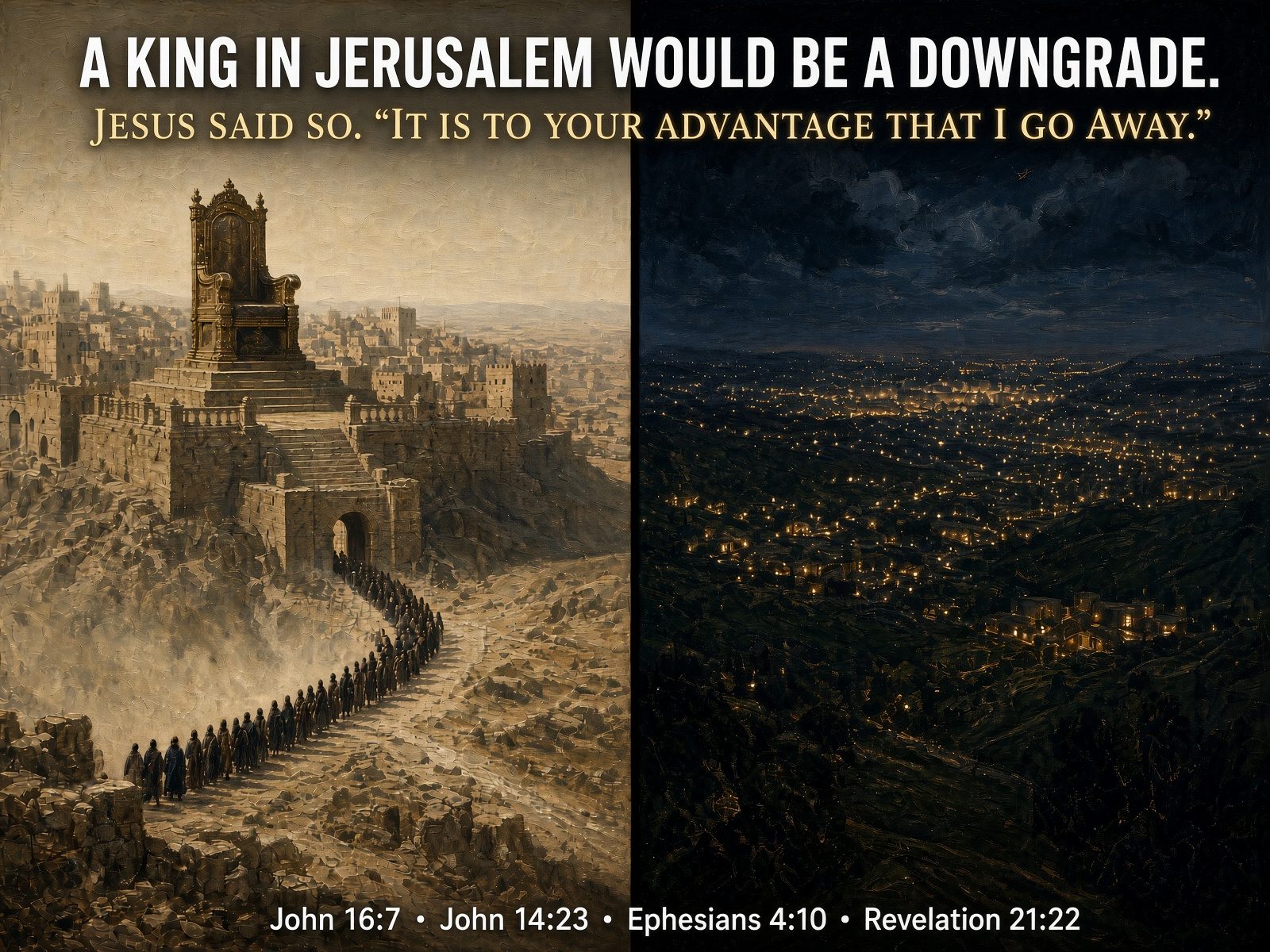
"It is to your advantage that I go away." If His going was the gain, His coming back to one city would be the opposite.
A commenter named Ryan made a great point on one of my posts last week that I'd never heard anyone make, and it might be the strongest practical case against a future earthly reign in the whole Bible. I read past it at first, and then my wife mentioned the depth of what she took from it, and it blew my mind. It goes like this. Jesus said it was better for us that He leave. She added: so why are we praying for Him to come back and sit on a throne in one city? I was a bit stunned.
Here's the verse. "I tell you the truth: it is to your advantage that I go away, for if I do not go away, the Helper will not come to you. But if I go, I will send him to you" (John 16:7). Read it as the disciples heard it. The man they'd followed for three years, who healed with a touch and taught like no one else, told them it was to their advantage that He leave. An advantage. Better. He didn't use the word "downgrade." He used the word "advantage," but the math is the same: if His going was the gain, His coming back to one city would be the opposite.
Then He told them what the Helper's coming would mean. "I will not leave you as orphans; I will come to you" (14:18). "If anyone loves me, he will keep my word, and my Father will love him, and we will come to him and make our home with him" (14:23). The Spirit's coming is how Jesus and the Father come to live in a person. That is a presence in every believer, on every continent, at the same moment. A body on a throne in Jerusalem can't be that. It can be in one place, and everybody else has to travel to Him.
Paul says the ascension was for exactly this. "He who descended is the one who also ascended far above all the heavens, that he might fill all things" (Ephesians 4:10). He went up in order to fill everything. A throne in one city is the opposite of filling all things. Paul had already stopped thinking of Him as a body in a place: "even though we once regarded Christ according to the flesh, we regard him thus no longer" (2 Corinthians 5:16).
He'd told a Samaritan woman where this was going. She asked which mountain was the right one for worship, and He said, "the hour is coming when neither on this mountain nor in Jerusalem will you worship the Father… the true worshipers will worship the Father in spirit and truth" (4:21, 23). Under the old covenant you went to a place. Under the new covenant, you are the place. "Do you not know that you are God's temple and that God's Spirit dwells in you?" (1 Corinthians 3:16). "We are the temple of the living God" (2 Corinthians 6:16). Paul told the Athenians, standing in a city of temples, that God "does not live in temples made by man" (Acts 17:24). When John finally sees the finished city, "I saw no temple in the city, for its temple is the Lord God the Almighty and the Lamb" (Revelation 21:22). "Behold, the dwelling place of God is with man" (21:3). With man. Not in a building man has to visit every year.
Hebrews tells you where He went when He left. "Christ has entered, not into holy places made with hands… but into heaven itself, now to appear in the presence of God on our behalf" (9:24). He's seated "at the right hand of the throne of the Majesty in heaven, a minister in the holy places, in the true tent that the Lord set up" (8:1–2). That's the throne. It's the one from which He can be present everywhere, because it isn't anywhere you could buy a ticket to.
Look at what the future-reign systems tell you to want. Christ back in one city. A rebuilt temple. Sacrifices resumed. Nations required to make a yearly pilgrimage to Jerusalem to keep a feast. A King you have to go see. Every one of those is a thing He dismantled or declared finished: the place, the building, the sacrifices, the pilgrimage. The system doesn't just add a thousand years to the story. It reverses the direction of the story, back to a presence in one location, after He told us the presence in every heart was the advantage. The Bible doesn't give us a physical-to-spiritual-and-back-to-physical fulfillment.
I'll put it the way Ryan put it, as a question my wife helped me ask. If Jesus said His going was to our advantage because it meant the Spirit in us, why would we pray for the arrangement He said was less? Why would we want Him back behind a veil, in a city, when He told the woman at the well the hour was coming when the city wouldn't matter, and then made the hour come?
Where this is contestable. Someone will say He can reign in a glorified body in Jerusalem and be everywhere by the Spirit at the same time; if so, the throne in Jerusalem adds nothing He doesn't already have from heaven, which is my point. Someone will cite Zechariah 14:16, the nations going up to Jerusalem to keep Tabernacles; that chapter gets its own post, because that argument requires a temple, a return to a sacrificial system, and an altar, but today's answer is John 4:21. Someone will cite Ezekiel's temple with its sacrifices; Ezekiel 45:15 and 17 say those sacrifices "make atonement," and Hebrews says "there is no longer any offering for sin" (10:18), so one of those has to give. No, I'm not denying that Christ has a body. He does. It's at the right hand of God in heaven (Hebrews 8:1), which is where Scripture says it does the most good.
He didn't leave us. He left the city so He could be in every room. "I am with you always" (Matthew 28:20) wasn't a promise about a future physical visit. It was a description of what He'd just done and would continue to do.
A throne in Jerusalem would be a smaller thing than what we have. He came for a much bigger purpose.