What about Grandma?
This is a five-part study, all in one place and in order: the hour, the last day, where the dead were, what kind of body, and Grandma.
Part 1 · The hour
WHO TOLD YOU JOHN 5:28 WAS ABOUT THE END OF THE WORLD?
I read insurance policies for a living. A word, a comma, even a semicolon changes the meaning. You learn to slow down and read what's actually on the page.
Then one day I read John 5 that way.
You know the verse. "An hour is coming when all who are in the tombs will hear his voice and come out" (John 5:28-29). We were all taught the same thing. End of the world. Graves popping open. Someday.
Did anybody ever show you the verse three lines above it?
"An hour is coming, and is now here, when the dead will hear the voice of the Son of God, and those who hear will live" (5:25).
Did you catch it? He says "an hour is coming" twice, and the first time He adds "and is now here."
TWO HOURS. One was already happening while He stood there. He'd just said what it was. Whoever hears Him and believes has already "passed from death to life." People who had never been near a grave were coming alive right in front of Him. That hour is still going. It's how you and I got here.
The other one hadn't started. That's the tombs.
How far off was it? A few years? Two thousand?
He'd talked this way before. One chapter back, at the well, He tells a Samaritan woman an hour is coming when she won't worship the Father on that mountain or in Jerusalem. Then He says an hour is coming "and is now here" when true worshipers worship in spirit and truth (4:21, 23). Same two phrases. One already started and one still ahead. The Jerusalem one has a date on it. That temple was gone in about forty years.
He does it again the night before the cross. An hour is coming when men will kill His disciples and think they're serving God (16:2). Paul says he was that man, zealous for God and hunting Christians to the death (Acts 22:3-4). An hour is coming when His friends will scatter (16:32). That was the same night.
I couldn't find one that took two thousand years to start. Could you?
The word "hour" doesn't settle it alone. In John it usually points at the cross, and an hour can last a long time. The one in verse 25 is still running.
What settles it for me is that Jesus put a date on this somewhere else. In John 5 He says the Father gave Him authority to judge "because he is the Son of Man" (5:27). In Matthew the Son of Man comes "with his angels in the glory of his Father" to "repay each person according to what he has done." Same title, same job. Then He says when. "There are some standing here who will not taste death until they see the Son of Man coming in his kingdom" (Matthew 16:27-28).
Some standing here!
John wrote to his own churches, "Children, it is the last hour" (1 John 2:18). He says it twice in one verse. Same John.
"It says TOMBS, Matt!" You're right. It does. A few chapters later Jesus stands at a real tomb, shouts "Lazarus, come out," and a real body walks out. That sounds like bodies and I can't make it sound like anything else. What kind of rising this is gets its own part below. Here I'm only asking about the timing.
If He told people standing in front of Him that some of them would live to see it, who moved it two thousand years?
Verses in this part: John 5:24-29 · John 4:21, 23 · John 16:2, 32 · Acts 22:3-4 · Matthew 16:27-28 · 1 John 2:18 · John 11:43-44
Part 2 · The last day
JESUS CORRECTED MARTHA. WE’RE STILL GIVING HER ANSWER.
Lazarus has been dead four days. The house is full of mourners. Martha hears Jesus is coming and goes out to meet Him, and the first thing out of her mouth is, "Lord, if you had been here, my brother would not have died."
Jesus tells her, "Your brother will rise again."
Martha gives the Sunday school answer. "I know that he will rise again in the resurrection on the last day" (John 11:24).
She'd been taught that. Me too. You too.
The last day of WHAT?
We fill in that blank without thinking. The last day of the world! The last day of time! Go look for those words in John. They aren't there. The one time John finishes the sentence, it's "the last day of the feast" (7:37). A last day is the last day OF something.
What were they living at the end of? Ask them. The disciples asked Jesus about "the end of the age" right after He told them the temple was coming down. Paul told the Corinthians the end of the ages had come on them. Hebrews opens with "in these last days." Were all of those men confused?
Daniel says it as clearly as anybody. He's told that many who sleep in the dust will wake up, "some to everlasting life, and some to shame and everlasting contempt" (Daniel 12:2). Somebody asks how long, and he gets an answer. "When the shattering of the power of the holy people comes to an end all these things would be finished" (12:7). Daniel is told he'll rest and stand in his place "at the end of the days."
It's the same day as the tombs, too. In John 5 Jesus says He seeks the will of the One who sent Him. In John 6 He picks those very words back up and tells us what that will is, to raise them up on the last day (5:30 and 6:38-39). He says He'll raise them up on the last day four times in that chapter.
Here's what I know. The temple, the priesthood, the sacrifices, that whole world Moses built, had a last day. Jesus said the dead would rise on it.
THE LAST DAY OF THE OLD COVENANT AGE. That's my answer.
Now go back to Martha, because Jesus doesn't let her answer stand. She gave Him one group and one day. He hands her back two.
"Whoever believes in me, though he die, yet shall he live, and everyone who lives and believes in me shall never die" (11:25-26).
The believer who died will live. The believer who is alive will never die. Why two? If He meant one thing, He said it twice in a row.
I think He split it on purpose. There's a before and an after. Everyone who died up to that day was raised on it. Everyone who believes after it never goes where they went. I can't prove that from this one verse. Most teachers don't see two groups there, and He doesn't say "after the last day." I still think it's why He answered her that way.
Which leaves me a hard question. Jesus said everyone who believes in Him gets raised on the last day (6:40). I believe in Him. Was MY last day in AD 70?
I'll answer that before we're done. First we have to find out where the dead were.
Verses in this part: John 11:17-26 · John 7:37 · Matthew 24:1-3 · 1 Corinthians 10:11 · Hebrews 1:2 · Daniel 12:2, 6-7, 13 · John 5:30 · John 6:38-40, 44, 54
Part 3 · Where the dead were
KING DAVID WASN'T IN HEAVEN?!
Peter said it. Day of Pentecost, preaching to a crowd in Jerusalem.
"Brothers, I may say to you with confidence about the patriarch David that he both died and was buried, and his tomb is with us to this day." A few lines later, "David did not ascend into the heavens" (Acts 2:29, 34).
Try that at a funeral!
I have always been taught that a believer immediately goes to heaven to be with Christ after we die.
"Then where was David?"
Where the Old Testament says the dead went. Sheol. The Greek word is Hades. Jacob thought his boy was dead and said he'd go down to Sheol to him (Genesis 37:35).
"That's the Old Testament."
Jesus told about a rich man in Hades, in torment, looking across at a poor man being comforted at Abraham's side (Luke 16:22-25). He told Nicodemus, "No one has ascended into heaven except he who descended from heaven, the Son of Man" (John 3:13).
"That's a parable!"
Maybe it is. He still built it out of what they believed about the dead.
"They were just stuck down there?"
Waiting. Hebrews says Abraham and the rest "did not receive what was promised," because God had "something better for us, that apart from us they should not be made perfect" (11:39-40). They were waiting on us!
"Christians don't go to Hades."
What does the Bible say about the first ones who died? Paul calls them asleep. He wanted to depart and be with Christ himself. John sees the martyrs asking "how long?" and they're told to rest "a little longer," UNTIL (Revelation 6:10-11). With Christ, and still told to wait. When the day comes, it's "Death and Hades" that give up the dead. I say both because the Bible says both. I can't draw you a map of it.
"Then what changed?"
Jesus told John, "I have the keys of Death and Hades" (Revelation 1:18). What's a key for? Later John sees it happen. "Death and Hades gave up the dead who were in them" (20:13).
In between, a voice from heaven. "Blessed are the dead who die in the Lord from now on" (14:13). The martyrs got an "until." These don't. I think the waiting was over. The verse doesn't say that in so many words.
Now go back to what I was taught. We go straight to heaven when we die, and we wait there for the resurrection. The martyrs were told "a little longer." Is two thousand years a little longer? If David still isn't raised, we aren't either. If the wait is over, then Christ already returned, and the faithful dead, the believers and the martyred saints were all raised when He did.
"That's not what the church has always taught!"
No, it isn't. I know which side of that count I'm on.
"David's bones are still in that tomb."
They are. Grandma's are still in hers.
Verses in this part: Acts 2:29-34 · Genesis 37:35 · Luke 16:19-31 · John 3:13 · Hebrews 11:39-40 · 1 Thessalonians 4:13-16 · Philippians 1:23 · Revelation 6:9-11 · Revelation 1:18 · Revelation 14:13 · Revelation 20:13
Part 4 · What kind of body
"THEN WHY IS GRANDMA STILL IN THE CEMETERY?"
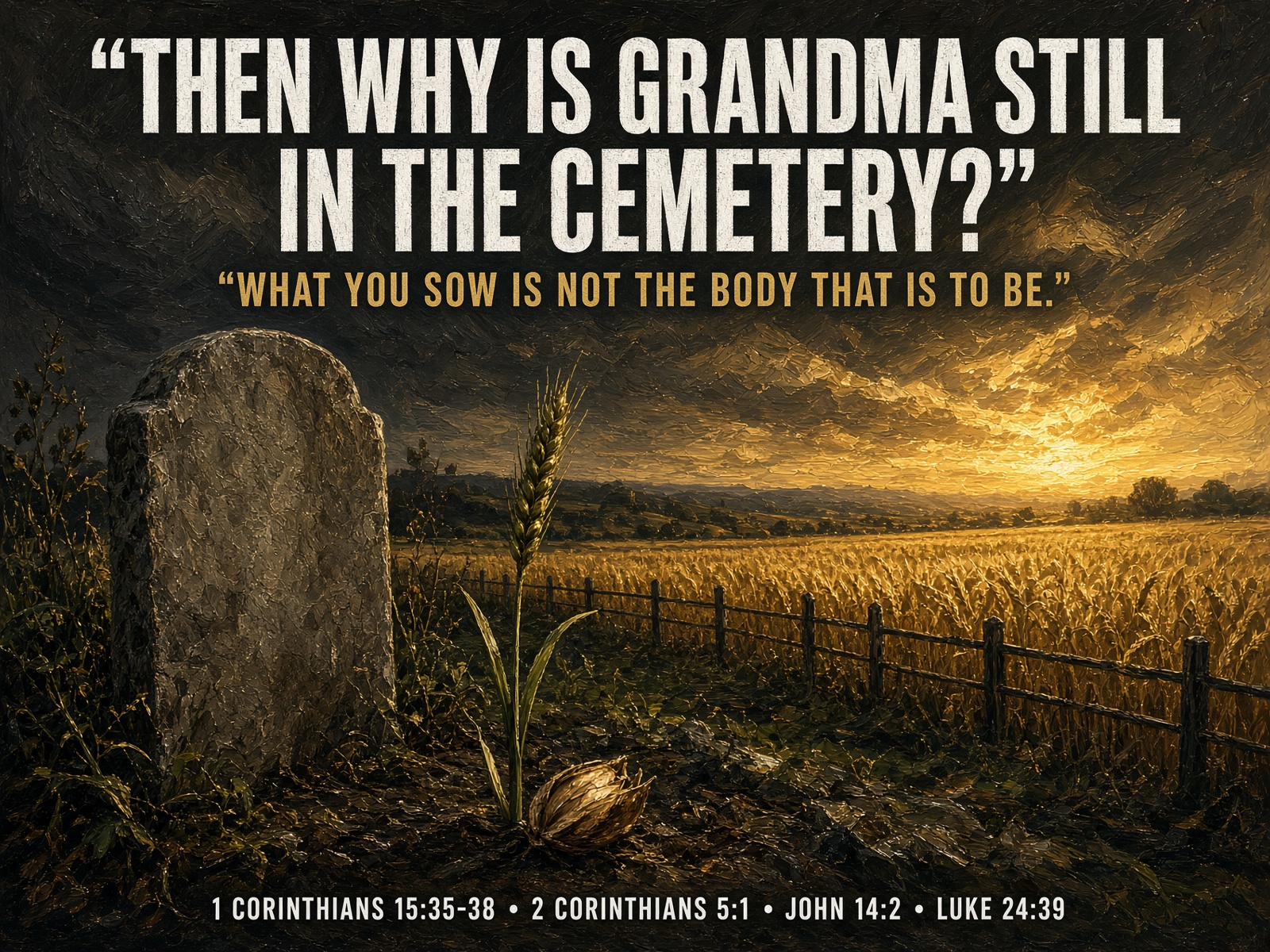
It's usually a question from someone who thinks that because the resurrection is past, we missed it and we have nothing to look forward to. "What about Grandma?" or "What about my dead son or husband?" "Will I ever see them again?" Oh my goodness, the depth of this, and boy does the answer sure make them feel better!
Jesus's body left the tomb. Grandma's hasn't. David's hasn't. If the dead were raised, shouldn't the cemeteries be empty?
Paul says Christ "will transform our lowly body to be like his glorious body" (Philippians 3:21). He says "this mortal body must put on immortality" (1 Corinthians 15:53). He says God "will also give life to your mortal bodies" (Romans 8:11). He calls Jesus the firstfruits, and the firstfruits walked out of a grave and left it empty.
Most of the church reads those verses of this same body, raised someday. Christ's empty tomb is their best reason.
Read each one where Paul put it.
Start with Philippians. Ten verses before "our lowly body," Paul tells you how he expects to get the glorious one. "Becoming like him in his death, that by any means possible I may attain the resurrection from the dead" (3:10-11). Death first. Then glory.
Romans 8:11 says God will "give life" to your mortal bodies. That's the word Paul uses for a seed. "What you sow does not come to life unless it dies" (1 Corinthians 15:36). He says the life comes "through his Spirit who dwells in you." The Spirit is the down payment (2 Corinthians 5:5). The body is what the down payment is on.
What about the firstfruits? Peter and Paul both prove Jesus rose by pointing at a body that did not decay, and a critic will turn that test on every grave. It's a fair push. Scripture says His body was the exception. David "saw corruption, but he whom God raised up did not see corruption" (Acts 13:36-37). David's body saw corruption. So does every body we bury. That's the seed dying.
Paul knew somebody would ask this exact question, and he answered it. "How are the dead raised? With what kind of body do they come?" He says look at a seed. "What you sow is not the body that is to be." God gives it a body as He chooses (1 Corinthians 15:35-38).
NOT THE BODY THAT IS TO BE. Paul said that!
He keeps saying "it is sown" and "it is raised" (15:42-44). I believe the "it" is the person. One seed, one plant. Grandma was sown. Grandma is raised. God gives her a body. That's why the grave isn't empty. What's in it is the seed.
What about the tombs in John 5? I believe Jesus meant the dead themselves, hearing His voice and coming out of Hades, where Part 3 left them. Lazarus was the sign in front of their eyes that His voice reaches the dead. Lazarus came back to the same life in the same mortal body. That wasn't the body that is to be either.
"It is raised a spiritual body." Wait!!! Spiritual doesn't mean ghost. Jesus said, "Touch me, and see. For a spirit does not have flesh and bones as you see that I have" (Luke 24:39). He ate fish in front of them. A spiritual body is real. It's run by the Spirit and it can't die. What's it made of? Paul didn't say, and I'm not smarter than Paul.
When does she get it? Paul says if this tent is torn down "we have a building from God, a house not made with hands, eternal in the heavens" (2 Corinthians 5:1). He didn't want to be "found naked." Paul wrote that before the day came. The ones who died before it waited, and Revelation says so. I believe that wait ended when the day came. No single verse says "at death" in one sentence. I'm putting Paul's tent next to the "little longer" the martyrs were given and the "from now on" John heard.
Where is she? Jesus said, "In my Father's house are many rooms," and that He was going to get a place ready (John 14:2). In our English Bibles the only other time He says "my Father's house" in John, He's standing in the temple. God's house. He said He'd come back and take them to Himself. Another Judas, not Iscariot, asked why the world wouldn't see it, and Jesus said He and the Father would come and make their home with the one who loves Him (14:22-23). In the Greek, "home" is the same word as "rooms." One house. We're brought into it here, where the world can't see it. When the tent comes down we go further in, to be with Him where He is and see His glory.
What about the ones who were alive that day? Paul said, "We shall not all sleep, but we shall all be changed" (1 Corinthians 15:51). Some of them would still be breathing when the trumpet sounded. Nobody's body changed in AD 70. The church was still on the ground the next morning. What changed? They had borne the image of the man of dust. Now they bore the image of the man of heaven (15:49). Out of Adam and into Christ! Death changed too. Before that day a believer who died slept and waited. After it, "though he die, yet shall he live, and everyone who lives and believes in me shall never die" (John 11:25-26). "The sting of death is sin, and the power of sin is the law" (15:56), and the sting was gone. The body came the way Paul said it had to. "What you sow does not come to life unless it dies" (15:36). I'm settled on the timing. Paul's next words, "this mortal body must put on immortality," sound like the body, and most people read them that way. This is where my view gets pushed the hardest.
Grandma has a body. A real one. She has it now.
Verses in this part: Philippians 3:20-21 · 1 Corinthians 15:20, 35-38, 42-44, 51-56 · Romans 8:11 · John 5:28-29 · John 11:43-44 · Luke 24:39-43 · 2 Corinthians 5:1-4 · Revelation 6:11 · Revelation 14:13 · John 2:16 · John 14:2-3, 19-23 · John 17:24
Part 5 · Grandma
SHE ISN'T WAITING!!
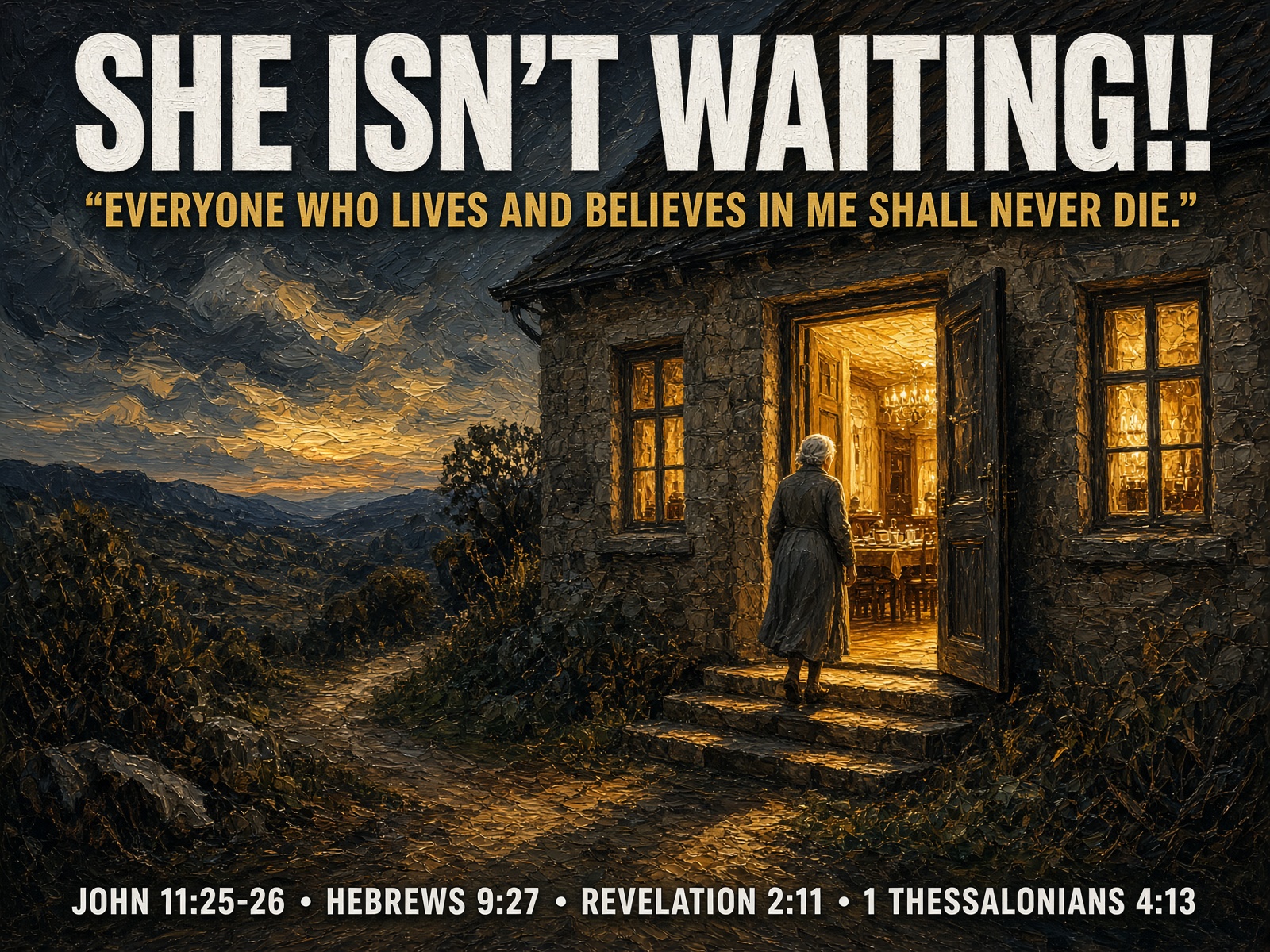
To the one who buried somebody this year.
Your loved one, who was in Christ, is already in their glorified body. Reigning for eternity with Christ! There is no better comfort than that, and that race is finished for them. Ours isn't, and when it is, we'll be there with Him too!
We all say it at the funeral. "She's with the Lord." Then most of us go home believing she's waiting. With Jesus and happy, but not finished. No body yet. Still listening for a trumpet.
Is that what they told you? It's what they told me.
After all of that, this is where I stand.
I think the hour came. I think the last day was the last day of that age. I think Hades gave up its dead and Jesus has the keys. I think when the tent comes down we have a house.
She closed her eyes here and she was home. Not waiting. Not in line. With Him, in a body that can't die. That's what I believe Jesus was telling Martha. The ones who died before that day would live. The ones who believe after it never die the death that held them.
"She still died."
She did. "It is appointed for man to die once" (Hebrews 9:27). We all die once. Twice isn't appointed for His people. Jesus told the church at Smyrna that the one who conquers "will not be hurt by the second death" (Revelation 2:11).
I owe you an answer from Part 2. Jesus said everyone who believes in Him would be raised on the last day. Was that for me? He made that promise to people who would either die before that day or live to see it, and He kept it. They were raised. I came to Him after. I get what they were raised into, and I never have to wait for it.
A lot of good pastors will tell you she's with the Lord and still waiting on her body. That was real. It's what the first believers had, right up until that day. I believe the day came.
Paul didn't want us to "grieve as others do who have no hope" (1 Thessalonians 4:13). You're going to grieve. Do it with hope!
P.S. I'm not a universalist. There is a second death, and "whoever does not obey the Son shall not see life" (John 3:36). The gate is open. You still have to walk through it. Today's a good day.
P.P.S. Somebody will post 2 Timothy 2:18, where Paul says two men had swerved from the truth, "saying that the resurrection has already happened." Paul wrote it before the day came, and in the same letter he still says Christ "is to judge the living and the dead" (4:1). Those men said it was over while Paul was still looking ahead to it. I'm saying it happened when Jesus said it would. Think about this. If the resurrection Paul preached was graves opening, how did anybody in that church get talked into believing it had already happened? I could be wrong.
If you think I've got it wrong, good. Disagree. Do it well, and bring the verse.
Verses in this part: John 11:25-26 · Hebrews 9:27 · Revelation 2:11 · John 6:40 · 1 Thessalonians 4:13 · Revelation 21:8 · John 3:36 · 2 Timothy 2:17-18 · 2 Timothy 4:1 · Revelation 22:5 · 2 Timothy 2:12
Where this is contestable. The creeds confess a resurrection still ahead, and this reading departs from them. Most of the church reads Philippians 3:21, Romans 8:11 and 1 Corinthians 15:53 of this same body raised, and Christ's empty tomb is their best reason. I read them of the same person given a new body, because that's how Paul explains it himself. God gives the seed a body (15:38). What is sown does not come to life unless it dies (15:36). Paul says he gets to the glorious body by "becoming like him in his death" (Philippians 3:10). No single verse says in one sentence that the believer receives his body at death. I get there by putting Paul's passages side by side. For the living in 15:51, the change at the trumpet was a change of head, out of Adam and into Christ (15:49), and a change in what death is. Their bodies came the way everyone's does, at death. That's the part I get pushed on hardest, mostly over Paul's "For" in 15:53. Some teachers on my own side read 2 Corinthians 5 as covenant language and hold that the resurrection was corporate only. I've said where I stand and why.