They wanted a King to take back the land. He gave us a Kingdom to take back the world.
Count it sometime. Jesus talks about the kingdom more than anything else. "Kingdom of heaven" thirty-two times in Matthew alone, "kingdom of God" close to seventy times across the New Testament, and the Gospels sum up His whole message in one phrase: "the gospel of the kingdom." John the Baptist opened with it. Jesus opened with it. Paul closed the book of Acts with it, "proclaiming the kingdom of God" in Rome "with all boldness and without hindrance" (Acts 28:31). If you want to know what the New Testament is about, start here. The kingdom is what everyone was waiting for, and Christ came to deliver it.
We must first ask what the people listening expected. Scripture tells you. They "supposed that the kingdom of God was to appear immediately" (Luke 19:11). They tried "to come and take him by force to make him king" (John 6:15). After the cross two of them said, "we had hoped that he was the one to redeem Israel" (Luke 24:21), and even after the resurrection the disciples asked, "Lord, will you at this time restore the kingdom to Israel?" (Acts 1:6). Josephus says the thing that most drove his nation into war with Rome was an oracle in their own Scriptures that around that time a ruler would rise from Judea. They were waiting for a king who would overthrow Rome, sit on David's throne in Jerusalem, and hand Israel the land. That's the kingdom they wanted. They wanted it so badly that when Jesus refused to be that kind of king, they followed men who promised they would be. Josephus names them.
Listen to what Jesus said about it instead.
The timing
John: "Repent, for the kingdom of heaven is at hand" (Matthew 3:2). Jesus: "The time is fulfilled, and the kingdom of God is at hand" (Mark 1:15). Then stronger: "If it is by the Spirit of God that I cast out demons, then the kingdom of God has come upon you" (Matthew 12:28). Then, to the Pharisees who wanted to see it: "The kingdom of God is not coming in ways that can be observed… behold, the kingdom of God is in the midst of you" (Luke 17:20–21). Then the deadline: "there are some standing here who will not taste death until they see the kingdom of God after it has come with power" (Mark 9:1). He tied that arrival in power to one event: "when you see Jerusalem surrounded by armies… when you see these things taking place, you know that the kingdom of God is near" (Luke 21:20, 31). At hand, come upon you, in your midst, coming with power inside this generation. Nowhere in His timing language is there a two-thousand-year gap.
The nature
"My kingdom is not of this world. If my kingdom were of this world, my servants would have been fighting… But my kingdom is not from the world" (John 18:36). Not "not on earth." Not from here. It doesn't come by the sword. It comes like a mustard seed and works like leaven (Matthew 13:31–33), the stone Daniel saw that "became a great mountain and filled the whole earth," set up "in the days of those kings," the Roman ones (Daniel 2:35, 44). Paul defines it in one line: "the kingdom of God is not a matter of eating and drinking but of righteousness and peace and joy in the Holy Spirit" (Romans 14:17).
The membership
"Do not presume to say to yourselves, 'We have Abraham as our father'" (Matthew 3:9). "Unless one is born again he cannot see the kingdom of God" (John 3:3). "Many will come from east and west and recline at table with Abraham… while the sons of the kingdom will be thrown into the outer darkness" (Matthew 8:11–12). "The kingdom of God will be taken away from you and given to a people producing its fruits" (Matthew 21:43). Not by birth. Not by land. By new birth and fruit.
The throne
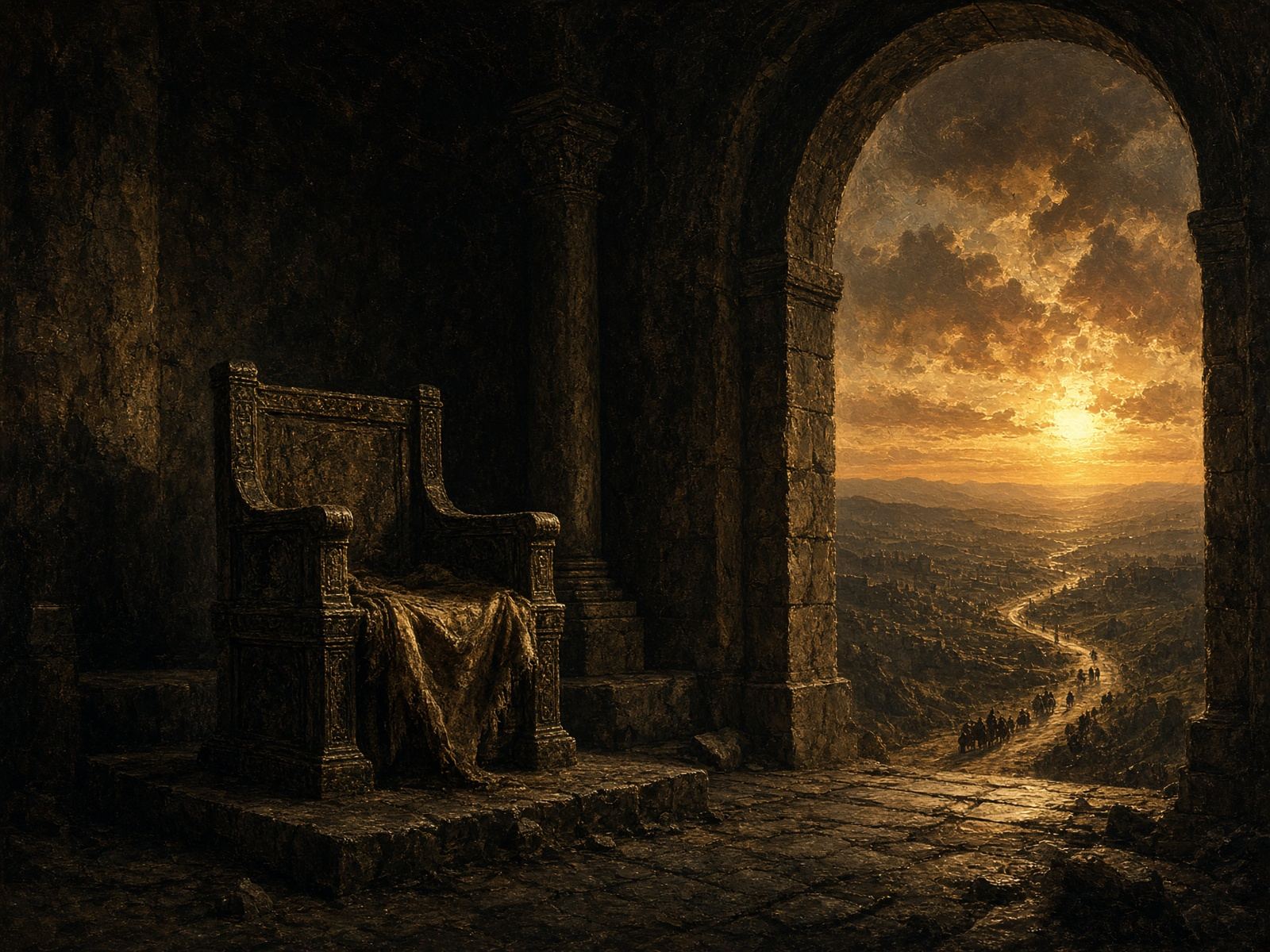
This is where the expectation and the reality meet head-on. Peter stood up at Pentecost and said God had sworn to David "that he would set one of his descendants on his throne," and that David "foresaw and spoke about the resurrection of the Christ" (Acts 2:30–31). The Davidic throne was taken at the resurrection and the ascension, "exalted at the right hand of God" (2:33). Daniel saw the same thing: the Son of Man comes "to the Ancient of Days" and is given "dominion and glory and a kingdom" (Daniel 7:13–14). He went up to receive it, not down. Then at the Jerusalem council James quoted Amos, "I will rebuild the tent of David that has fallen," and said it was being fulfilled as Gentiles came into the church (Acts 15:16–17). The rebuilt house of David is Jew and Gentile, one body, under one King. The Davidic throne is already occupied by Jesus Christ. "Sit at my right hand, until I make your enemies your footstool" (Psalm 110:1).
What did the apostles say they had? Not a kingdom they were waiting for. "He has delivered us from the domain of darkness and transferred us to the kingdom of his beloved Son" (Colossians 1:13). Past tense. "Receiving a kingdom that cannot be shaken" (Hebrews 12:28), while the old one was being shaken down. John wrote Revelation as "your brother and partner in the tribulation and the kingdom" (Revelation 1:9). He was in it when he wrote.
They wanted a kingdom that would change who ruled the land. He brought a kingdom that changed who ruled the heart, and then He let the land's old covenant order fall, inside that generation, so nobody could mistake the one for the other.
Which means the question for us isn't "when will the kingdom come?" Jesus answered that to the people standing in front of Him. The question is whether we're living like citizens of the one that came. Are we trying to escape it, or are we trying to help it fill the whole earth?