We thought we were living in Satan's Little Season. Then we tested Scripture.
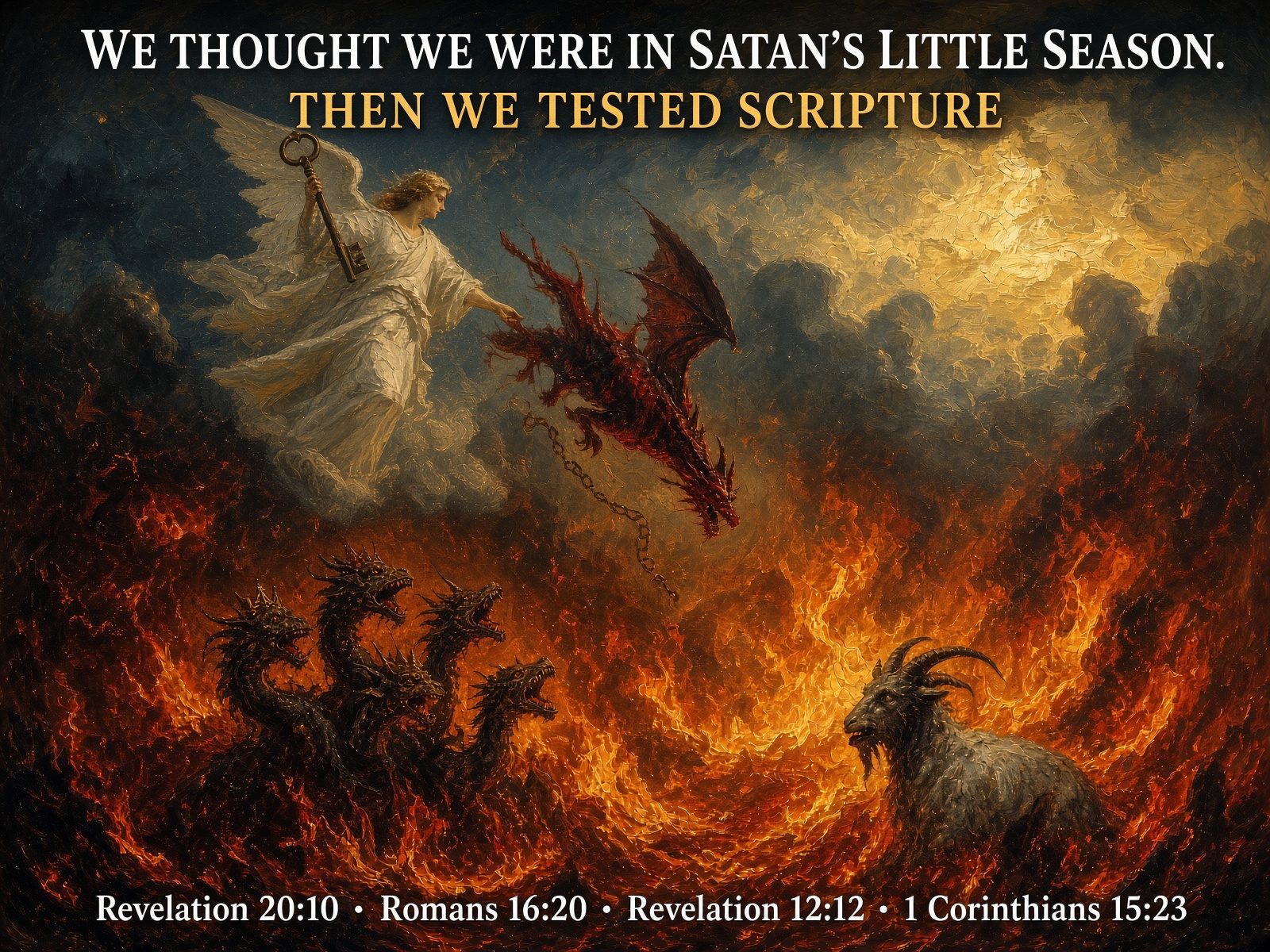
One of my first doorways into AD 70 was a YouTube teacher I still respect. Humble guy, searching Scripture, always reserving the right to be wrong. He was on the same hunt for truth I was on, and he was convinced we were living in Satan's Little Season: the thousand years of Revelation 20 had run from AD 70 to somewhere around now, there had been a 700-year gap in the calendar that nobody can account for, so it isn't really 2026, Satan had been loosed around 1776, and the final battle and the great white throne were the only things left on the calendar, imminently close.
My wife and I went all in. We were already fascinated by the unexplained, the old-world buildings, the theories that come with them, and SLS gave all of it a frame. Coming out of the dispensational system, it felt like a soft landing: AD 70 was real, the millennium had happened, and we got to keep the creeds. A future return, a future bodily resurrection, a future judgment, all still ahead, all parked in seven verses at the end of Revelation 20. The signs were everywhere. Hostility toward Christians, sin everywhere you looked, nations getting louder, wars breaking out. You know. All the signs.
Then we kept reading. Daniel 7 and 12. Matthew 10, 16, 24, 25. 1 Thessalonians 4. 1 Corinthians 15. Revelation 20, 21, 22. The more we read, the less we could make the gap hold.
Here's what SLS actually asks you to believe. Every coming, resurrection, and judgment text in the New Testament lands in AD 70, which SLS agrees with, except one short paragraph, Revelation 20:7–15, which gets pushed two thousand years down the road. One book, one chapter, a handful of verses, in the most symbolic book in the Bible, cut loose from every parallel passage and carrying the entire creedal future on its back. That's not a faithful reading. It's a lifeboat to protect the system we inherited and came out of.
The first thing we couldn't get past: the resurrection has a date, and it isn't ours. Paul says the dead are raised "at his coming" (1 Corinthians 15:23). SLS says His coming was AD 70. Then the resurrection was AD 70. You can't keep the coming and move the resurrection; Paul welded them. Daniel did too: the resurrection of "many of those who sleep in the dust" happens "when the shattering of the power of the holy people comes to an end" (Daniel 12:2, 7), which is the Temple's fall. John ties the judgment of the dead to the seventh trumpet, "the time for the dead to be judged" (Revelation 11:18), and most SLS teachers put the seventh trumpet in AD 70. The great white throne of Revelation 20:11–15 isn't a different judgment of the dead two thousand years later. It's the same one John already announced at the trumpet, told again from the end. Revelation tells the same judgment more than once from different angles, the trumpet and the throne, the way a scroll is read and reread. Scholars call it recapitulation; John just calls it the next vision.
The second thing: Revelation doesn't allow a two-thousand-year millennium. The book says of itself, start and finish, that its contents "must soon take place" and "the time is near" (1:1, 3; 22:6, 10). Revelation 20 is inside that book. If the thousand years run from AD 70 to now, then the loosing of Satan, the final war, and the judgment were not "soon" for John's readers; they were twenty centuries off, which is the exact move we left dispensationalism to escape. We just moved the gap from the seventieth week to the twentieth chapter.
The third thing: the devil's sentence is dated by his cellmates. "The devil who had deceived them was thrown into the lake of fire and sulfur where the beast and the false prophet were" (20:10). The beast and the false prophet went into the lake in 19:20, at the coming SLS places in AD 70. Satan is thrown in "where they were," the same lake, the same event. John doesn't describe a two-thousand-year gap between the beast's judgment and the devil's. He describes the devil joining them. The apostles dated it the same way from their side. Paul to the Romans: "The God of peace will soon crush Satan under your feet" (Romans 16:20). John in this very book: "the devil has come down to you in great wrath, because he knows that his time is short!" (12:12). Soon, and short, to the people holding the letters.
The fourth thing: there is no third coming. Hebrews says Christ "will appear a second time" (9:28). Second. Not second and then a third at the end of history. SLS needs a coming in AD 70 and another coming to end the little season. Jesus never promised two; the apostles never preached two. Every "coming" text has one deadline, and it's the one He gave: "this generation will not pass away" (Matthew 24:34).
The fifth thing: the kingdom has no end, and a millennium that ends in a war has one. "Of the increase of his government and of peace there will be no end" (Isaiah 9:7). "Of his kingdom there will be no end" (Luke 1:33). "His dominion is an everlasting dominion" (Daniel 7:14). A reign that runs a thousand years and then faces Satan loosed, the saints surrounded, and fire from heaven to save the day is a reign with a chapter break in it. The kingdom Jesus brought grows like leaven until the whole lump is leavened. It doesn't pause for a rematch.
What was the little season, then? The reading I find most faithful: a short span inside that generation. Satan was bound in Jesus' ministry so the strong man's house could be plundered (Matthew 12:29) and the nations could hear the gospel (Revelation 20:3; Acts 26:18). He was loosed "for a little while" to deceive the nations into the war that ended it, the armies gathered against God's people (20:8–9), the fire falling on the ones who had surrounded them, and then the devil joined the beast in the lake in the same judgment. I hold the details of that with an open hand. I hold the structure with a closed one: one coming, one resurrection, one judgment, one book that says "soon," and no gap anywhere in it.
About the signs. I believed them. Hostility, sin, wars, nations raging. Here's what I noticed after a year of reading: every generation of Christians has had exactly those signs, and every one of them thought the signs meant the end. The dispensationalist reads the headlines and sees the tribulation coming. The SLS believer reads the same headlines and sees Satan loosed. It's the same newspaper, held up to a different verse. Jesus told us the kingdom "is not coming in ways that can be observed" (Luke 17:20). The signs He gave had an audience and a deadline, and they were met.
About the creeds. This is the part I want to say carefully, because it's where we were stuck. We didn't want to be called heretics. We wanted a future return and a future resurrection because the creeds have them, and the creeds are old and the men who wrote them were serious. A creed is a summary of what its authors understood Scripture to say, and the authors were not inspired. The Westminster divines said it themselves: councils "may err, and many have erred." The creeds are right that Christ returns, judges, and raises the dead. They're wrong about when, the same way the church's consensus has been wrong before and corrected itself by going back to the text. We'd been holding the creed's calendar against the Bible's. The Bible won. It always should.
Where this is contestable. Gog and Magog in 20:8 are "the nations in the four corners of the earth," and a reader can fairly ask how that's Judea; my answer is that John is reusing Ezekiel 38–39 as a symbol, the way he reuses Babylon and Sodom, and I hold it as a reading. "A thousand years can't be forty years" is a fair objection too; my answer is that a thousand is the Bible's number for a complete span (Psalm 50:10; Deuteronomy 7:9; 2 Peter 3:8) and that the book's own time statements sit on both sides of chapter 20. Verse 5, "the rest of the dead did not come to life until the thousand years were ended," I read through John 5:25 and 28, the hour that "is now here" and the hour that "is coming," two stages of one resurrection closing at the end of the age. On all three I've given you my reading, not a proof. The structure is what I'd stake the post on.
If you're in SLS right now, I'm not writing this at you. I'm writing it from where you're sitting. You already believe AD 70 was the coming; you've done the hard part. The last step is letting Revelation 20 be in the same book as Revelation 1 and 22. Read the seven verses in the light of the other four hundred, and ask whether the gap you're keeping is the one you came here to get away from.
We're all on the same journey and seeking truth. I'm excited for the future with so many going back to Him and testing His Word.