Nobody leaves in 1 Thessalonians 4.
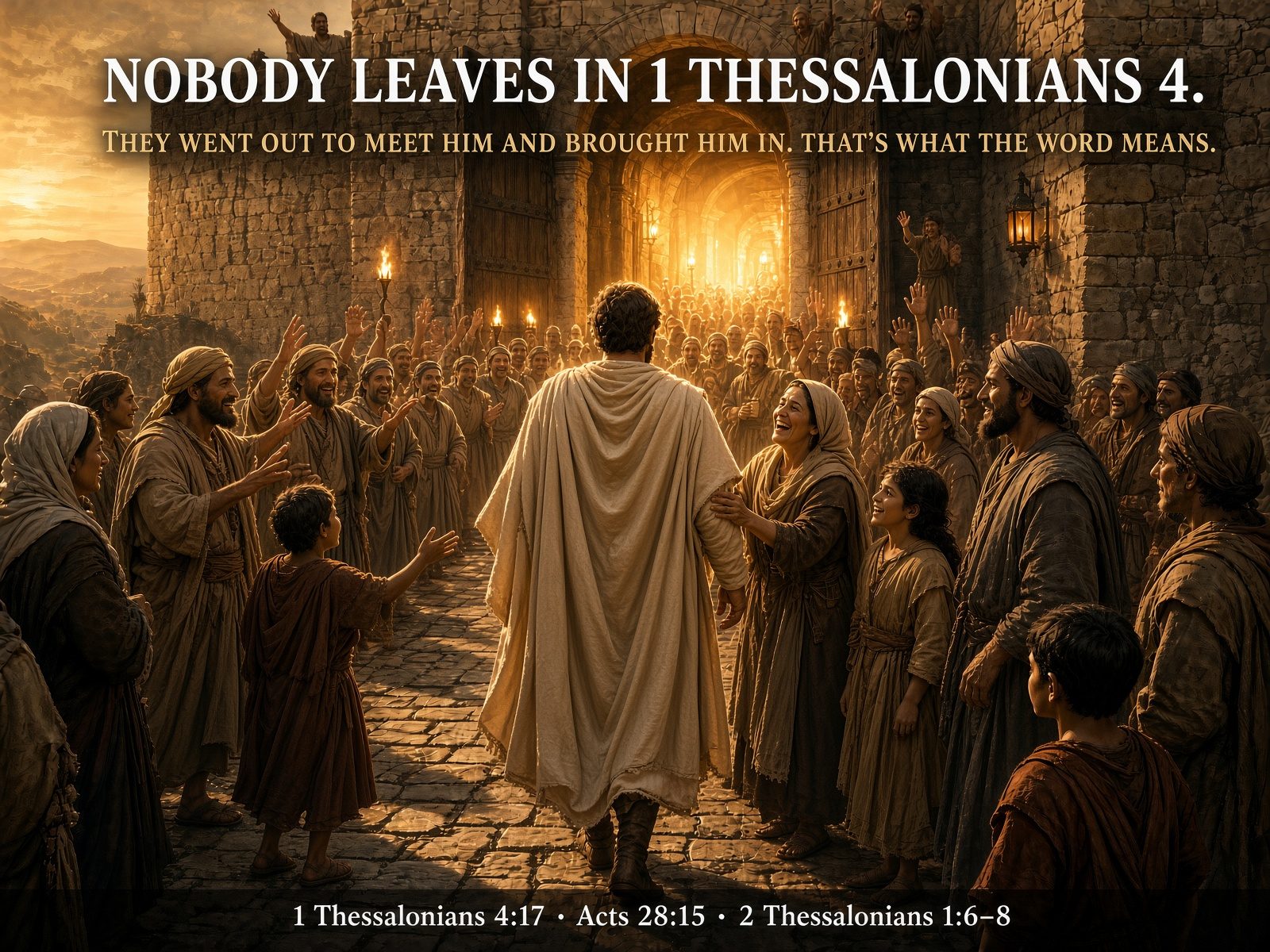
This is the passage everyone uses to prove a rapture of the church. If you grew up where I did, you can quote it: caught up, clouds, meet the Lord in the air. It's the verse under every chart, every "left behind" novel, every movie about driverless cars. I'm going to walk through it slowly, because the thing everybody assumes it says is the one thing it doesn't say.
Start with why Paul wrote it. "We do not want you to be uninformed, brothers, about those who are asleep, that you may not grieve as others do who have no hope" (1 Thessalonians 4:13). Thessalonian believers had died. The church was afraid those people would miss the Lord's coming. The passage is an answer to grieving people about their dead, not a timetable for the church escaping the planet. Read it that way and the structure opens up: the dead won't miss it, and the living won't get ahead of them.
Now the famous verses. "For the Lord himself will descend from heaven with a cry of command, with the voice of an archangel, and with the sound of the trumpet of God. And the dead in Christ will rise first. Then we who are alive, who are left, will be caught up together with them in the clouds to meet the Lord in the air, and so we will always be with the Lord" (4:16–17).
Three things to see.
First, the vocabulary is Sinai. A descent, a trumpet, a cloud, a people brought out to meet God. That's Exodus 19: "there were thunders and lightnings and a thick cloud on the mountain and a very loud trumpet blast… Then Moses brought the people out of the camp to meet God" (Exodus 19:16–17). Paul isn't inventing a scene. He's describing the covenant-making God coming to His people the way He came the first time, and Hebrews says the new covenant people have come not to Sinai but to "Mount Zion… the heavenly Jerusalem" (Hebrews 12:18–22). "The Lord himself will descend" is the same idiom as "He bowed the heavens and came down" (Psalm 18:9) and "the LORD is coming out of his place, and will come down" (Micah 1:3). Nobody saw a body in the sky either time. They saw God act.
Second, "to meet" means the opposite of leaving. The Greek word is apantēsis, and the New Testament uses it two other times. When Paul arrived in Italy, "the brothers there… came as far as the Forum of Appius and Three Taverns to meet us" (Acts 28:15). They went out to meet Paul and walked him into Rome. In the parable of the virgins, "Here is the bridegroom! Come out to meet him" (Matthew 25:6), and they go in with him to the feast. Both times, people go out to greet someone who is arriving and bring him in. The meeting isn't the destination. The one arriving has a destination, and Paul tells you what it is in the next clause: "and so we will always be with the Lord." Not "and so we will always be in the air."
Third, it's the same coming Jesus described on the Mount of Olives. Put them side by side. Matthew 24:30–31: the Son of Man "coming on the clouds of heaven," and "he will send out his angels with a loud trumpet call, and they will gather his elect." 1 Thessalonians 4:16–17: the Lord descends, an archangel's voice, the trumpet of God, believers gathered to Him in the clouds. Clouds, angels, trumpet, gathering. Paul says he got it "by a word from the Lord" (4:15), and the only word from the Lord with all four is the Olivet Discourse. The Olivet Discourse has a date on it: "this generation will not pass away until all these things take place" (24:34).
Paul put the same date on it. "We who are alive, who are left until the coming of the Lord" (4:15). We. Then, in the next breath, to the same readers: "You yourselves are fully aware that the day of the Lord will come like a thief in the night… But you are not in darkness, brothers, for that day to surprise you like a thief" (5:2–4). The day was coming on them; they just wouldn't be caught off guard. He opened the letter the same way: they had turned to God "to wait for his Son from heaven… Jesus who delivers us from the wrath to come" (1:10). Waiting, delivered, wrath to come. All first person, all present.
Relief for the persecuted and vengeance on the persecutors, at one revealing, in one sentence.
Here is the part the pre-tribulation rapture has no room for. In his second letter to the same church, Paul describes the same event again, and he tells you what else happens at it: "God considers it just to repay with affliction those who afflict you, and to grant relief to you who are afflicted as well as to us, when the Lord Jesus is revealed from heaven with his mighty angels in flaming fire, inflicting vengeance on those who do not know God" (2 Thessalonians 1:6–8). A pre-tribulation rapture needs two events seven years apart: the church taken, then the judgment. Paul puts them in the same hour, and he names who gets judged: the ones afflicting the Thessalonians, in the first century. In the next chapter he calls the whole thing "the coming of our Lord Jesus Christ and our being gathered together to him" (2:1). The gathering of 1 Thessalonians 4 and the coming of Matthew 24, one phrase.
What's not in the passage: a seven-year tribulation, a secret departure, anyone vanishing, empty clothes, planes falling, a world wondering where the Christians went. Those come from the theory we were handed. The text has a grieving church, a promise that the dead won't be left out, a Sinai-style coming of God, and a people gathered to meet their King and be with Him.
What happened, then? The Lord came in that generation, the way He said, in judgment on the city that had killed Him and was persecuting His church. The dead in Christ were raised into His presence. The living were gathered into His kingdom, "transferred," as Paul told the Colossians, "to the kingdom of his beloved Son" (Colossians 1:13). Nobody was airlifted out. History records a church that kept meeting, kept writing, kept growing, and never once mentioned a mass disappearance. The passage never promised one. We read a conclusion into it that the words don't carry.
Paul wrote it so a grieving church would stop grieving. "Therefore encourage one another with these words" (4:18). Two thousand years later we've turned the most comforting paragraph he ever wrote into the most frightening doctrine in the church. That's not what the words say. Nobody leaves in 1 Thessalonians 4. Everybody is brought in.
Set the theory down and get back to His Word. Our job is not to scare people out of a tribulation or a left-behind world. It is to invite them into His New Covenant, His Kingdom, and eternity with Him. It's an invitation out of love, not a repentance out of fear.