At Pentecost they spoke languages. Luke says so three times.
This came up at my Bible study and we couldn't leave it alone. What were tongues? Why don't we see them now? I've sat in more than one church where somebody jumped up and started speaking words I can only describe as babbling. No language anybody knew. No interpreter. Nobody could tell you what it meant, and it built up the body exactly not at all. I want to walk through what the text says, because I think most of us were handed a version of this that Luke wouldn't recognize.
A bunch of Galileans were speaking languages they had never learned, and the people who grew up speaking them understood.
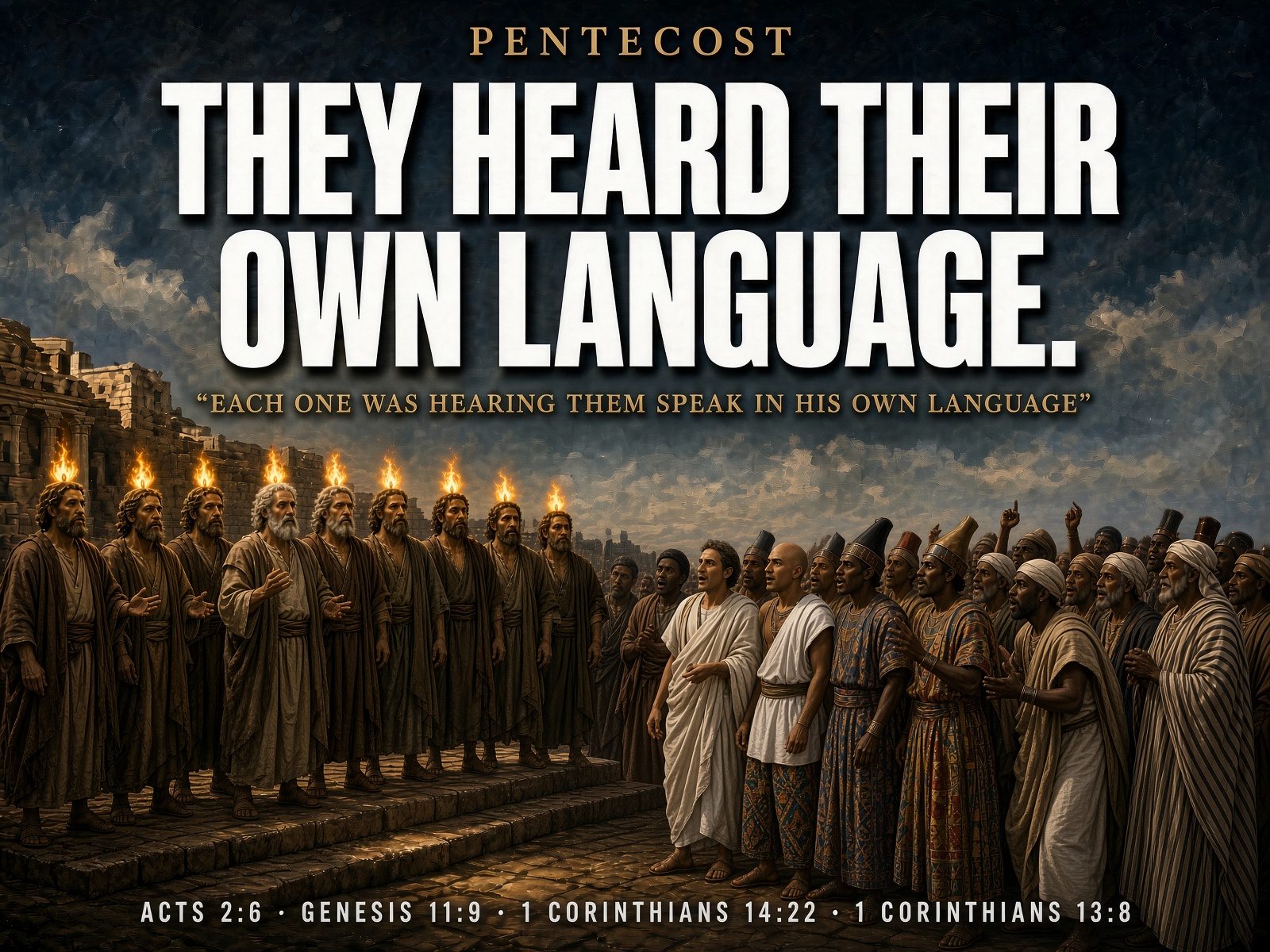
Start with what Luke wrote down. The Spirit comes, and the disciples "began to speak in other tongues" (Acts 2:4). Then Luke tells us what the crowd heard. "Each one was hearing them speak in his own language" (2:6). "How is it that we hear, each of us in his own native language?" (2:8). "We hear them telling in our own tongues the mighty works of God" (2:11). Three times in six verses. The Greek word for "tongues" is the everyday word for languages, and the word in verses 6 and 8 is where we get "dialect." A bunch of Galileans were speaking languages they had never learned, and the people who grew up speaking them understood. Luke doesn't mention an interpreter. Nobody needed one.
Look at the guest list. Luke could have said "a big crowd." He names them. Parthians, Medes, Elamites, people from Mesopotamia, Cappadocia, Pontus, Asia, Phrygia, Pamphylia, Egypt, Libya, Rome, Crete, Arabia. "Jews, devout men from every nation under heaven" (2:5), along with converts (2:11). Go back to Genesis 10, the table of nations, where the families of the earth spread out "each with his own language" (10:5). Elam is there. Egypt is there. The Medes are there. One chapter later, at Babel, "the LORD confused the language of all the earth" (11:9), and the nations scattered. At Pentecost, Jews and converts from those scattered nations are standing in one city, and God tells them His mighty works in every one of their languages.
Isaiah had a list like Luke's. The Lord would recover the remnant of His people "from Assyria, from Egypt, from Pathros, from Cush, from Elam, from Shinar" (Isaiah 11:11). Jeremiah has a whole oracle about Elam. God scatters them until "there shall be no nation to which those driven out of Elam shall not come," and then says, "in the latter days I will restore the fortunes of Elam" (Jeremiah 49:36, 39). I won't tell you Acts 2 is that verse fulfilled, because Luke doesn't say so. I'll tell you men from Elam are standing in the crowd, and when Peter explains what is happening he starts with Joel's words, "in the last days" (Acts 2:17).
Paul tells us what the sign was for. This is the part that gets skipped. Paul quotes Isaiah: "By people of strange tongues and by the lips of foreigners will I speak to this people, and even then they will not listen to me." Then he draws the conclusion. "Thus tongues are a sign not for believers but for unbelievers" (1 Corinthians 14:21-22). In Isaiah 28 the foreign tongue was Assyria's, and it meant judgment was at the door for a people who wouldn't listen. Moses had warned of "a nation whose language you do not understand" (Deuteronomy 28:49). When Israel heard foreign languages in the streets of Jerusalem, that was a sign for them. Some were amazed. Some said, "They are filled with new wine" (Acts 2:13). Peter finished his sermon with "Save yourselves from this crooked generation" (2:40).
The languages followed the gospel out. When the Spirit fell on Cornelius's house, the Jewish believers with Peter "were amazed, because the gift of the Holy Spirit was poured out even on the Gentiles. For they were hearing them speaking in tongues and extolling God" (Acts 10:45-46). Peter said the Spirit fell on them "just as on us at the beginning" (11:15). It happened again at Ephesus (19:6). It was the same gift, moving out from Jerusalem to the nations as the gospel went.
The word went where the languages pointed. Jesus said the gospel would be proclaimed "throughout the whole world as a testimony to all nations, and then the end will come" (Matthew 24:14). Thirty years later Paul says it "has been proclaimed in all creation under heaven" (Colossians 1:23). "Their voice has gone out to all the earth" (Romans 10:18). The mystery "has been made known to all nations" (Romans 16:26). Men from every nation under heaven heard it in Jerusalem, and Paul says it reached all creation under heaven in his lifetime.
Why they aren't here. Paul said they wouldn't last. "As for prophecies, they will pass away; as for tongues, they will cease; as for knowledge, it will pass away... when the perfect comes, the partial will pass away" (1 Corinthians 13:8-10). In the first chapter of the same letter he ties the gifts to a wait. "You are not lacking in any gift, as you wait for the revealing of our Lord Jesus Christ" (1:7). I read "the perfect" as the coming of Christ they were waiting on, at the end of the old covenant age. Plenty of believers read it as the finished New Testament, and plenty read it as a day still ahead. Verse 12, "then face to face" and "then I shall know fully," is the hard part for my reading and I won't hide it. "Face to face" is how the Old Testament speaks of a living man. "The LORD used to speak to Moses face to face" (Exodus 33:11), and God set that against the riddles He gave the prophets (Numbers 12:8). Paul's "dimly" is that same word in the Greek Old Testament, so I read him as setting the part against the whole. "Know fully" I still can't prove. On any of the three, Paul said tongues had an end date.
None of this means God stopped healing. When my brother was a boy he nearly died of croup. My parents and my grandma prayed over him. He coughed one last cough and he was healed. Nobody in that room had a gift of healing. God healed him, and they asked. James told the church to do that. "The prayer of faith will save the one who is sick, and the Lord will raise him up" (James 5:15). The power belongs to God.
What tongues never were. They were never the proof that you're saved. Paul asks, "Do all speak with tongues?" (1 Corinthians 12:30), in the same breath as "Are all apostles?" The answer is no. "By grace you have been saved through faith" (Ephesians 2:8). My mom grew up in a cult that taught you weren't saved if you couldn't speak in tongues. Think about what that produces. People fake it, because they're afraid of being put out. That is what I find disgusting. Paul didn't want a church meeting filled with sounds nobody there could understand, either. He compares tongues to real languages. "There are doubtless many different languages in the world, and none is without meaning" (1 Corinthians 14:10). If nobody present could interpret, the speaker was to keep silent in church (14:28). Paul spoke in tongues more than any of them (14:18), and he still said that in church he would "rather speak five words with my mind in order to instruct others, than ten thousand words in a tongue" (14:19).
I know where the other reading comes from. Paul says the one speaking in a tongue "speaks not to men but to God; for no one understands him" (14:2). He lets the man with no interpreter "speak to himself and to God" (14:28). I read both as a real language nobody in the room speaks, which is why he demands an interpreter. Some say Corinth was a different gift from Pentecost. Paul uses the same word Luke does, and the verse he quotes from Isaiah is about a foreign nation's language. If you grew up praying in tongues, I'm not mocking you and I'm not questioning whether you love the Lord. I'm asking you to set what you were taught beside Acts 2 and see if they match. I will say this plainly. Claiming a gift from God that He hasn't given is a serious thing, and I'd be very cautious around anyone who does it.
Two more verses belong here. Paul says, "if I pray in a tongue, my spirit prays but my mind is unfruitful" (14:14), and he says he'll pray and sing both ways (14:15). That is the best verse for a private prayer language. Paul doesn't forbid it, and he prayed that way himself (14:18). I read it as the same gift used in private, because he tells the man who speaks in a tongue to "pray that he may interpret" (14:13). When Paul says tongues will cease (13:8), he doesn't set the private use apart. The other verse is "the tongues of men and of angels" (13:1). Paul says "if," and his next "if" is having "all knowledge" (13:2). A few verses later he says he didn't have that (13:9). When Gabriel speaks, Zechariah understands him (Luke 1:13).
If someone told you that you aren't saved because you never spoke in tongues, they added a requirement Paul didn't.
Where this is contestable. Three places, and I'll name them. First, 1 Corinthians 13:12. If "the perfect" has come, a fair critic will ask whether we now "know fully," and that is the hardest verse for my reading. Second, the private-prayer reading of 1 Corinthians 14:2, 14:14 and 14:28 is held by serious people, and my answer is one way of reading the chapter. Third, history. Irenaeus, about AD 180, wrote that we "hear many brethren in the Church, who possess prophetic gifts, and who through the Spirit speak all kinds of languages" (Against Heresies 5.6.1). That is about a century after Jerusalem fell, and I can't explain it away. He does call them languages.