"We're in the last days!" The apostles said they were, more than thirty times.
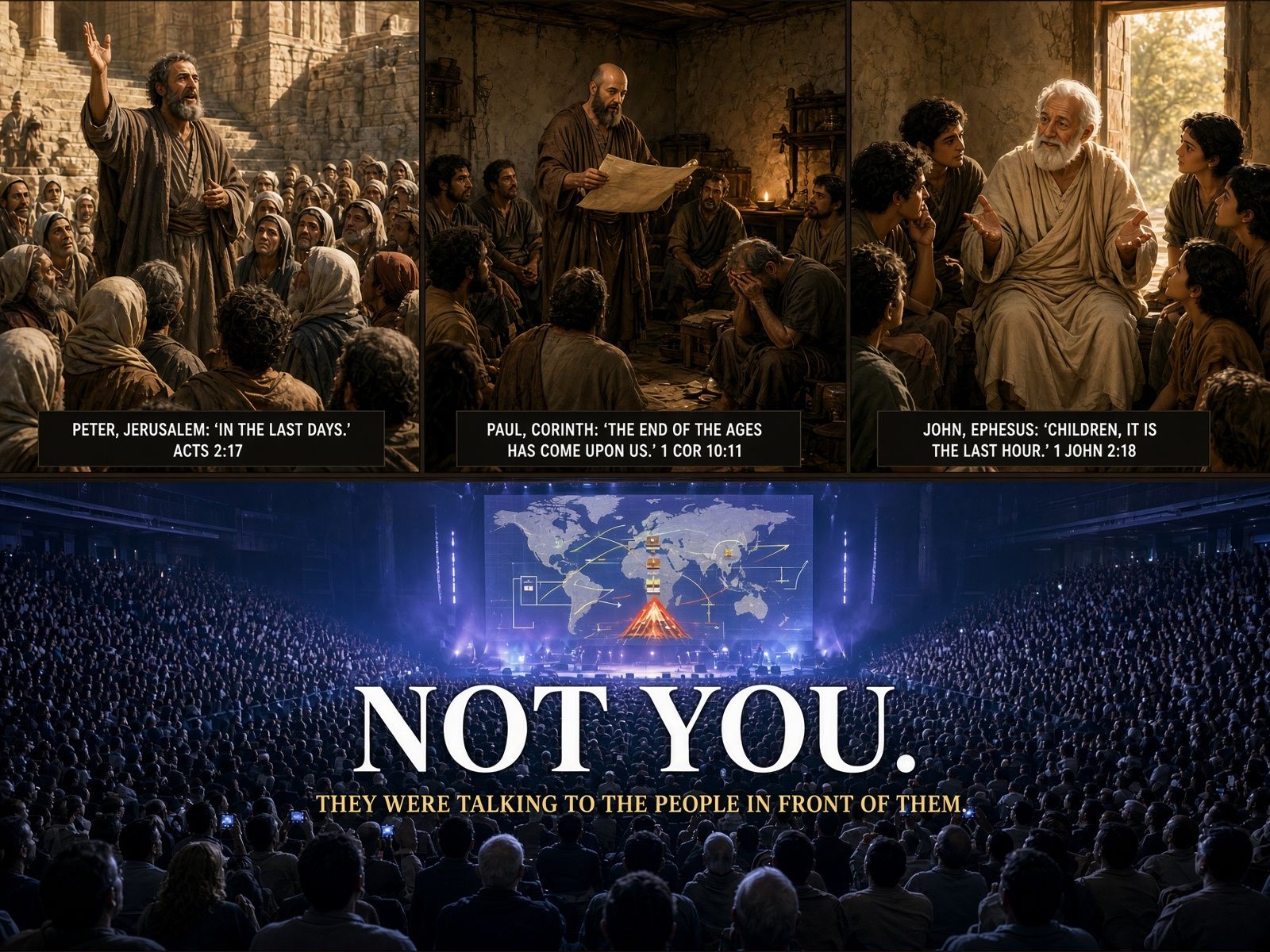
"The last days" is one of the most misused phrases in the church. We've been trained to look for them in the headlines. The apostles didn't look for them anywhere. They said they were standing in them, and they said it more than thirty times.
Peter named his own day as the last days. Joel wrote, "And it shall come to pass afterward, that I will pour out my Spirit on all flesh" (Joel 2:28). When Peter quoted it at Pentecost, he changed one word on purpose: "This is what was uttered through the prophet Joel: 'And in the last days it shall be, God declares, that I will pour out my Spirit on all flesh'" (Acts 2:16–17). Joel's "afterward" became Peter's "in the last days," and Peter was pointing at the crowd in front of him. Nobody is saying every last-days event finished that morning. The last days had begun, and their end was on the way.
The other apostles said the same thing. Hebrews 1:2: "in these last days he has spoken to us by his Son." Hebrews 9:26: Christ "has appeared once for all at the end of the ages to put away sin." 1 Corinthians 10:11: the Corinthians were the ones "on whom the end of the ages has come." 1 Peter 1:20: Christ "was made manifest in the last times for the sake of you." 1 Peter 1:5: a salvation "ready to be revealed in the last time." 1 John 2:18: "Children, it is the last hour… Therefore we know that it is the last hour." Twice in one verse. James 5:3, to the rich men in his own churches: "You have laid up treasure in the last days." 1 Timothy 4:1: "in later times some will depart from the faith," and then Paul warns Timothy about those exact teachings. 2 Timothy 3:1–5: "in the last days there will come times of difficulty," followed by "Avoid such people," because the people were already there. Jude 18–19: "In the last time there will be scoffers," and then: "It is these who cause divisions." Jude points at them.
2 Peter 3:3 doesn't break any of this. Peter warned that "scoffers will come in the last days." Jude repeats the warning and identifies the scoffers as present. Even if 2 Peter was written around AD 65, warning about something still ahead inside a period already running doesn't mean the period hadn't started. If the last days began at Pentecost and closed in AD 70, Peter in AD 65 could warn about what was still coming. Paul did the same thing in 2 Timothy 3: described the last days and, in the same breath, told Timothy to avoid the men he was describing.
Then look how near they said the end was.
Romans 13:12: "The night is far gone; the day is at hand." 1 Corinthians 7:29, 31: "the appointed time has grown very short… the present form of this world is passing away." 1 Thessalonians 4:15: "we who are alive, who are left until the coming of the Lord." 1 Thessalonians 5:4: "you are not in darkness, brothers, for that day to surprise you like a thief." 2 Thessalonians 1:7: relief "to you who are afflicted… when the Lord Jesus is revealed." 2 Thessalonians 2:7: "the mystery of lawlessness is already at work." Hebrews 8:13: the old covenant "is ready to vanish away." Hebrews 10:25: "as you see the Day drawing near." Hebrews 10:37: "Yet a little while, and the coming one will come and will not delay." James 5:8–9: "the coming of the Lord is at hand… the Judge is standing at the door." 1 Peter 4:7: "The end of all things is at hand." 1 Peter 4:17: "it is time for judgment to begin at the household of God." Philippians 4:5: "The Lord is at hand." 1 John 4:3: the spirit of the antichrist "now is in the world already."
Jesus set the limit before any of them wrote. Matthew 10:23: the disciples would not finish the towns of Israel "before the Son of Man comes." Matthew 16:28: "some standing here who will not taste death until they see the Son of Man coming in his kingdom." Matthew 23:36: "all these things will come upon this generation." Matthew 24:34: "this generation will not pass away until all these things take place," repeated in Mark 13:30 and Luke 21:32. Luke 21:20–22: Jerusalem surrounded by armies, "these are days of vengeance." Matthew 26:64, to the high priest's face: "from now on you will see the Son of Man seated at the right hand of Power and coming on the clouds of heaven."
John put Revelation inside the same window. Revelation 1:1: things "that must soon take place." 1:3: "the time is near." 1:9: John, already "your brother and partner in the tribulation and the kingdom." 3:11: "I am coming soon." 22:6: "must soon take place." 22:7 and 22:12: "I am coming soon." 22:10: "Do not seal up the words of the prophecy of this book, for the time is near." 22:20: "Surely I am coming soon." Set that beside Daniel, who was told to "seal the book, until the time of the end" (Daniel 12:4) because his was far off. John was told the opposite, because his wasn't.
Now put them in one room. Peter: in the last days. Hebrews: these last days. Paul: the end of the ages has come upon us. John: it is the last hour. James: the Judge is standing at the door. Jesus: this generation will not pass away.
The New Testament writers were not predicting that the last days would begin two thousand years after their deaths. They said they were living in them. The last days were the last days of the old covenant age, and they ended where Jesus said they would, in Jerusalem, in that generation.
Why do we keep telling them they were wrong? How do we ignore this much evidence?