No new prophets. No new books. Paul said prophecy had an end date.
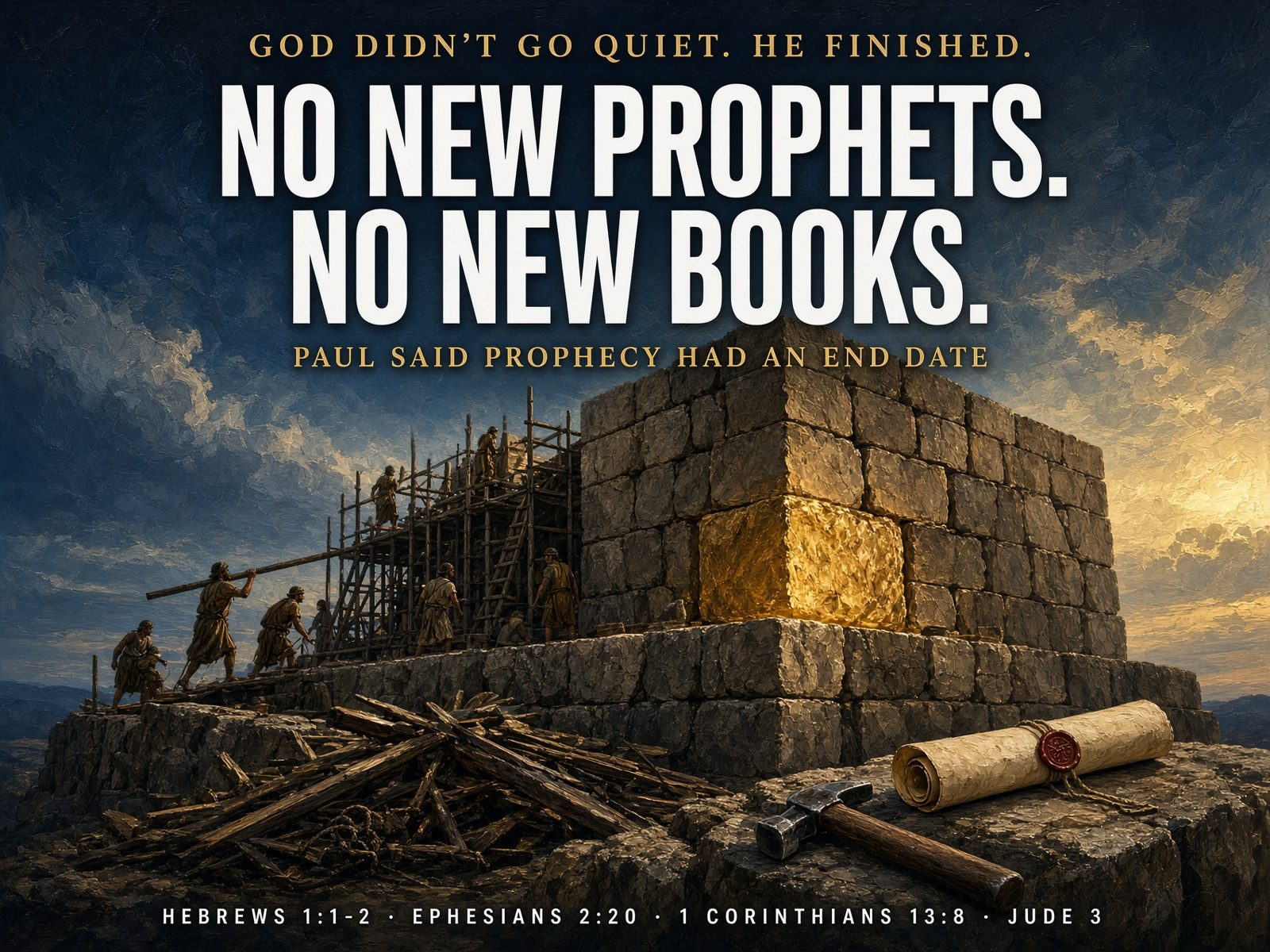
Somebody told me that all the confusion about the end times is "exactly why we need modern-day prophets and new books of the Bible." I understand the instinct. If the predictions keep failing, maybe the fix is a new prediction. Scripture already spoke to that, and it's worth walking through slowly.
God didn't go quiet. He finished what He said He would do, and Paul said prophecy would pass away when He did.
God's last word was His Son. "Long ago, at many times and in many ways, God spoke to our fathers by the prophets, but in these last days he has spoken to us by his Son" (Hebrews 1:1–2). The prophets came first, and then the Son, in what Hebrews calls "these last days." He is where the line was headed. Jude calls what the apostles handed down "the faith that was once for all delivered to the saints" (Jude 3). Once for all doesn't leave room for a sequel.
There were still prophets after the cross, and that has to be faced. Agabus "foretold by the Spirit" a famine (Acts 11:28). Corinth had prophets speaking in its meetings (1 Corinthians 14:29). Paul tells us where they fit. The church is "built on the foundation of the apostles and prophets, Christ Jesus himself being the cornerstone" (Ephesians 2:20). They were the ones who delivered the Son's word to the first churches. That is also where Scripture came from. The mystery was "revealed to his holy apostles and prophets by the Spirit" (Ephesians 3:5), and "men spoke from God as they were carried along by the Holy Spirit" (2 Peter 1:21). You lay a foundation once. If the apostles and prophets are finished, there is nobody left to write a new book.
Paul tied them to a wait. He told the Corinthians, "you are not lacking in any gift, as you wait for the revealing of our Lord Jesus Christ" (1 Corinthians 1:7). Later in the same letter he says what happens to them. "As for prophecies, they will pass away; as for tongues, they will cease; as for knowledge, it will pass away. For we know in part and we prophesy in part, but when the perfect comes, the partial will pass away" (13:8–10). Paul calls prophecy partial, and he says the partial has an end. I read "the perfect" as the coming of Christ they were waiting on, at the end of the old covenant age. "Then face to face" (13:12) sounds to me like John's city, where "they will see his face" (Revelation 22:4). That verse is also the hardest one for my reading, because Paul adds "then I shall know fully," and a fair critic will ask whether we do. I walk through the tongues half of this in the Pentecost post.
Peter said what the gifts were for. At Pentecost he explained the tongues and the prophesying from Joel. "In the last days... your sons and your daughters shall prophesy," and all of it comes "before the day of the Lord comes, the great and magnificent day" (Acts 2:17, 20). The outpouring belonged to the last days and ran up to that day. Hebrews says what the signs were for. The message "was attested to us by those who heard, while God also bore witness by signs and wonders and various miracles and by gifts of the Holy Spirit" (Hebrews 2:3–4). The gifts were God's signature on the apostles' testimony.
Daniel was given a clock. The seventy weeks were decreed "about your people and your holy city," and one of the six things on the list is "to seal both vision and prophet" (Daniel 9:24). I read that as vision and prophet reaching their finish inside Israel's own timeline. When the question came, "How long?", the answer was "when the shattering of the power of the holy people comes to an end all these things would be finished" (12:7). I take that as the fall of Jerusalem. Jesus called those days "days of vengeance, to fulfill all that is written" (Luke 21:22).
John's last page. In Revelation the mystery of God is "fulfilled, just as he announced to his servants the prophets" (10:7), and the book closes with a warning. "I warn everyone who hears the words of the prophecy of this book: if anyone adds to them, God will add to him the plagues described in this book" (22:18). That warning guards Revelation, and I won't stretch it over the whole Bible.
What to do when someone says he's a prophet. Be very cautious. Scripture is hard on anyone who claims to speak for God when God hasn't sent him. "The prophet who presumes to speak a word in my name that I have not commanded him to speak... that same prophet shall die" (Deuteronomy 18:20). "I did not send the prophets, yet they ran" (Jeremiah 23:21). Jesus said, "Beware of false prophets, who come to you in sheep's clothing" (Matthew 7:15). Moses gave the test. "If the word does not come to pass or come true, that is a word that the LORD has not spoken" (Deuteronomy 18:22). John said, "do not believe every spirit, but test the spirits to see whether they are from God, for many false prophets have gone out into the world" (1 John 4:1). Hold the new word up against the finished one. If it adds a date, a book, or a requirement the apostles never gave, you have your answer. The same goes for anyone claiming a gift he doesn't have.
God didn't go quiet. He finished. The Son was the last word, the apostles and prophets laid the foundation, and prophecy, tongues and knowledge ran until the revealing they were given to serve. The church has all the revelation it needs. We keep reading a finished book as if it were still being written.
Where this is contestable. Four places, and I'll name them. First, history. Justin Martyr, around AD 160, wrote that "the prophetical gifts remain with us, even to the present time" (Dialogue with Trypho 82). Irenaeus, about AD 180, wrote that we "hear many brethren in the Church, who possess prophetic gifts, and who through the Spirit speak all kinds of languages" (Against Heresies 5.6.1). That is about a century after Jerusalem fell, and it cuts against a clean stop in AD 70. I can't explain those reports away. By about AD 390, Chrysostom said of 1 Corinthians 12 that such things "used to occur but now no longer take place" (Homily 29 on 1 Corinthians). Second, Ephesians 4:11–13 says the gifts were given "until we all attain to the unity of the faith," and that list includes "shepherds and teachers." If "until" ended prophets, a critic will say it ended pastors, so I rest on the foundation in 2:20 and the three gifts Paul names in 1 Corinthians 13:8. Third, "no new books" depends on every New Testament book being written before Jerusalem fell. I hold that, Revelation included, and Irenaeus is the main witness for a later date. My case for the early date is on the Tough Verses page. Fourth, Zechariah 13:2 says God will "remove from the land the prophets," and I used to quote it here. The next verse shows they are prophets who "speak lies in the name of the LORD," so I've stopped leaning on it.