Jesus is not coming back to rule from Jerusalem. He already rules from heaven. Ask Pilate.
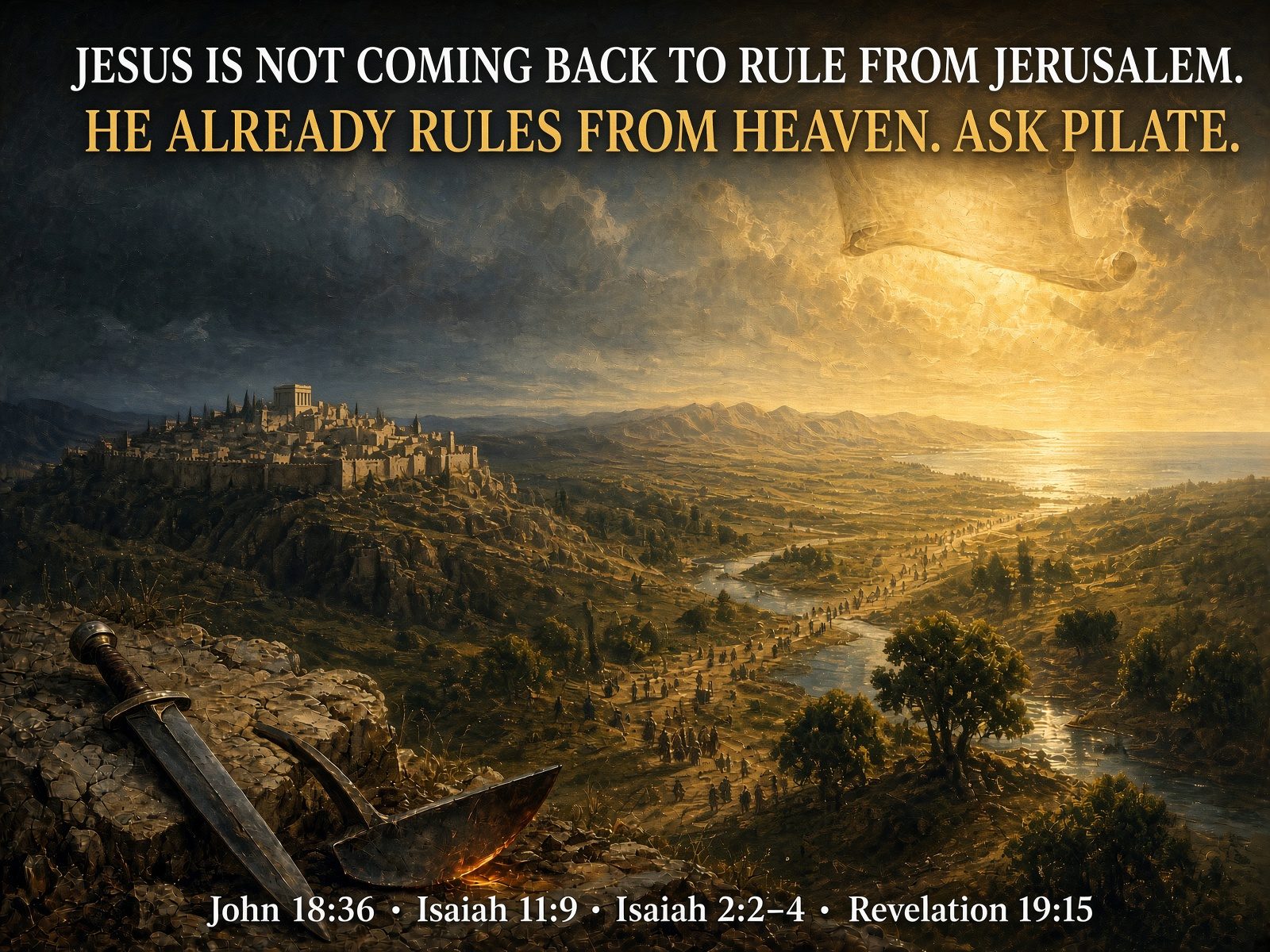
They promised you a throne in one city. The Bible gave you the whole earth.
A reader asked me this week, kindly, whether she had me right: that I believe all prophecy is fulfilled, so there's no millennium where the lion lies down with the lamb, no swords beaten into plowshares, and no physical kingdom on earth. "I can believe already-but-not-yet," she wrote, "but you seem to be saying there is no future fulfillment."
She had me mostly right, and I want to answer her out loud, because the question underneath hers is the one I had to answer for myself: if it's all fulfilled, where did the hope go?
What I believe. Every prophecy with a deadline on it was fulfilled by AD 70, including the coming, the resurrection, and the judgment, because that's the deadline Jesus and the apostles gave. No future millennium. No future physical throne in Jerusalem. That sounds like less. Let me show you why it's more.
Ask Pilate. Jesus told the governor what kind of kingdom He has, and how to tell. "My kingdom is not of this world. If my kingdom were of this world, my servants would have been fighting, that I might not be delivered over to the Jews. But my kingdom is not from the world" (John 18:36). The test of a worldly kingdom is that its men fight for it. A few hours earlier Peter had tried; he drew a sword and took off the ear of the high priest's servant (18:10). Jesus told him, "Put your sword into its sheath" (18:11), and healed the man (Luke 22:51). That was the last sword drawn to advance the kingdom of God with its King's approval. Gabriel had already said the kingdom would have no end (Luke 1:33), and a kingdom with no end doesn't need to be defended with steel; it can't lose.
So the weapon changed. "The sword of the Spirit, which is the word of God" (Ephesians 6:17). "The weapons of our warfare are not of the flesh" (2 Corinthians 10:4). The word of God is "sharper than any two-edged sword" (Hebrews 4:12). When John finally sees the King ride out, the sword comes "from his mouth" (Revelation 19:15). A throne in Jerusalem would need an army to hold it. This King holds the earth with a word, and He hands the same weapon to us.
The lion and the lamb. They're not cancelled. Read where Isaiah puts them. "The wolf shall dwell with the lamb… They shall not hurt or destroy in all my holy mountain; for the earth shall be full of the knowledge of the LORD as the waters cover the sea" (Isaiah 11:6, 9). The peace comes as the knowledge spreads. It's not a switch thrown at the start of a millennium; it's the result of the earth filling up with the knowledge of God, which is exactly what Habakkuk said the kingdom would do (2:14). The very next verse tells you when it started: "In that day the root of Jesse, who shall stand as a signal for the peoples, of him shall the nations inquire" (11:10). Paul quotes that verse about his own missionary work: "The root of Jesse will come… in him will the Gentiles hope" (Romans 15:12). Paul read Isaiah 11 as happening in his day, with him. The lion-and-lamb chapter was already underway when Romans was written.
The plowshares. "It shall come to pass in the latter days that the mountain of the house of the LORD shall be established… and all the nations shall flow to it… and they shall beat their swords into plowshares" (Isaiah 2:2–4). The latter days started at Pentecost (Acts 2:17). Hebrews tells the first-century church, "you have come to Mount Zion" (12:22). The nations have been flowing in for two thousand years, and where the gospel has gone, enemies have laid down weapons they would otherwise have used on each other. That isn't finished. It's the work. "Of the increase of his government and of peace there will be no end" (Isaiah 9:7).
The one that settled it for me. Jesus said leaving was the better deal. "It is to your advantage that I go away, for if I do not go away, the Helper will not come to you" (John 16:7). The Helper isn't a consolation prize until He gets back; Jesus said the Helper is the advantage. Through the Spirit, He and the Father "will come to him and make our home with him" (14:23), in every believer, on every continent, at once. Under the old covenant you went to the place. Under the new one, "you are God's temple and God's Spirit dwells in you" (1 Corinthians 3:16), and in the city John saw, there is no temple, "for its temple is the Lord God the Almighty and the Lamb" (Revelation 21:22). A future reign that puts Him back in one city, on one throne, with people traveling to where He is, is a step back from what He called better.
Where this is contestable. Someone will read Isaiah 11:6 as literal animals; I read it through 11:9, where the peace is coextensive with the knowledge filling the earth, and through Paul's use of 11:10, and I hold that as a reading. Someone will say Isaiah 2:4 is future; it was future to Isaiah, in "the latter days," and Peter dated those. "Put your sword away" is about advancing the kingdom, not about civil justice or defending your family; Romans 13:4 still gives the magistrate the sword. If the gates never shut and the nations are still coming in, then the kingdom isn't finished, and that's exactly my point.
So here's my already-but-not-yet. The "not yet" isn't an event on a calendar. It's a kingdom still filling the earth, one heart at a time, with no ceiling on the increase. The events had deadlines and the deadlines were met. The growth has no deadline, because it has no end.
The question that changed my mind was this: is a physical throne in one city, held by force for a thousand years, a bigger hope than a King already reigning over the whole earth from heaven, with every nation invited in through gates that never shut? I came to believe the second is the larger hope, and the one the text describes.
They promised me a throne in Jerusalem. The Bible gave me the whole earth, and a Word sharp enough to take it.