The day a 15-year-old helped me stop believing my own chart.
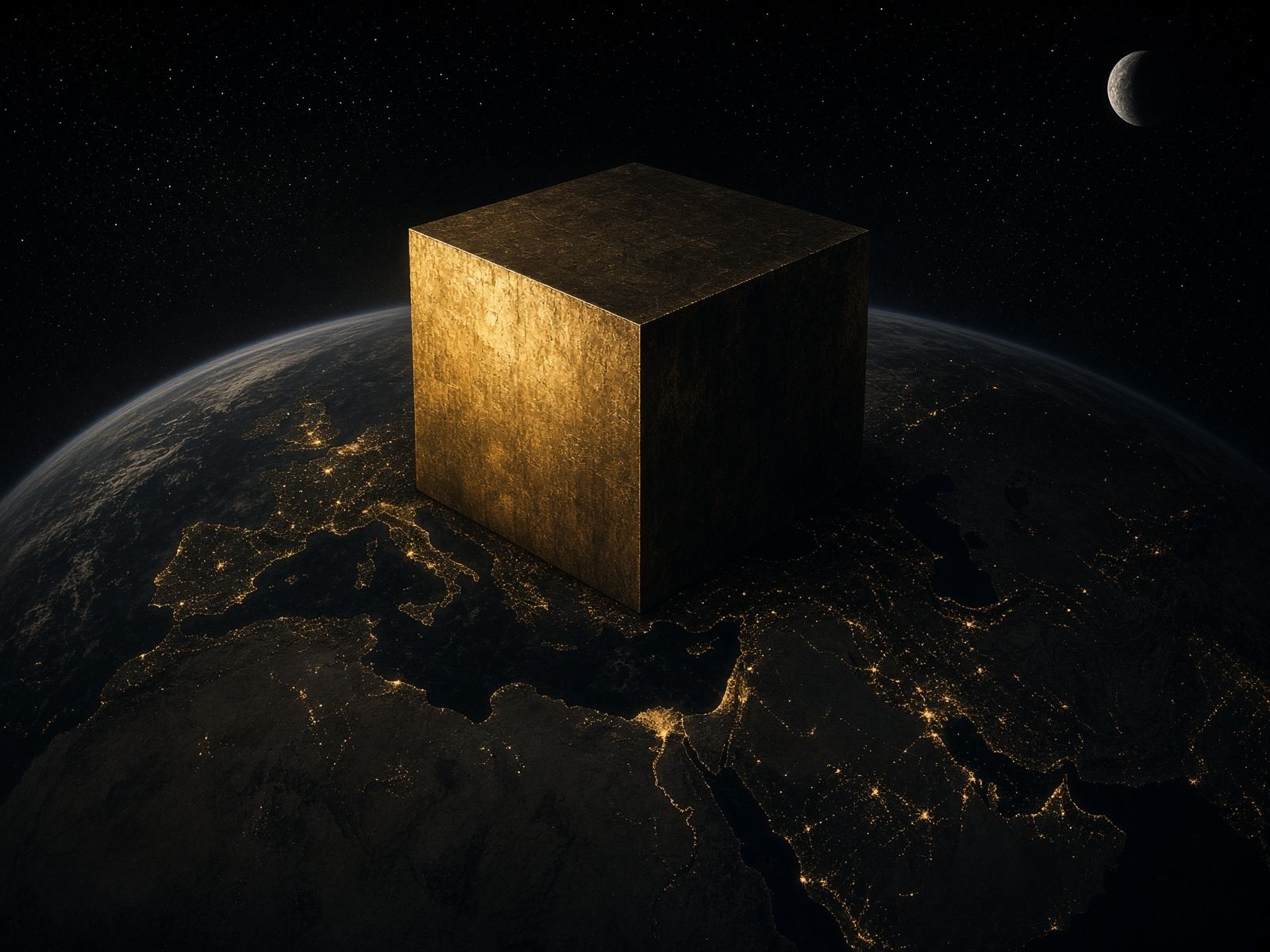
I was still a dispensationalist when I first did this math. I had the verse, I had a calculator, and I was thrilled. Revelation 21:16: "its length and width and height are equal," twelve thousand stadia. I worked it out to a roughly 1,500-mile cube, and I couldn't wait to tell somebody.
The somebody was a fifteen-year-old pastor's kid. I remember telling him, did you know a city 1,500 miles long, 1,500 miles wide, and 1,500 miles tall is coming down to earth? That's New Jerusalem. His eyes lit up. He was amazed. For about three seconds so was I.
Then I actually pictured it. A block of gold sitting on the Middle East with its roof twenty-two times higher than the edge of space. Something dropped in my stomach. Not doubt about God. Doubt about me. Have I really been this ignorant? What is Scripture actually trying to tell me here? Because this cannot possibly be literal, and I had just taught it to a kid as though it were.
That moment was the beginning of the end for me. Not the end of believing the Bible. The end of trusting the system I had inherited to tell me what the Bible meant.
Let's do the math honestly. The Greek word is stadia, about 607 feet each, which puts the city at roughly 1,380 miles on a side. That's the distance from Jerusalem to Rome. As a footprint it covers Israel, Lebanon, Jordan, Syria, Iraq, Cyprus, and most of Egypt, about sixty percent of the lower forty-eight. As a height it is 250 Everests stacked on top of each other, five and a half times higher than the space station orbits. Its volume is about half the Moon's. John says it's "pure gold, like clear glass" (Revelation 21:18); if you take that literally too, it weighs nearly three Moons. And then the detail that should stop every literalist cold: the wall around it is "144 cubits" (21:17). About 216 feet. A 216-foot wall around a 1,380-mile-tall city. Scripture itself is telling you not to get out the tape measure.
So what is it telling you? Start with the shape. Length, breadth, and height equal. There is exactly one other cube in the Bible: the Holy of Holies, "twenty cubits long, twenty cubits wide, and twenty cubits high" (1 Kings 6:20). The room where God's presence dwelt, that one man entered one day a year. John is saying the whole city is now that room. Which is why the next thing he says is "I saw no temple in the city, for its temple is the Lord God the Almighty and the Lamb" (21:22), and why the voice from the throne announces, "Behold, the dwelling place of God is with man. He will dwell with them" (21:3).
Then the numbers. Twelve thousand is twelve times a thousand. One hundred forty-four is twelve times twelve. John has just told you the twelve gates carry "the names of the twelve tribes of the sons of Israel" (21:12) and the twelve foundations carry "the twelve names of the twelve apostles of the Lamb" (21:14). The measurements are the people. Old covenant Israel and the apostles of the new, built into one city. John told you who the city is before he ever measured it: "Come, I will show you the Bride, the wife of the Lamb. And he… showed me the holy city Jerusalem" (21:9–10). The city is the Bride. Paul calls her "the Jerusalem above… our mother" (Galatians 4:26). Hebrews tells first-century believers they had already arrived: "you have come to Mount Zion and to the city of the living God, the heavenly Jerusalem" (Hebrews 12:22).
That's what the text was trying to tell me while I was busy calculating cubic miles. Not a gold block landing on Jordan. God dwelling with His people, with no veil, no temple, and no one-day-a-year access.
I'm not writing this to make fun of anyone. I was that guy, and I was excited about it. I'm writing it because somewhere there's another fifteen-year-old about to be handed a chart. If you've got the calculator out, good. Finish the math. Then ask the question the math forced on me: what is Scripture actually trying to say? The answer is better than the cube.