AD 70 was not irrelevant. It was everything.
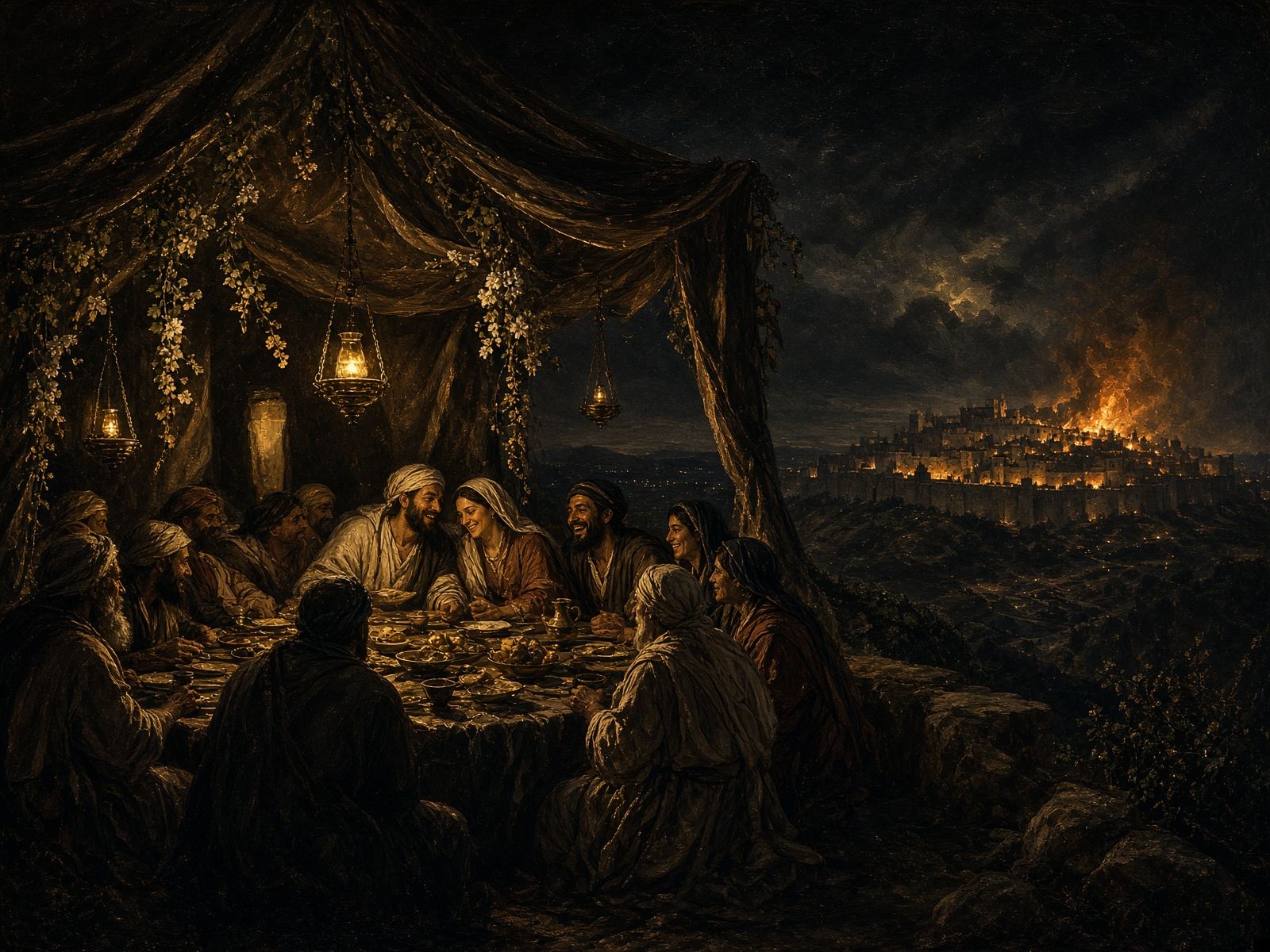
Most Christians treat AD 70 as a footnote. A sad Jewish tragedy, a Roman atrocity, something Josephus wrote about. Jesus didn't treat it that way. He put a burning city and a wedding feast in the same parable, back to back, and told you which came first.
"The kingdom of heaven may be compared to a king who gave a wedding feast for his son." The invited guests refused to come. They seized his servants, treated them shamefully, and killed them. "The king was angry, and he sent his troops and destroyed those murderers and burned their city. Then he said to his servants, 'The wedding feast is ready'" (Matthew 22:2–8). Read the order. The city burns. Then the hall is filled from the roads. The judgment isn't a detour on the way to the feast. It's the door into it, and nothing separates them but a single verse, not a two-thousand-year gap.
John saw the same sequence. Revelation 18 is the great city burning. Revelation 19 opens with heaven shouting Hallelujah over her smoke, and a few verses later: "the marriage of the Lamb has come, and his Bride has made herself ready… Blessed are those who are invited to the marriage supper of the Lamb" (19:7–9). Burning city, then wedding. Jesus told it as a parable. John saw it as a vision. History did it in AD 70.
Paul explains why the two had to happen together, and he does it with two women. Abraham had two sons: one by Hagar, the slave, and one by Sarah, his free wife. Paul says those two mothers stand for two covenants. "One is from Mount Sinai, bearing children for slavery; she is Hagar… she corresponds to the present Jerusalem, for she is in slavery with her children. But the Jerusalem above is free, and she is our mother" (Galatians 4:24–26). Hagar is the old covenant and the earthly Jerusalem. Sarah is the new covenant and the Jerusalem above, the Bride. Then Paul quotes Genesis and lands it: "Cast out the slave woman and her son" (4:30). The earthly Jerusalem had to be put out of the house before the Bride could take her place in it.
Hebrews says the same thing from the other side. The way into the holy places "is not yet opened as long as the first section is still standing" (Hebrews 9:8), and the old covenant was "becoming obsolete and growing old" and "ready to vanish away" (8:13). The cross made it obsolete; in AD 70 it vanished. "There will not be left here one stone upon another" (Matthew 24:2), inside the generation He named (24:34). "These are days of vengeance, to fulfill all that is written" (Luke 21:22).
What ended: the Temple, the sacrifices, the Levitical priesthood, the shadows. What stood in their place: a temple that is His body, a better sacrifice, a royal priesthood, the substance. A King on His throne and a Bride at the table.
If AD 70 is a footnote, then every promise is still out there somewhere, two thousand years late and counting. If AD 70 is the wedding, then God did exactly what He said, exactly when He said it, and the Bride has been at the table ever since.
The gates are open and the invitation is still going out: "The Spirit and the Bride say, 'Come'" (Revelation 22:17).
Not a delay. Not a failure. Not a side note. The city burned, and the wedding was ready.