Put yourself in their sandals. Would you have heard two thousand years?
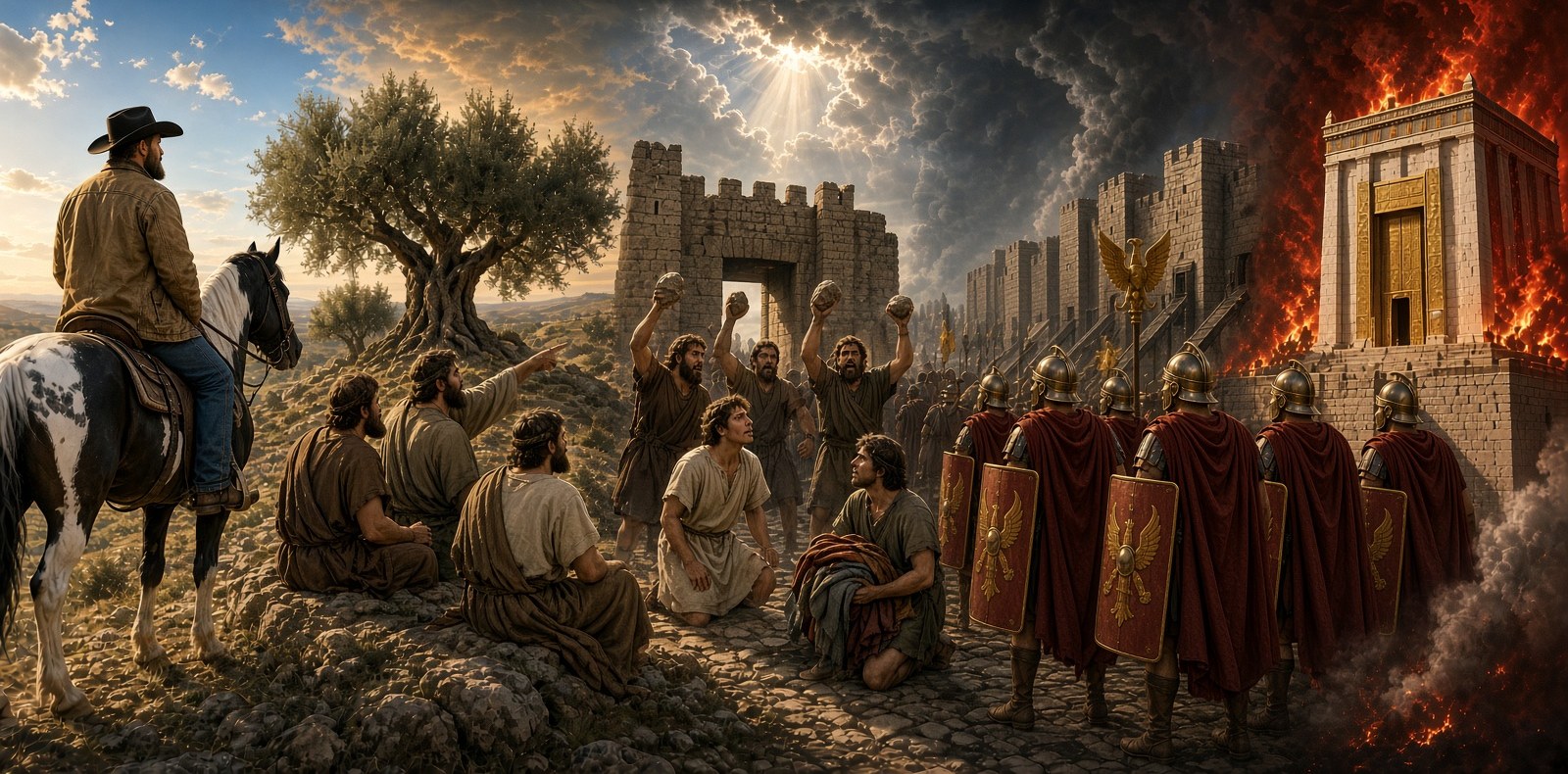
Before we decide what Jesus meant, read it as the people He was looking at when He said it.
Here's a question I'd like you to sit with for a minute.
Imagine you're one of the people around Jesus in the last week of His life. You're not a reader in 2026 with a study Bible and an end-times timeline. You're in the temple courts in Jerusalem, with the dust of the city on your feet.
You hear Him tell the parable of the tenants, and you watch the chief priests and Pharisees react. "They perceived that he was speaking about them" (Matthew 21:45). They didn't think He meant someone else.
You hear Him pronounce woe after woe on the scribes and Pharisees, then say, "Truly, I say to you, all these things will come upon this generation" (23:36).
You walk out with Him. The disciples point at the temple buildings, and He says, "there will not be left here one stone upon another that will not be thrown down" (24:2). He sits down on the Mount of Olives, looking across at that building, and tells you, "this generation will not pass away until all these things take place" (24:34).
Would you have heard two thousand years in that?
Now keep living.
He told you, "they will deliver you up to tribulation and put you to death" (24:9), and "you will be brought before kings and governors for my name's sake" (Luke 21:12). Then you watched it happen. Peter and John were arrested (Acts 4:3). Stephen was stoned (7:58). "There arose on that day a great persecution against the church in Jerusalem" (8:1). James was killed with the sword (12:2). Paul was stoned at Lystra (14:19), then stood before the governors Felix and Festus and King Agrippa (Acts 24 to 26).
Would you have told yourself none of that was about you?
You were in the crowd before Pilate when the people shouted, "His blood be on us and on our children!" (Matthew 27:25). You heard Jesus on the road to the cross tell the women of the city, "Daughters of Jerusalem, do not weep for me, but weep for yourselves and for your children" (Luke 23:28). That cry came from one crowd on one morning in one city. Jesus' answer on the road was grief for that city's children.
Then, within forty years of the cross, you saw what He told you to watch for. "When you see Jerusalem surrounded by armies, then know that its desolation has come near" (Luke 21:20). The church historian Eusebius says the believers in Jerusalem were warned to leave before the war, and they went to Pella (Church History 3.5.3). Josephus, who was there, says Titus ordered the city and the temple torn down (Wars 7.1.1). The building Jesus pointed at was gone.
Would you still be waiting on a generation far off in the future?
Jesus said, "So also, when you see all these things, you know that he is near, at the very gates" (Matthew 24:33). He said "you." He said it to people who would see it.
"But what about Luke 21:24?" Some will point to one verse: "Jerusalem will be trampled underfoot by the Gentiles, until the times of the Gentiles are fulfilled" (Luke 21:24). They say that "until" opens a gap of two thousand years. Keep reading. Three verses later: "they will see the Son of Man coming in a cloud with power and great glory" (21:27). Eight verses later: "Truly, I say to you, this generation will not pass away until all has taken place" (21:32). All. I read the trampling as inside that "all."
John saw the same trampling and gave it a length. The holy city is "given over to the nations, and they will trample the holy city for forty-two months" (Revelation 11:2). It's the same verb and the same nations in the Greek. Forty-two months is a set time. An open-ended age doesn't come with a number. From the start of the war in Judea in the spring of AD 67 to the fall of the temple in August of AD 70 is close to three and a half years.
"But Jesus said, 'I am with you always.'" Others will point to the last verse of Matthew: "I am with you always, to the end of the age" (Matthew 28:20). They say Jesus' "you" there reaches all of us, so His "you" in chapter 24 might too. Read the whole sentence. "To the end of the age." In the Greek that's the same phrase the disciples used on the Mount of Olives: "what will be the sign of your coming and of the end of the age?" (24:3). Matthew uses that same phrase five times: three times in the harvest parables (13:39, 40, 49), once in the disciples' question (24:3), and once here. Jesus promised the men He sent out that He would be with them all the way to the end of the age they had asked Him about.
He didn't leave when that age ended. The age that followed is the one where "the dwelling place of God is with man" (Revelation 21:3). "I will never leave you nor forsake you" (Hebrews 13:5) stands for every believer.
The sign He gave those men had a finish line. "This gospel of the kingdom will be proclaimed throughout the whole world as a testimony to all nations, and then the end will come" (Matthew 24:14). Within thirty years Paul could write that the gospel "has been proclaimed in all creation under heaven" (Colossians 1:23). The commission itself never closed, and the invitation still stands: "The Spirit and the Bride say, 'Come.' And let the one who hears say, 'Come'" (Revelation 22:17).
Where this is contestable. Some readers take the forty-two months as symbolic, and I offer the three and a half years as a match and nothing more. Others say "until" in Luke 21:24 implies a later restoration of the city. My answer is the "all" in 21:32. The strongest pushback comes from partial preterists, who agree with almost everything on this page. They say Jesus changes subjects at Matthew 24:36, "But concerning that day and hour no one knows," and from there on He's talking about a final coming. The Greek opener, peri de, "now concerning," is a phrase Paul uses to change subjects (1 Corinthians 7:1; 8:1), so the point is fair. I read "that day" as the day of "those days" He had just described (24:29), because the disciples asked about the temple and His coming in one breath (24:3), and He was still answering them (more on 24:36 and Matthew 25). People read that one both ways. The question this post asks isn't contestable, though. Jesus was speaking to real people standing in front of Him, about a building they could see.
We read Matthew 24 from two thousand years away. We have no choice about that. Before we decide what Jesus meant, though, put yourself in their sandals. Read it as the people He was looking at when He said it.
How would you have heard Him?