All the signs already happened. The apostles wrote them down as they came.
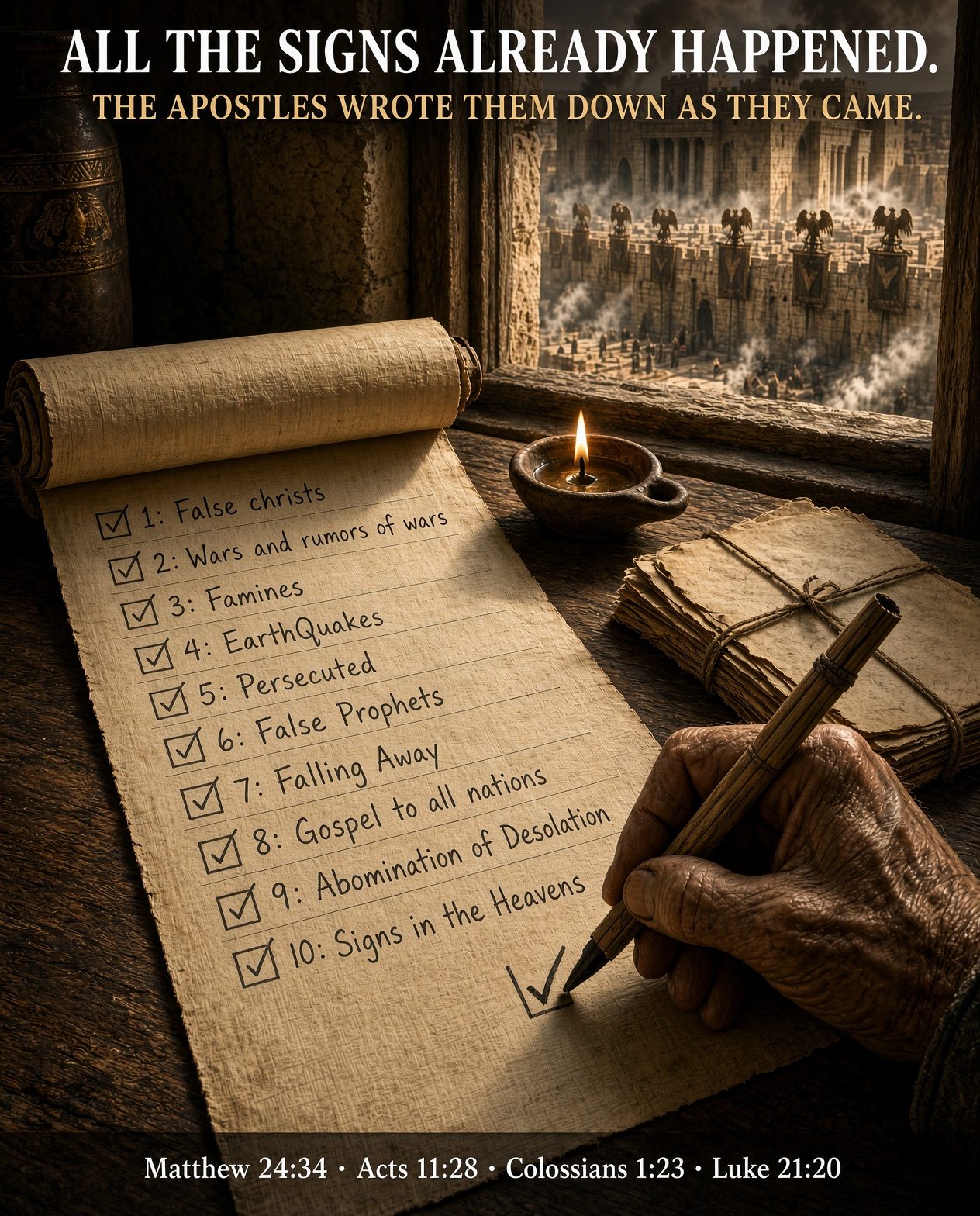
Here is the claim I keep getting, straight out of the old Scofield notes: Jesus meant the generation that would be alive when all the signs of Matthew 24 appear, not the generation in front of Him. "Learn sentence structure," one commenter told me.
Fine. Let's do sentence structure.
Count the pronouns. "See that you are not alarmed" (24:6). "They will deliver you up to tribulation" (24:9). "When you see the abomination of desolation" (24:15). "If anyone says to you, 'Look, here is the Christ!'" (24:23). "When you see all these things, you know that he is near, at the very gates" (24:33). Then the sentence that closes it: "Truly, I say to you, this generation will not pass away until all these things take place" (24:34). Every sign is addressed to "you," and the "you" is the four men sitting on the Mount of Olives (24:3; Mark 13:3). There is no second audience in the grammar. There is one.
The only question left is whether "all these things" happened to the people He said "you" to. Open the New Testament. The apostles recorded the fulfillment of every sign as it came, usually in the same words.
False christs (24:5). Simon in Samaria, whom the people called "the power of God that is called Great" (Acts 8:10). The Egyptian who "led the four thousand men of the Assassins out into the wilderness" (Acts 21:38). Josephus's "impostors and deceivers" who persuaded crowds to follow them into the desert promising signs (War 2.13.4).
Wars and rumors of wars (24:6). Rome's war with Parthia in the late fifties and early sixties, then Rome's own civil war of 68 and 69, four emperors in a single year. Tacitus opens his Histories calling it "a period rich in disasters" (1.2).
Famines (24:7). Agabus "foretold by the Spirit that there would be a great famine over all the world (this took place in the days of Claudius)" (Acts 11:28). Luke didn't just record the prophecy. He recorded that it happened.
Earthquakes (24:7). The one that opened the prison at Philippi (Acts 16:26). Laodicea leveled in AD 60 (Tacitus, Annals 14.27). Pompeii shaken in 62, seventeen years before the eruption.
Terrors and great signs from heaven (Luke 21:11). Luke lists these among the early signs, before the armies surround the city (21:20), and Josephus records them before the revolt: a star like a sword over the city, a comet that continued a whole year, chariots and troops of soldiers seen running about among the clouds before sunset, and at Pentecost the priests hearing a voice in the Temple, "Let us remove hence" (War 6.5.3). A Roman with no reason to help confirms it: "Contending hosts were seen meeting in the skies, arms flashed… and a superhuman voice cried: 'The gods are departing'" (Tacitus, Histories 5.13). These are the early portents of Luke 21:11, not the darkened sun of Matthew 24:29; that one comes further down.
Delivered up, persecuted, hated (24:9). Acts 4, 5, 7, 8, and 12, and Paul's own résumé: "Five times I received at the hands of the Jews the forty lashes less one. Three times I was beaten with rods. Once I was stoned" (2 Corinthians 11:24–25).
Many false prophets (24:11). "Many false prophets have gone out into the world" (1 John 4:1). "There will be false teachers among you" (2 Peter 2:1). John and Peter say the sign had arrived.
Love grown cold, falling away (24:10–12). "All who are in Asia turned away from me" (2 Timothy 1:15). "They went out from us" (1 John 2:19).
The gospel to all nations (24:14). Paul: "proclaimed in all creation under heaven" (Colossians 1:23). "Then the end will come," Jesus said. Paul says the condition was met.
The abomination of desolation (24:15). Luke decodes it in the parallel account: "When you see Jerusalem surrounded by armies, then know that its desolation has come near" (Luke 21:20). Cestius Gallus in 66. Titus in 70.
Sun, moon, and stars (24:29–30). "Immediately after the tribulation of those days." The tribulation was the siege; after it came the fall. This is the prophets' language for a nation's end. They used it for Babylon (Isaiah 13:10), Edom (Isaiah 34:4), and Egypt (Ezekiel 32:7), and not one literal star fell on any of them. Jerusalem's lights went out when the Temple burned and the nation fell, still inside "this generation" (24:34). "Coming in the clouds" is Daniel 7:13, where the Son of Man comes to the Ancient of Days to receive a kingdom, and Jesus told Caiaphas, "From now on you will see" it (26:64).
Then the end. "There will not be left here one stone upon another" (24:2). Titus razed the Temple to its foundations, and Josephus says the ground was so leveled that visitors would not believe it had ever been inhabited (War 7.1.1).
Every sign, in the generation He addressed as "you," written down by Luke, Paul, Peter, and John as it happened to them, and confirmed by historians who were there. That's the record.
"He never meant that generation" has a problem bigger than sentence structure. It has to explain why the apostles kept recording the fulfillment of signs that, on that reading, weren't for them. It has to explain why Luke wrote "this took place." It has to explain why Jesus said "you" again and again and meant somebody else every time.
Here is the part I want you to hear. I agree with the commenter's conclusion. Jesus did mean the generation that would be alive when all the signs of Matthew 24 appeared. Read the signs. Then read who saw them.