No one knows the day or hour. They knew the generation.
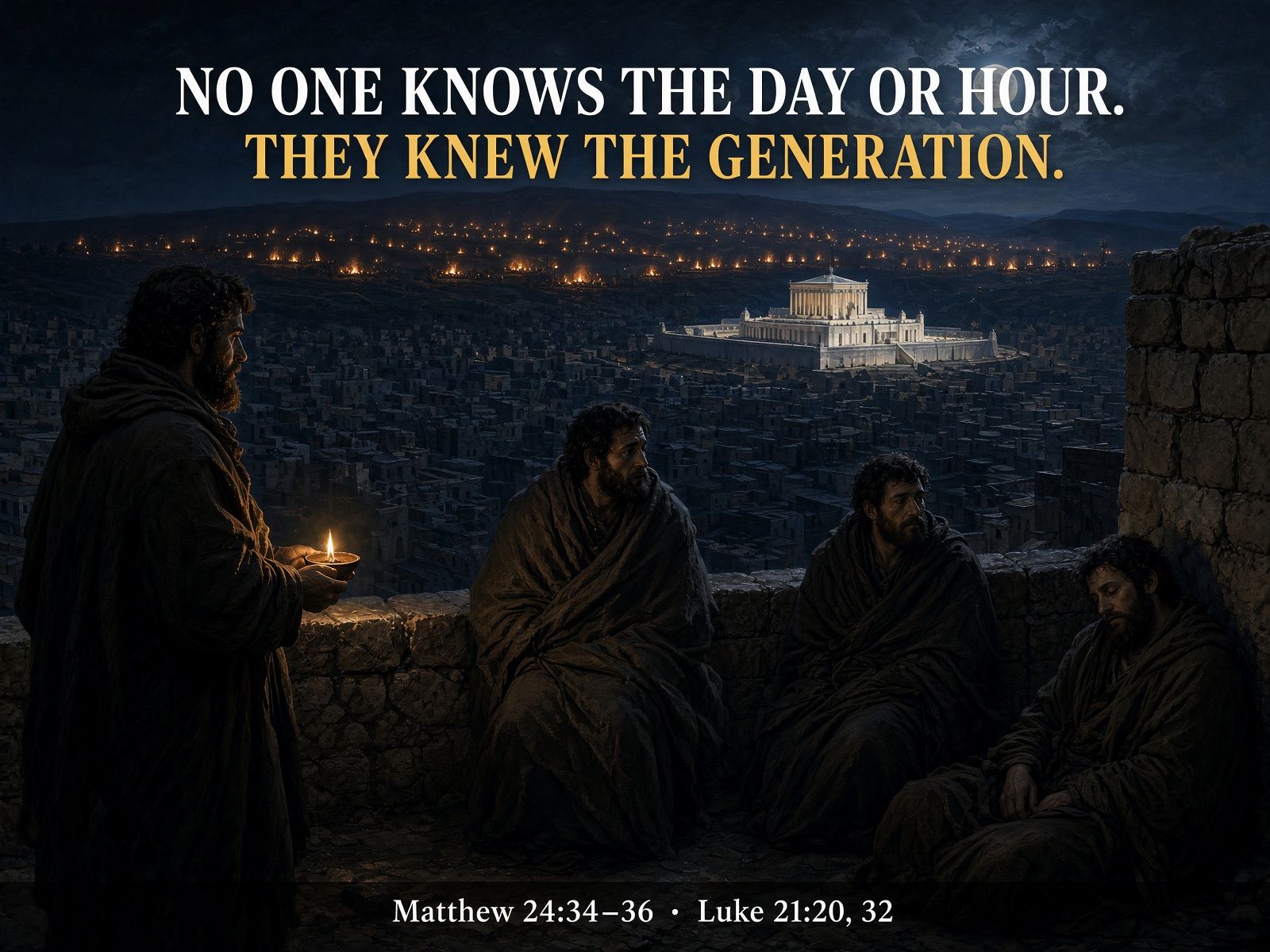
If you grew up in the system I grew up in, you were taught that Matthew 24 has a seam in it. Somewhere between verse 34 and verse 36, the subject changes. Verse 34, "this generation will not pass away until all these things take place," is about AD 70 (some refuse to even admit that). Verse 36, "concerning that day and hour no one knows," is about a second, undated, still-future coming. One chapter, two events, two thousand years apart, and the hinge is a chapter you can read in four minutes and a seam nobody can define, locate, or agree on.
Read the two verses together, without the seam. "Truly, I say to you, this generation will not pass away until all these things take place. Heaven and earth will pass away, but my words will not pass away. But concerning that day and hour no one knows, not even the angels of heaven, nor the Son, but the Father only" (Matthew 24:34–36).
Verse 34 gives the window: this generation. Verse 36 says nobody knows the exact day inside it. That's not two comings. That's one coming with a known deadline and an unknown date.
It's the way everyone talks about a due date. "The baby's coming this spring; nobody knows the day." You don't hear that and conclude there are two babies.
Watch the pronouns. Verse 36 says "that day." Not "another day." Not "a different coming." That day, the one He has been describing for thirty-plus verses. If Jesus wanted to introduce a second event He had every word available to do it, and He had just used the demonstrative that would have done it: "this generation" in verse 34 is this, the near one; "that day" in verse 36 is that, pointing back to the day already on the table. The grammar runs the two verses together, not apart.
Now watch what He does next, because the futurist reading needs verses 37 through 51 to be about a far-future coming, and Jesus keeps talking to the same men. "Therefore, stay awake, for you do not know on what day your Lord is coming" (24:42). "Therefore you also must be ready, for the Son of Man is coming at an hour you do not expect" (24:44). "You." Not "they," not "a future generation." The same disciples who heard "this generation" are told they must stay awake because they don't know the day. The unknown day is in their future.
Mark and Luke have the same discourse, and neither of them has a seam. Mark: "this generation will not pass away until all these things take place… But concerning that day or that hour, no one knows" (Mark 13:30, 32), and then, "Be on guard, keep awake. For you do not know when the time will come" (13:33). Luke runs "this generation will not pass away" (21:32) straight into "stay awake at all times" (21:36) with no break at all, and Luke is the one who told you the kingdom would be near when you saw "Jerusalem surrounded by armies" (21:20, 31) and goes on to tell them to flee to the mountains of Judea. Three Gospels, one discourse, one coming.
Here's where the whole thing unravels. The system that puts a seam at verse 36 doesn't do it because the text asks for one. It does it because verse 34 is unbearable without one. If "this generation" means what it means in every other verse of Matthew, then the Son of Man coming on the clouds (24:30), the angels and the trumpet (24:31), the gathering of the elect, all of it, landed inside the lifetime of the men listening. The seam exists to rescue a system we adopted and grew up in.
The men who heard it didn't hear a seam. Peter, decades later: "The end of all things is at hand" (1 Peter 4:7). James: "the Judge is standing at the door" (James 5:9). John: "it is the last hour" (1 John 2:18). Paul, to Rome: "the night is far gone; the day is at hand" (Romans 13:12). Every apostle treated the unknown day as near and the window as theirs. They were right. The day came in AD 70. Nobody knew the date. Everybody knew the generation.
Think about this. If there is some hidden gap, put yourself in the shoes of the disciples and tell me if you would've caught it. Would you have understood that He meant events thousands of years away, or would you have thought it was imminent? Would you have seen Jerusalem surrounded by armies and fled, or would you have stayed because it wasn't meant for you? Be honest.
"No one knows the day or hour" was never permission to push the coming two thousand years down the road. It was the reason to stay awake that week, that year, that generation. Jesus told them the window and withheld the date. We kept the mystery and threw away the window.